As an affiliate, we may earn a commission from qualifying purchases. We get commissions for purchases made through links on this website from Amazon and other third parties.
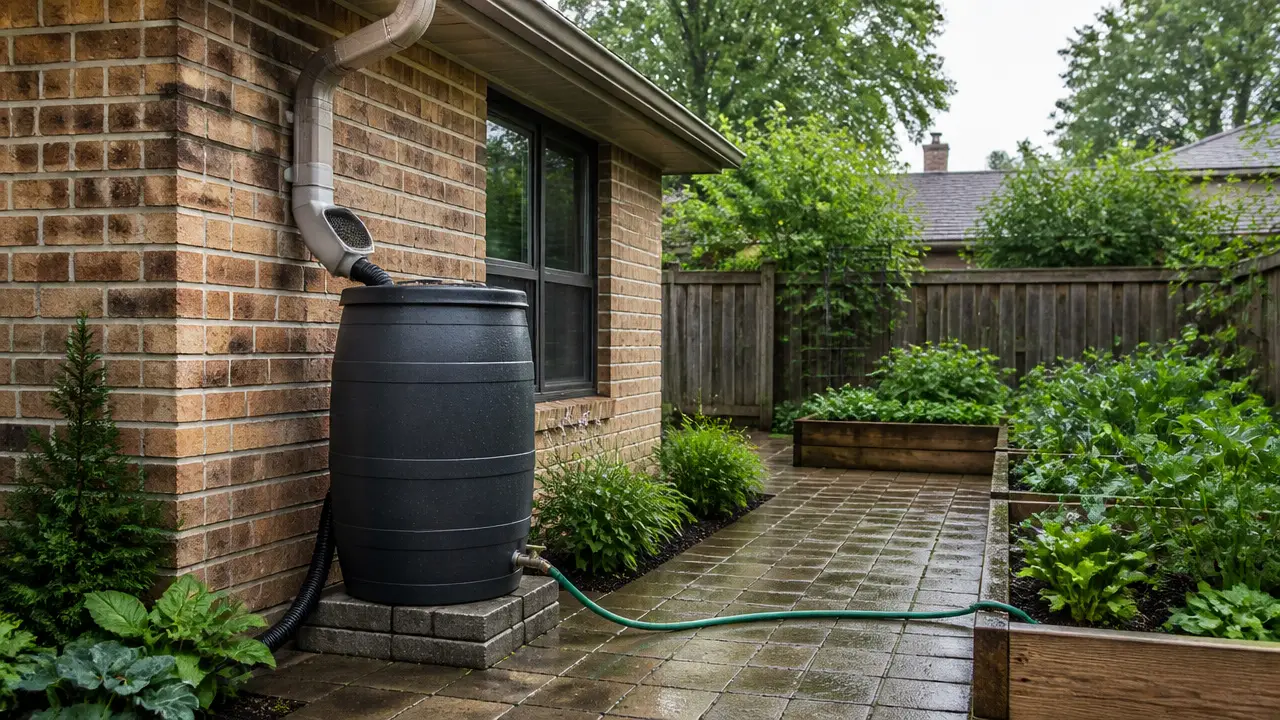
The best rain barrels in 2026 are not defined by a brand name. For most homes, the best choice is a rigid, opaque 50- to 60-gallon barrel with a screened inlet, secure lid, dependable spigot, and a properly sized overflow or downspout diverter.
That setup is simple to maintain, works well for garden watering, and keeps light, leaves, insects, and excess roof runoff under better control. University of Maryland Extension notes that typical rain barrels hold about 50 to 60 gallons.
The right barrel still depends on your roof, rainfall, available space, climate, and what you plan to do with the water.
Best Rain Barrel Types for 2026
| Rain barrel type | Best for | Main advantage | Main drawback |
|---|---|---|---|
| Rigid 50-60 gallon plastic barrel | Most homes | Simple, durable, easy to connect | Limited storage |
| Slimline barrel | Patios and tight spaces | Smaller footprint | Can be less stable if tall and narrow |
| Linked barrel system | Larger gardens | More storage without a large cistern | More fittings and potential leak points |
| Repurposed food-grade barrel | DIY systems | Easy to customize | Requires careful cleaning and fitting installation |
| Decorative molded barrel | Visible locations | Blends into landscaping | Design can make cleaning harder |
| Large tank or cistern | High water demand | Much greater storage | More complex installation |
For a basic garden system, a conventional rigid barrel is usually the best place to start.
What Makes a Good Rain Barrel?
A rain barrel is more than a container with a faucet. The inlet, outlet, overflow, lid, and base all matter.
An Opaque Container
Look for a barrel that blocks sunlight.
Sunlight entering stored water can encourage algae growth. Dark or opaque walls make the barrel easier to manage than a clear or translucent container.
UV-resistant outdoor plastic is also preferable when the barrel will stay outside for years.
A Screened Inlet
Roof water can carry:
- Leaves
- Seeds
- Grit
- Roofing debris
- Insects
- Bird and animal waste
A removable screen at the inlet catches larger debris before it enters the barrel.
The screen also helps keep mosquitoes from reaching the stored water. CDC recommends screening rainwater collection systems or regularly emptying rain barrels as part of mosquito control.
Choose a design where you can remove and clean the screen without taking the entire system apart.
A Secure Lid
The top should close securely.
An open barrel is harder to keep clean and can create a drowning hazard for small children or animals. A secure top also limits mosquitoes and debris.
A barrel with a removable but lockable or tightly fitted lid is especially useful because you can still reach the inside for cleaning.
A Useful Overflow System
Overflow is one of the most important rain barrel features.
Once a barrel fills, every additional gallon coming from the roof must go somewhere. Without a controlled overflow, water may spill beside the foundation.
Penn State Extension recommends directing rain barrel overflow toward a suitable landscaped area and away from buildings.
Good systems generally use one of two approaches.
A barrel overflow outlet sends extra water through a hose or pipe.
A downspout diverter sends water into the barrel until it fills and then allows additional runoff to continue through the downspout.
A diverter can be especially useful where there is no good place for a separate overflow hose.
Do not assume a small garden hose will handle all the water entering from a large downspout during heavy rain. The overflow system needs enough capacity for the runoff reaching the barrel.
Best Overall: A Rigid 50- to 60-Gallon Barrel
For most homeowners, a rigid plastic barrel in the 50- to 60-gallon range offers the best balance.
It is large enough to provide useful garden water but still small enough to fit beside most homes.
These barrels are also common enough that replacement spigots, bulkhead fittings, hoses, and diverters are generally easy to match.
A bulkhead fitting is a fitting that passes through the wall of a tank and creates a sealed connection for a pipe, valve, or hose.
Look for:
- Opaque walls
- A screened inlet
- A secure top
- A threaded hose-compatible spigot
- A drain near the bottom
- A large overflow connection
- A removable screen
- Access for cleaning
Avoid choosing a barrel mainly because it has an unusual shape or decorative finish. The fittings and overflow system will matter much more after the first heavy storm.
Best Rain Barrel for Small Spaces
A slimline barrel can make sense beside a patio, narrow side yard, or walkway.
These tanks are taller and narrower than standard round barrels.
Check the dimensions carefully. A barrel may look compact online while still being too deep for the space beside your downspout.
Also consider stability.
Water weighs about 8.3 pounds per gallon. A 50-gallon barrel contains more than 400 pounds of water. A 60-gallon barrel holds about 500 pounds before including the weight of the container and fittings.
Tall, narrow barrels therefore need a firm and level base.
Do not place a full rain barrel on a weak shelf, unstable stack of blocks, or structure that was not designed for that load.
Best Rain Barrel for a Large Garden
One rain barrel can fill surprisingly fast.
About 1 inch of rain falling on 100 square feet of roof represents roughly 62 gallons of water before allowing for collection losses.
The basic relationship is:
Gallons collected ≈ roof area in square feet × rainfall in inches × 0.623
For example:
200 square feet × 1 inch × 0.623 = about 125 gallons
A 55-gallon barrel would not hold all of that runoff.
This is why gardeners with larger watering needs often get more value from two or more connected barrels than from choosing a slightly larger single barrel.
Connected barrels can work well for:
- Vegetable gardens
- Raised beds
- Several flower beds
- Greenhouses
- Garden areas far from a household faucet
The barrels need compatible connections, and the system still needs a controlled final overflow.
If you regularly need several hundred gallons, a small cistern or larger rainwater tank may make more sense than a long row of barrels.
Best Rain Barrel for DIY Use
A repurposed plastic barrel can work well when its history is known.
Food-grade barrels are commonly used for DIY rain barrel projects. Penn State recommends knowing what a reused barrel previously contained and avoiding containers that held hazardous or toxic chemicals.
Do not use an unknown secondhand drum simply because it looks clean.
A DIY barrel should still have the same basic features as a manufactured system:
- Secure lid
- Screened inlet
- Overflow
- Bottom outlet
- Stable base
- Cleanable interior
Bulkhead fittings are generally easier to service than improvised fittings held in place only with sealant.
Best Rain Barrel for Freezing Climates
There is no need to search for a barrel that claims to make freezing irrelevant.
A better approach is to choose a barrel that is easy to disconnect and drain.
Water expands as it freezes. Trapped water can damage the barrel, valves, hoses, and fittings.
University of Minnesota Extension recommends completely draining rain barrels before winter in freezing climates and either storing them or protecting them so they cannot refill.
A winter-friendly barrel should therefore have:
- An accessible drain
- Removable hoses
- Easy downspout disconnection
- Replaceable fittings
- A design that can be cleaned while empty
Do not leave a barrel full because the container is described as heavy-duty.
Best Rain Barrel for Drip Irrigation
The barrel itself is only half of the question when you want to run irrigation.
Rain barrels provide relatively low pressure.
Water pressure from gravity depends on head height, which is the vertical distance between the water level and the outlet or irrigation line.
Raising the barrel can increase gravity pressure, which is one reason rain barrels are commonly installed on elevated bases. Penn State also recommends elevation where appropriate to improve flow from the spigot.
However, a few feet of height produces much less pressure than a household water supply.
Before connecting drip irrigation, check whether the:
- Timer works at low pressure
- Filter works at low pressure
- Pressure regulator is actually needed
- Emitters can operate at available pressure
- Hose diameter can carry enough flow
A pump may be needed for irrigation equipment designed for normal household water pressure.
Should You Choose a Downspout Diverter?
For many installations, yes.
A downspout diverter can make the system easier to manage because it limits how water enters the barrel and can return excess runoff to the normal downspout path after the barrel fills.
Details about key facts about a good rain barrel for small spaces help assess cleaning access for sediment and odor control.
It can also make winter disconnection easier.
A direct-open inlet may still work well when you have plenty of space and a properly designed overflow.
Whichever system you choose, check the size and shape of your downspout before buying fittings. Common downspout sizes are not all interchangeable.
Look at the Spigot Before Buying
Small differences in the outlet can make a rain barrel frustrating to use.
Check:
- Thread type
- Hose compatibility
- Distance above the ground
- Distance from the bottom of the barrel
- Whether the valve can be replaced
- Whether you can reach the fitting from inside
A spigot placed several inches above the bottom leaves space for sediment, but it also leaves some water that cannot drain through the faucet.
A separate bottom drain makes cleaning easier.
Also make sure there is enough space below the faucet for a watering can if you plan to fill one directly.
Choose a Barrel You Can Clean
Maintenance is easier when the barrel has good access.
Sediment and organic material eventually collect inside most roof-fed systems.
Look for a barrel with either:
- A removable lid
- A large inspection opening
- A bottom drain that allows flushing
Extremely narrow decorative openings may look attractive but can make cleaning difficult.
Screens should also be easy to remove because leaves and roof debris can block them.
A First-Flush Diverter Can Improve the System
A first-flush diverter sends the first portion of runoff from a storm away from storage.
That first water can carry a higher concentration of dust, animal waste, and other material that accumulated on the roof during dry weather.
CDC identifies first-flush diversion as one way to improve collected rainwater quality.
It does not make rainwater safe to drink. It is simply one part of reducing contamination entering storage.
Rain Barrel Water Is Not Automatically Drinking Water
A good rain barrel is normally best treated as a non-potable water system.
Non-potable means the water is not intended for drinking.
Roof runoff can collect germs and chemicals from:
- Bird and animal waste
- Dust
- Roofing materials
- Gutters
- Piping
- Storage materials
CDC states that collected rainwater is not necessarily safe to drink and recommends a much higher level of care when rainwater will be used for drinking, cooking, or bathing.
A screened inlet, first-flush diverter, sediment filter, or clear-looking barrel does not prove that water is potable.
Drinking-water use should be treated as a complete system involving appropriate collection materials, treatment designed for the contaminants present, ongoing maintenance, current laboratory testing, and applicable local requirements.
For a simple backyard barrel, using the water for non-potable outdoor purposes is usually the more straightforward approach.
Features Worth Paying For
Rather than focusing on decorative extras, prioritize the parts that affect everyday operation.
The most useful features are:
- Opaque, durable walls
- Secure removable lid or cleaning access
- Fine inlet screen
- Reliable overflow or diverter
- Replaceable spigot
- Bottom drain
- Standard connection sizes
- Stable shape and base
Linked-barrel connections are also valuable if you expect to expand the system later.
Features That Matter Less Than They Seem
Some features sound impressive but do not solve the main rain barrel problems.
Very Large Capacity Without Good Overflow
A larger barrel simply takes longer to fill. It still needs somewhere to send water when full.
Tiny Decorative Faucets
A stylish faucet is not very useful if it restricts flow or cannot accept a garden hose.
Transparent Water-Level Windows
They can be convenient, but any part that admits sunlight can encourage biological growth. A mechanical level indicator or opaque system avoids that problem.
Claims of Maintenance-Free Operation
Roof runoff carries debris.
Screens clog. Sediment collects. Fittings loosen. Hoses age.
Every practical rain barrel requires inspection and cleaning.
How to Choose the Right Capacity
Start with your intended use rather than choosing the biggest barrel that fits.
A single 50- to 60-gallon barrel works well when you want water for:
- Containers
- A small flower bed
- Occasional hand watering
- Washing garden tools
Consider multiple barrels or larger storage when you regularly water a substantial garden.
Remember that storage capacity and water supply are different things. A 200-gallon system cannot provide 200 gallons between storms unless enough rain falls on the connected roof to refill it.
Likewise, a large roof can produce far more water than one barrel can store.
Check the Installation Area
Before choosing a barrel, measure:
- Available width
- Available depth
- Downspout position
- Spigot clearance
- Overflow route
- Base area
- Hose route
The ground should be firm and level.
EPA guidance also emphasizes stable placement and directing overflow away from the home foundation.
Do not underestimate the loaded weight. A full barrel is too heavy to reposition safely.
Set the base correctly before filling it.
The Best Choice for Most Homes
For a typical home garden in 2026, start with a 50- to 60-gallon opaque rigid barrel with a secure screened top, replaceable hose-compatible spigot, bottom drain, and dependable overflow or downspout diverter.
Choose a slimline design when space is limited.
Use linked barrels when one barrel does not provide enough storage.
Move to a larger tank or cistern when your water needs have clearly outgrown rain-barrel scale.
Above all, choose a barrel based on the whole water path:
roof → gutter → inlet → storage → outlet → intended use → overflow
A barrel that fits that path correctly will usually serve you better than one chosen because it has the most accessories.
Frequently Asked Questions
What size rain barrel is best for most homes?
A 50- to 60-gallon barrel is a practical starting point for many homes. It offers useful garden storage without taking up the space required by a large tank. Larger gardens may benefit from connected barrels or a cistern.
Is a 50-gallon rain barrel big enough?
It can be enough for containers, flower beds, and occasional hand watering. It is small compared with the amount of runoff a roof can produce, though. Just 1 inch of rain on 100 square feet of roof represents about 62 gallons before collection losses.
What color rain barrel is best?
An opaque barrel is generally preferable to a clear or translucent one because blocking sunlight helps limit algae growth. The outside color matters less than whether light can reach the stored water.
Are plastic rain barrels safe?
Suitable plastic rain barrels are widely used for non-potable rainwater storage. For a repurposed barrel, know what it previously contained. Do not reuse containers that held hazardous or toxic materials.
Should a rain barrel have an overflow hose?
Every rain barrel needs a safe way to handle excess runoff. That may be a dedicated overflow hose or pipe, or a downspout diverter that returns excess water to the normal drainage path.
Do rain barrels need mosquito screens?
A screened inlet is strongly recommended. It keeps larger debris out and helps prevent mosquitoes from accessing stored water. The screen should remain intact and be cleaned when debris accumulates.
Can I leave a rain barrel outside all winter?
In climates where water freezes, the barrel should normally be drained and disconnected before freezing conditions. Water left inside can freeze, expand, and damage the barrel or fittings.
Can you drink water from a rain barrel?
Do not assume rain barrel water is safe to drink. Roof runoff can contain germs and chemicals. Drinking-water use requires suitable collection, appropriate treatment, regular maintenance, current water testing, and compliance with applicable local requirements.