As an affiliate, we may earn a commission from qualifying purchases. We get commissions for purchases made through links on this website from Amazon and other third parties.
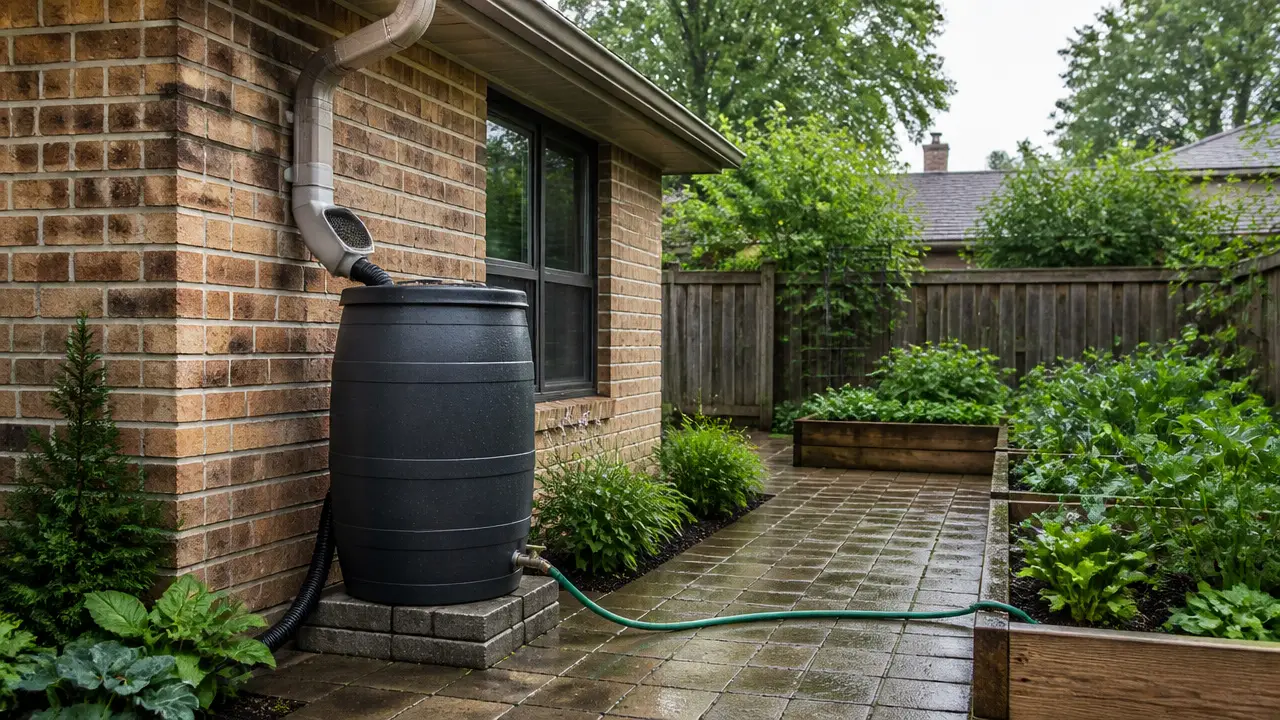
A 50-gallon rain barrel is enough for small, occasional outdoor watering, but it is usually too small if you want to store a meaningful amount of rain from an average house roof.
The important question is not only how much the barrel holds. You also need to consider how much rain your roof can collect and how quickly you will use the stored water.
How Much Water Does a 50-Gallon Rain Barrel Hold?
A full 50-gallon barrel gives you:
- Ten 5-gallon watering cans
- About 400 pounds of water
- Enough water to give roughly 100 square feet of garden about 0.8 inch of water
That can be useful for container plants, a small vegetable bed, or a few shrubs.
For a larger garden, the water can disappear surprisingly fast.
How Quickly Will a 50-Gallon Barrel Fill?
Roof runoff adds up quickly.
A useful estimate is:
Gallons collected = roof area in square feet × rainfall in inches × 0.623
The 0.623 figure is the approximate number of gallons produced by 1 inch of rain falling on 1 square foot.
For example, 100 square feet of roof receiving 1 inch of rain produces a theoretical maximum of about:
100 × 1 × 0.623 = 62 gallons
Actual collection will be lower because some water stays on the roof, splashes away, remains in gutters, or is diverted by a first-flush system.
This means a 50-gallon barrel connected to even a fairly small roof section can fill during one good rain.
A Larger Roof Can Fill It Very Quickly
Consider a 1,000-square-foot roof.
One inch of rain on that roof represents about:
1,000 × 0.623 = 623 gallons
A single 50-gallon barrel can store only a small part of that water.
You do not necessarily need enough storage to capture every drop. But if your goal is to save a large portion of your roof runoff, one barrel will usually be the limiting part of the system.
When Is a 50-Gallon Rain Barrel Enough?
A single barrel can make sense when your water needs are small.
It may be enough for:
- Patio and container plants
- A small raised garden bed
- A few shrubs or trees
- Occasional hand watering
- Washing garden tools
- Other small non-potable outdoor uses
Non-potable means water that is not intended for drinking.
A 50-gallon barrel is especially practical when rain falls regularly and you use some of the stored water between storms. Emptying part of the barrel creates room for the next rainfall.
When Is 50 Gallons Too Small?
You will probably want more storage if you plan to water:
- A large vegetable garden
- Several raised beds
- A greenhouse
- Large landscaped areas
- Trees during dry weather
- Drip irrigation for long periods
It can also be too small in climates where rainfall comes in large storms followed by long dry periods.
In that situation, the barrel may overflow during a storm and then run empty before the next one.
Estimate How Much Storage You Need
Start with your actual water use rather than choosing a tank size first.
Step 1: Estimate Your Roof Collection Area
You only need the part of the roof that drains toward the downspout you plan to use.
For example, a house might have a 1,600-square-foot roof, but one downspout may receive runoff from only 400 square feet.
Use that drainage area in your calculation.
Step 2: Estimate Rainfall Collection
Use:
Roof area × rainfall × 0.623
For a 400-square-foot roof section receiving half an inch of rain:
400 × 0.5 × 0.623 = about 125 gallons theoretically available
Actual collection will be somewhat less.
A 50-gallon barrel could therefore fill while much of the remaining runoff goes through the overflow.
Step 3: Estimate How Quickly You Use the Water
Think about how you normally water.
If you use only 10 gallons between storms, a 50-gallon barrel may work well.
If you routinely need 75 or 100 gallons at a time, increasing storage will be more useful than repeatedly running the barrel dry.
Should You Connect Multiple Rain Barrels?
Connecting barrels is one way to increase storage without installing a large cistern.
For example:
- One 50-gallon barrel = 50 gallons
- Two barrels = 100 gallons
- Four barrels = 200 gallons
Linked barrels need compatible connections and a dependable overflow path.
Alongside the fill rate of a 50-gallon rain barrel, understand stored volume against consumption and seasonal refill patterns.
Do not assume that simply placing another barrel beside the first will make them share water correctly. The connection location and hose or pipe arrangement determine how the barrels fill and drain.
Every barrel also needs a stable base capable of supporting its full weight.
A full 50-gallon barrel can weigh more than 400 pounds once the container itself is included.
Storage Capacity Is Only Part of the System
Before increasing storage, check the rest of the setup.
Overflow
A full barrel must have somewhere safe to send additional rainwater.
The overflow should move water away without causing erosion, foundation problems, or unwanted pooling.
Increasing storage does not eliminate the need for an overflow.
Screens
Openings should be screened to help keep leaves, insects, and larger debris out of the barrel.
Roof runoff can still contain dirt, bird droppings, organic material, roofing contaminants, and other pollutants even when a screen is installed.
First Flush
A first-flush diverter sends away some of the initial roof runoff before water enters storage.
That first runoff can contain a higher concentration of material that accumulated on the roof between rains.
A first-flush device can be useful, but it does not by itself make stored rainwater safe to drink.
Barrel Outlet
The outlet needs to match the hose, irrigation line, or other equipment you plan to connect.
Many rain barrel frustrations come from connection problems rather than storage capacity.
Check thread type, fitting size, hose size, and whether adapters are needed before building the system.
Will a 50-Gallon Barrel Provide Enough Water Pressure?
Usually not for equipment that expects household water pressure.
Water leaving a barrel by gravity gets pressure from the height of the water above the outlet. This vertical distance is sometimes called head height.
A barrel sitting slightly above ground may work well for:
- Filling watering cans
- Slow hose watering
- Some low-pressure drip systems
It may not operate sprinklers, long hose runs, pressure-compensating irrigation equipment, or other devices that require higher pressure.
Adding more gallons increases how long water is available, but it does not automatically solve a pressure problem.
Is a Bigger Rain Tank Better?
Not always.
More storage is useful only if you have enough roof runoff to fill it and enough water use to empty it.
A larger tank also requires:
- More space
- A stronger foundation
- Larger or additional connections
- Proper overflow handling
- Access for inspection and cleaning
Large tanks become extremely heavy when full. A 500-gallon tank, for example, contains more than 4,000 pounds of water.
Its base and location therefore need much more consideration than those of a small rain barrel.
A Practical Starting Point
For someone who wants rainwater mainly for a few plants, starting with one 50-gallon barrel is reasonable.
Use it for a while and watch what happens.
If the barrel frequently overflows while you still need more water during dry periods, additional storage would probably help.
If it rarely empties, adding hundreds of gallons of storage may accomplish very little.
The best capacity is not the biggest tank you can install. It is enough storage to match your roof collection, rainfall pattern, available space, and actual water use.
Frequently Asked Questions
Is a 50-gallon rain barrel enough for a garden?
It can be enough for containers, a small raised bed, or limited hand watering. Larger vegetable gardens and landscaped areas can use 50 gallons quickly, especially during hot or dry weather.
How much rain does it take to fill a 50-gallon barrel?
The answer depends on the roof area feeding the barrel. The theoretical collection from 100 square feet of roof during 1 inch of rain is about 62 gallons. Real collection will be lower because of normal losses.
How many rain barrels should I have?
Start with your roof collection area and expected water use. Multiple barrels can make sense when one barrel regularly overflows and you have a use for the additional stored water.
Can I connect two 50-gallon rain barrels?
Yes. Two properly connected barrels can provide about 100 gallons of storage. The barrels need compatible connections, stable support, and a safe overflow arrangement.
How long will 50 gallons of rainwater last?
It depends entirely on your water use. At 5 gallons per day, 50 gallons could theoretically last 10 days. At 25 gallons per day, it would last only about two days.
Does a bigger rain barrel provide more water pressure?
Not necessarily. Gravity pressure mainly depends on the vertical height of the water above the outlet. A larger container gives you more stored water, but not automatically enough pressure for sprinklers or other pressure-dependent equipment.
Can I drink water from a rain barrel?
Do not assume roof runoff stored in a rain barrel is safe to drink. Drinking-water use requires a suitable collection system, appropriate treatment stages, current laboratory testing, ongoing maintenance, and compliance with applicable local requirements. A simple barrel, screen, first-flush diverter, or single filter does not establish that the water is potable.