As an affiliate, we may earn a commission from qualifying purchases. We get commissions for purchases made through links on this website from Amazon and other third parties.
A 50-gallon rain barrel can fill with surprisingly little rain if it collects runoff from a large enough roof. The amount of rain you need depends mainly on the roof area draining into the barrel.
As a useful rule of thumb, 1 inch of rain on 1 square foot of roof produces about 0.623 gallons of water before losses.
That means a 50-gallon barrel connected to 100 square feet of roof needs about 0.8 inch of rain in theory. Connected to 500 square feet of roof, it needs only about 0.16 inch.
Real systems collect somewhat less because water can be lost to roof wetting, gutters, first-flush diversion, splashing, leaks, and overflow.
How to Calculate the Rain Needed
Use this formula:
Rain needed in inches = Barrel capacity ÷ (Roof area × 0.623)
For a 50-gallon barrel:
Rain needed = 50 ÷ (roof area × 0.623)
Here are a few examples before accounting for collection losses:
| Roof area draining to barrel | Rain needed to collect 50 gallons |
|---|---|
| 50 sq. ft. | 1.61 inches |
| 100 sq. ft. | 0.80 inch |
| 200 sq. ft. | 0.40 inch |
| 500 sq. ft. | 0.16 inch |
| 1,000 sq. ft. | 0.08 inch |
These numbers assume every drop reaching that roof area makes it into the barrel. A real rainwater system will usually need a little more rain.
Why a Small Rainfall Can Fill a Barrel
Rain falling on a roof adds up quickly.
One inch of rain over 100 square feet is about:
100 × 0.623 = 62.3 gallons
So even a relatively small roof section can produce more water than a 50-gallon barrel can hold during a good rain.
For example, suppose one downspout drains 200 square feet of roof.
With 0.5 inch of rain:
200 × 0.5 × 0.623 = 62.3 gallons
That is more than enough water to fill an empty 50-gallon barrel in ideal conditions.
The extra water needs somewhere to go once the barrel is full. A properly planned overflow route is therefore an important part of a rain barrel setup.
How to Find Your Roof Collection Area
You do not always need the area of your entire roof.
You need the area that drains toward the specific downspout connected to your rain barrel.
For a simple rectangular roof section:
Length × width = collection area
For example, if a roof section measures 20 feet by 15 feet:
20 × 15 = 300 square feet
The theoretical rainfall needed to produce 50 gallons would be:
50 ÷ (300 × 0.623) = about 0.27 inch
If your roof has several slopes or several downspouts, only count the portions that feed the downspout supplying the barrel.
The roof's horizontal footprint is generally the useful area for estimating rainfall collection. You do not need to increase the area because the roof is sloped.
Real Rain Barrel Yield Is Lower Than the Formula
The formula gives a theoretical maximum. Your barrel may receive less.
Some water can be lost because it:
- wets a dry roof before runoff begins
- remains in gutters and downspouts
- splashes out of the collection system
- leaks through poor connections
- is diverted by a first-flush device
- bypasses the barrel because of a diverter
- overflows once the barrel reaches capacity
A first-flush diverter sends away the first portion of roof runoff. This can help keep some roof debris and contaminants out of storage, but it also reduces how much water reaches the barrel.
If you want a planning estimate, you can include a collection-efficiency factor rather than assuming 100% capture.
For example, using an 80% collection assumption:
Collected gallons = Roof area × rainfall × 0.623 × 0.80
This is only an example planning assumption, not a guaranteed efficiency for every system.
On a 100-square-foot collection area:
100 × 1 inch × 0.623 × 0.80 = about 49.8 gallons
So under that assumption, roughly 1 inch of rain would fill a 50-gallon barrel.
What If the Barrel Is Already Partly Full?
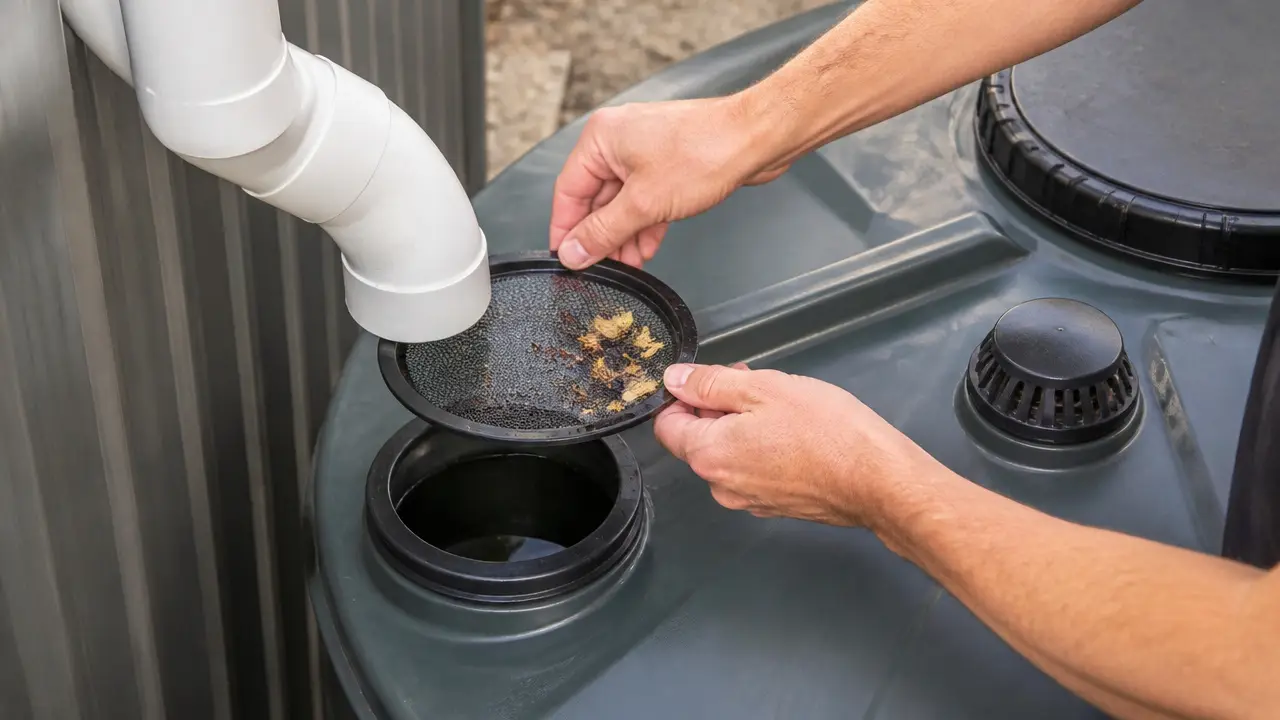
Examine gallons produced by one inch of roof rainfall to evaluate catchment choices for likely rainfall and roof debris.
You only need to calculate the empty capacity.
Suppose a 50-gallon barrel already contains 20 gallons. You need another:
50 − 20 = 30 gallons
If the barrel receives runoff from 200 square feet:
30 ÷ (200 × 0.623) = about 0.24 inch
That is the theoretical amount of additional rain needed.
Again, allow for normal collection losses in a real system.
Roof Size Often Matters More Than Barrel Size
A common mistake is to think a 50-gallon barrel requires a major storm to fill.
Often, it does not.
A barrel attached to a large roof area can fill during a fairly small rainfall. This is one reason a single 50-gallon barrel may provide much less storage than the roof could potentially supply.
For example, 500 square feet of collection area receiving 1 inch of rain produces theoretically:
500 × 1 × 0.623 = 311.5 gallons
A 50-gallon barrel could store only a fraction of that runoff.
If you frequently see water flowing from the overflow during storms, your roof may be producing much more water than your current storage can hold. Additional barrels or a larger storage tank may make sense if you have a useful purpose for the extra water and a suitable location for the added weight.
Remember that stored water is heavy. Fifty gallons of water alone weighs more than 400 pounds, so barrels need a stable, level base designed to support the load.
Do Not Forget the Overflow
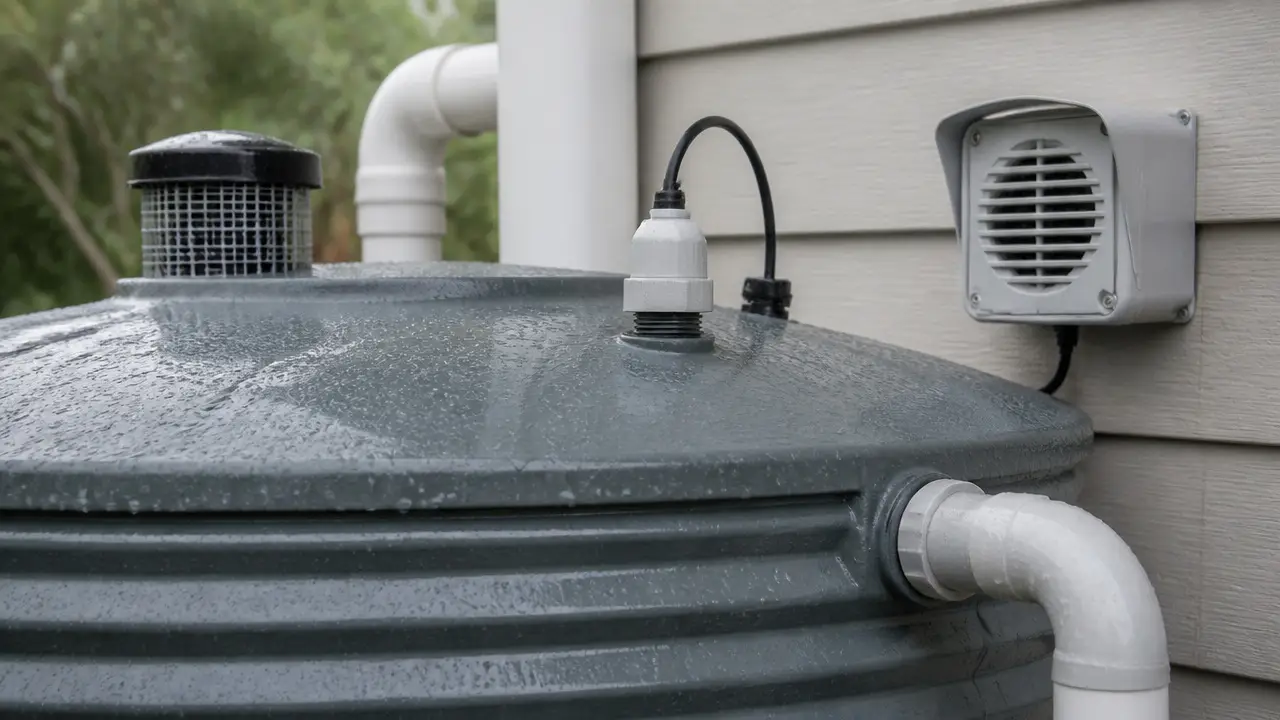
Once a 50-gallon barrel fills, incoming runoff must be directed somewhere safe.
An overflow should carry excess water away without causing:
- erosion
- foundation problems
- standing water
- flooding around the barrel
- uncontrolled discharge near walkways or structures
If you connect several barrels together, make sure the connecting fittings and overflow can handle incoming runoff. A large roof can supply water faster than small fittings can move it during heavy rain.
Rainfall Amount Does Not Tell You Water Quality
Collecting 50 gallons does not mean the water is clean or safe for every use.
Roof runoff can contain dirt, bird or animal waste, roofing particles, pollen, microorganisms, and other contaminants. For garden irrigation and other non-potable uses, the treatment needs may be different from those for drinking water.
Potable means suitable for drinking. Non-potable means water that is not intended for drinking.
If rainwater will be used as drinking water, filling the barrel is only one part of the system. Safe potable use requires suitable collection materials, prefiltration, appropriate treatment, maintenance, current laboratory testing, and compliance with applicable local requirements. A screen, simple filter, UV unit, or home water test by itself does not establish that roof runoff is safe to drink.
A Simple Rule to Remember
For quick planning:
1 inch of rain × 100 square feet of roof = about 62 gallons before losses.
From there, you can scale the number up or down.
So for a typical 50-gallon rain barrel:
- 100 sq. ft. of roof needs about 0.8 inch theoretically.
- 200 sq. ft. needs about 0.4 inch.
- 500 sq. ft. needs about 0.16 inch.
Your actual requirement will be somewhat higher whenever the collection system loses or intentionally diverts part of the runoff.
Frequently Asked Questions
How many gallons does 1 inch of rain produce?
One inch of rain produces about 0.623 gallons per square foot of horizontal collection area. A 100-square-foot roof section therefore receives about 62.3 gallons from 1 inch of rain before collection losses.
Will half an inch of rain fill a 50-gallon barrel?
It can. A roof area of about 161 square feet theoretically produces 50 gallons from 0.5 inch of rain. In practice, you will need somewhat more collection area or rainfall because not all runoff reaches the barrel.
How much roof area do I need to fill a 50-gallon rain barrel?
With 1 inch of rain, about 80 square feet of roof theoretically produces 50 gallons. A larger collection area allows the barrel to fill with less rainfall.
Can a rain barrel fill during a light rain?
Yes. If a large enough section of roof drains into the barrel, even a relatively small rainfall can produce 50 gallons. Whether the barrel actually fills also depends on how much water was already stored and how much runoff is lost or diverted.
Does roof slope change how much rainwater I can collect?
For basic rainwater-yield calculations, use the horizontal footprint of the roof area draining to the barrel rather than the larger surface area created by the roof slope.
Why didn't my barrel fill even though the calculation says it should?
The basic formula assumes perfect collection. Real systems lose water through roof wetting, gutters, first-flush diversion, leaks, splashing, diverters, and other pathways. Also check that the expected section of roof actually drains to the connected downspout.
What happens when a 50-gallon rain barrel becomes full?
Additional runoff must leave through an overflow or downspout-diverter system. The overflow should discharge to a suitable location where it will not cause erosion, standing water, or problems near the building.