As an affiliate, we may earn a commission from qualifying purchases. We get commissions for purchases made through links on this website from Amazon and other third parties.
A surprisingly small amount of rain can fill a typical rain barrel if it collects runoff from a large section of roof. For example, a 55-gallon rain barrel connected to 500 square feet of roof needs only about 0.18 inch of rain in ideal conditions.
Actual rainfall needed will usually be a little higher. Some water is lost to roof wetting, gutters, splashing, leaks, debris screens, and first-flush devices.
How to Calculate the Rain Needed to Fill a Rain Barrel
In U.S. units, 1 inch of rain falling on 1 square foot of roof equals about 0.623 gallons of water.
Use this formula:
Gallons collected = roof area in square feet × rainfall in inches × 0.623
To find the rainfall needed to fill your barrel, rearrange the formula:
Rainfall needed = barrel capacity ÷ (roof area × 0.623)
This calculation assumes every drop reaches the barrel. Real systems collect somewhat less.
Example: Filling a 55-Gallon Rain Barrel
Suppose your downspout drains 500 square feet of roof.
The calculation is:
55 ÷ (500 × 0.623) = about 0.18 inch
So, under ideal conditions, less than one-quarter inch of rain could fill the barrel.
Here is how roof size changes the result:
| Roof area draining to barrel | Rain needed for 55 gallons* |
|---|---|
| 100 sq. ft. | 0.88 in. |
| 200 sq. ft. | 0.44 in. |
| 500 sq. ft. | 0.18 in. |
| 1,000 sq. ft. | 0.09 in. |
*Ideal theoretical collection. Actual systems require more rainfall because some water does not reach storage.
This is why rain barrels can fill much faster than new users expect.
Measure the Roof Area Feeding the Barrel
Do not automatically use the square footage of your entire house.
What matters is the section of roof that drains into the specific downspout connected to your barrel.
For a simple rectangular roof section:
Length × width = catchment area
For example, if the roof area feeding one gutter is 25 feet long and 20 feet wide:
25 × 20 = 500 square feet
That is the catchment area you would use in the rainfall formula.
A house with several downspouts may divide its roof runoff among several drainage points. A barrel attached to one downspout may therefore collect runoff from only part of the roof.
Why a Little Rain Produces So Much Water
Rainfall depth can be misleading.
A quarter inch of rain does not sound like much, but it is spread across hundreds or thousands of square feet of roof.
For example, one-quarter inch falling on 500 square feet represents:
500 × 0.25 × 0.623 = about 78 gallons
That is already more than enough water to theoretically fill a 55-gallon barrel.
The roof acts as a large collection surface and directs that water into a relatively small container.
Real Rainwater Collection Is Lower Than the Formula
The basic calculation tells you the maximum theoretical runoff. Your barrel will normally receive less.
Water can be lost when it:
- wets a dry roof at the beginning of a storm
- remains in gutters
- splashes or leaks from gutter joints
- bypasses a downspout diverter
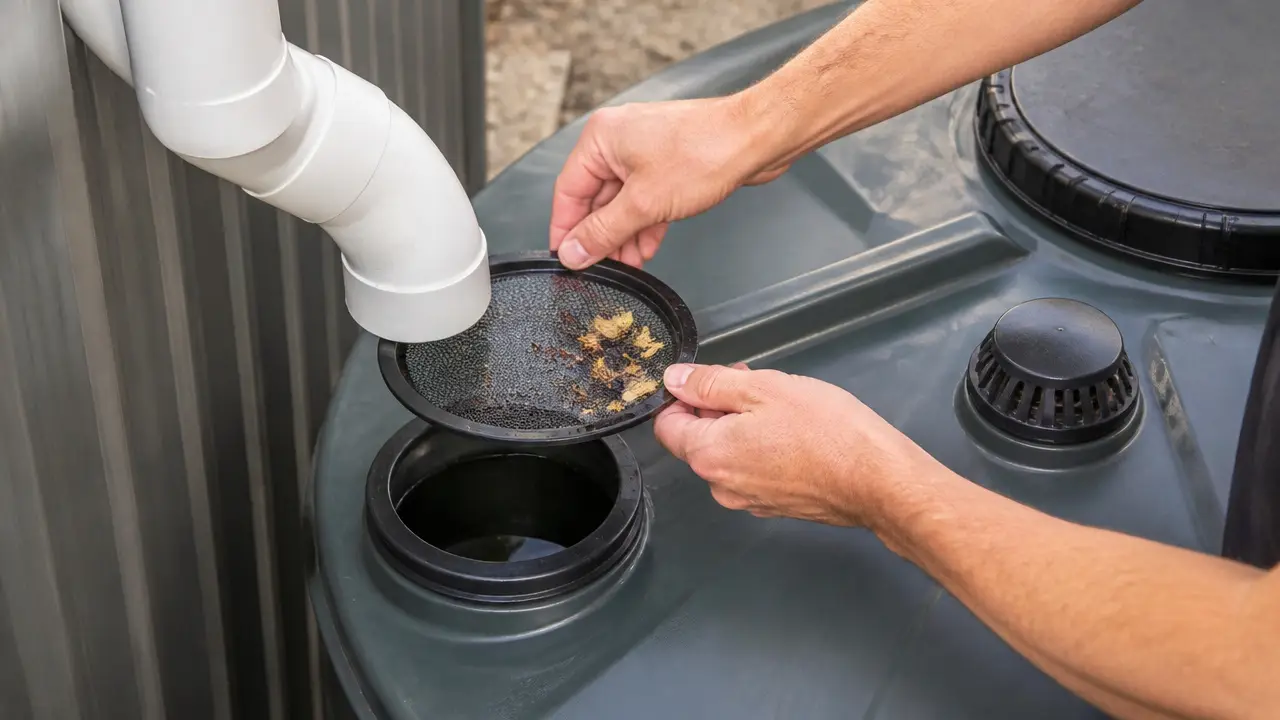
- is blocked by leaves or debris
- is intentionally diverted by a first-flush system
- overflows once the barrel becomes full
A first flush is the initial portion of roof runoff that is diverted away from storage. It can help remove some dust, debris, and contaminants washed from the roof at the start of a rainfall event.
Because every roof and collection system is different, avoid assuming that the theoretical calculation equals the amount you will actually store.
What If You Use Metric Measurements?
The metric calculation is especially simple:
1 millimeter of rain on 1 square meter of roof produces 1 liter of water in ideal conditions.
So:
Liters collected = roof area in square meters × rainfall in millimeters
For example, a 10-square-meter catchment receiving 10 mm of rain could theoretically produce:
10 × 10 = 100 liters
Use the fill rate of a 50-gallon rain barrel to verify storage-surface compatibility with the planned application.
To fill a roughly 208-liter barrel from that same 10-square-meter roof:
208 ÷ 10 = 20.8 mm of rain
Again, actual collection will be somewhat lower.
Barrel Size Matters Less Than Roof Size
A larger barrel needs more rainfall to fill, but roof area often has an even bigger effect.
A 55-gallon barrel collecting from a small shed roof may take a substantial storm to fill. The same barrel connected to several hundred square feet of house roof could fill during a short rain.
You can use the same formula for larger tanks:
Rainfall needed = storage capacity ÷ (roof area × 0.623)
For example, an ideal 275-gallon IBC tote receiving runoff from 1,000 square feet of roof would need:
275 ÷ (1,000 × 0.623) = about 0.44 inch of rain
That does not mean every 0.44-inch storm will put exactly 275 gallons into the tote. Collection losses still apply.
Check Whether Your Barrel Will Overflow
Because roof runoff adds up quickly, overflow planning is important.
A barrel connected to a large roof can become full before a storm ends. Once that happens, the remaining runoff needs somewhere safe to go.
An overflow should direct excess water away from places where it could cause trouble, such as:
- foundations
- crawl spaces
- basement walls
- doors
- neighboring property
- areas that already drain poorly
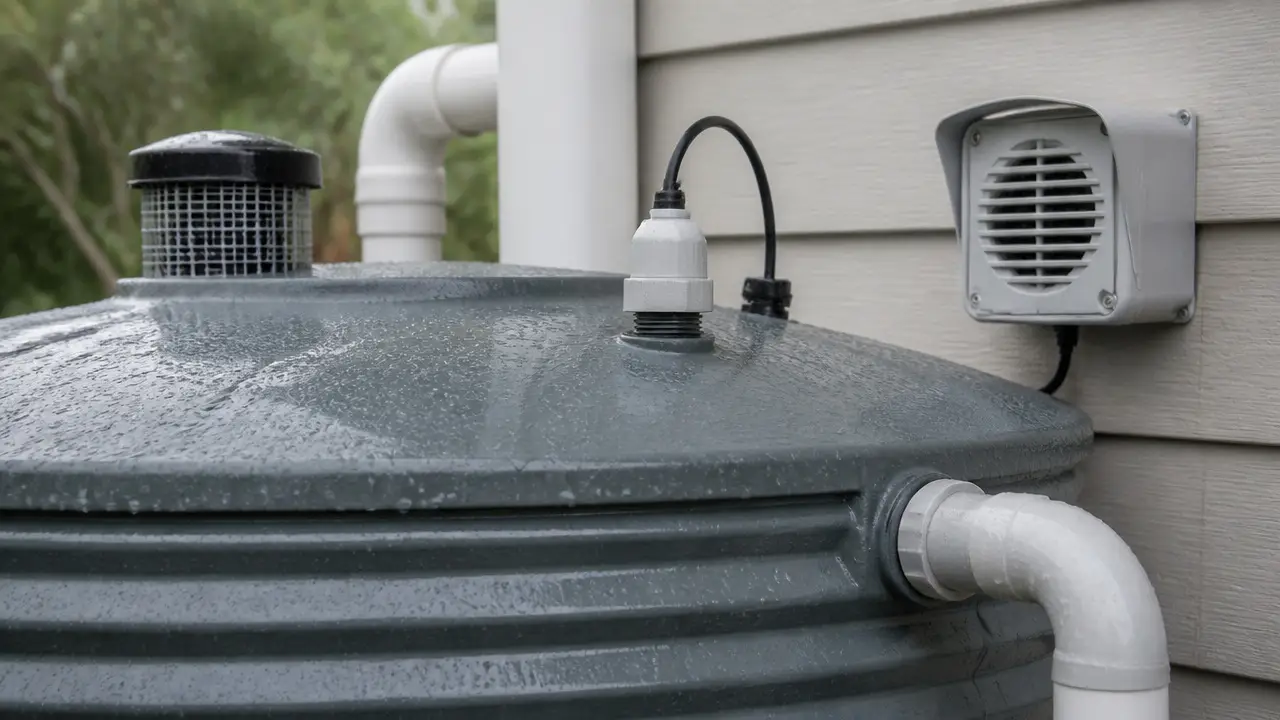
Do not simply cap the overflow opening. The system needs a way to handle water after the barrel reaches capacity.
If you connect several barrels, make sure the connections and overflow arrangement can move water fast enough for your setup.
Does a Downspout Diverter Change the Amount Collected?
It can.
A downspout diverter sends some gutter water into the barrel while allowing excess water to continue through the normal downspout once the barrel is full.
Different diverter designs move water differently. The actual amount entering your barrel can depend on the diverter, installation, gutter flow, debris, and rainfall intensity.
For planning purposes, use the roof-and-rainfall formula to estimate how much runoff is available. Then treat the amount actually reaching storage as less than that theoretical maximum.
How Much Rain Do You Need for a Useful Amount of Water?
You do not have to wait for the barrel to become completely full.
For a 500-square-foot catchment, the ideal runoff from different rainfall amounts is roughly:
| Rainfall | Theoretical runoff |
|---|---|
| 0.05 in. | 16 gallons |
| 0.10 in. | 31 gallons |
| 0.25 in. | 78 gallons |
| 0.50 in. | 156 gallons |
| 1.00 in. | 312 gallons |
A standard barrel may therefore overflow during a moderate storm unless water is being used or additional storage is available.
Remember What the Water Will Be Used For
Calculating rainfall tells you how much water may be available. It does not tell you whether that water is suitable for a particular use.
Roof runoff can pick up material from roofing, gutters, animal droppings, insects, dust, smoke particles, and other contaminants.
For many rain barrel systems, the intended use is non-potable water, such as suitable outdoor irrigation. Non-potable means water that is not intended for drinking.
Do not assume stored roof runoff is safe to drink simply because it looks clear or has passed through a screen or filter.
Drinking-water use requires a whole-system approach that considers the collection surface, prefiltration, treatment, storage, current laboratory testing, maintenance, and applicable local requirements.
Frequently Asked Questions
How much rain does it take to fill a 55-gallon rain barrel?
It depends mainly on the roof area feeding the barrel. In ideal conditions, a 55-gallon barrel receiving runoff from 500 square feet of roof needs about 0.18 inch of rain. Actual systems usually need more because some water is lost before reaching the barrel.
How many gallons does 1 inch of rain produce?
One inch of rain on one square foot produces about 0.623 gallons. A 500-square-foot roof could therefore produce about 312 gallons from 1 inch of rain before collection losses.
Can a rain barrel fill during a light rain?
Yes. A barrel connected to a large roof area can fill during a fairly small rainfall event. Even 0.25 inch of rain on 500 square feet represents about 78 gallons of theoretical runoff.
Should I use my whole roof area in the calculation?
Only if the entire roof drains to the downspout connected to your storage system. Most homes have several downspouts, so one barrel may receive runoff from only one section of the roof.
Why didn't my barrel collect as much as the formula predicted?
The formula calculates theoretical runoff. Water may be lost to roof wetting, gutters, leaks, screens, first-flush diversion, downspout diverters, splashing, and other parts of the collection system.
What happens when a rain barrel gets full?
Additional water must leave through an overflow or properly designed diverter. Overflow should be routed somewhere that will not cause drainage or foundation problems.
Can rain barrel water be used for drinking?
Do not assume roof runoff stored in a barrel is potable, or safe to drink. Drinking-water use requires suitable collection, treatment, current laboratory testing, maintenance, and compliance with applicable local requirements.