As an affiliate, we may earn a commission from qualifying purchases. We get commissions for purchases made through links on this website from Amazon and other third parties.
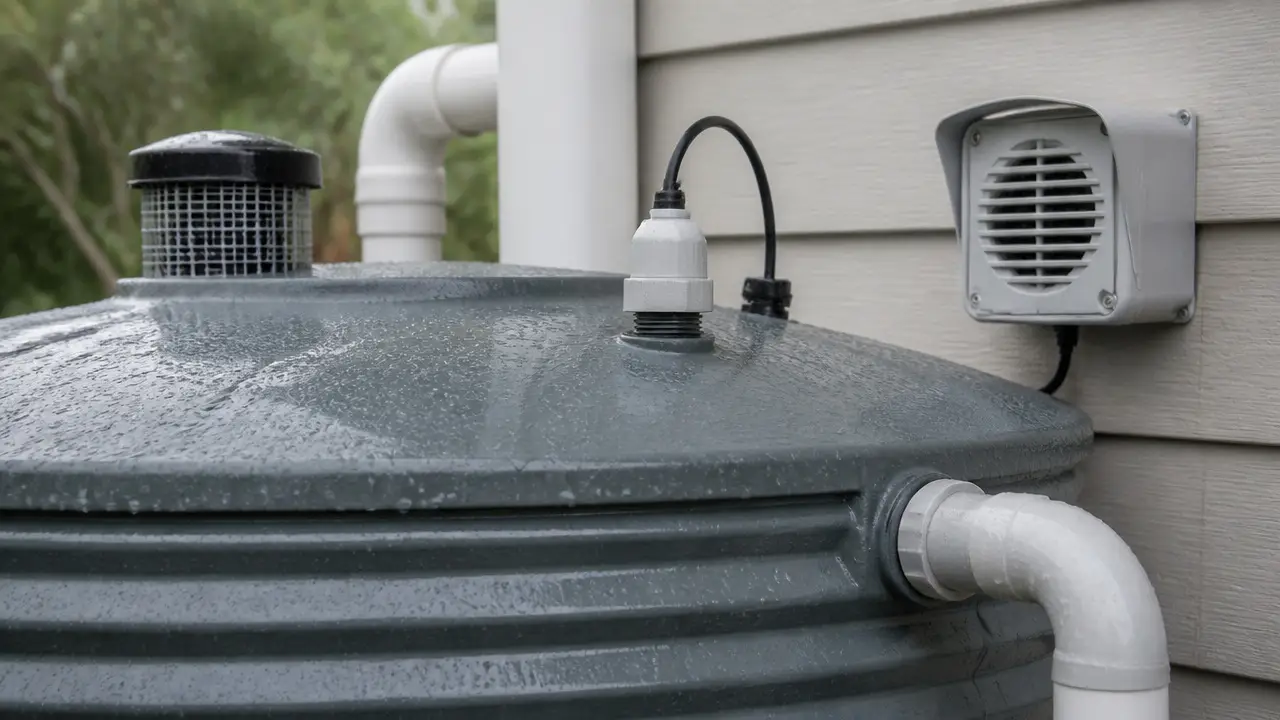
A rainwater tank overflow pipe is usually about 90 to 100 mm (roughly 3.5 to 4 inches) in diameter for many residential systems. But there is no single correct size for every tank. The overflow must be large enough to carry water away at least as fast as the tank can receive it during heavy rain.
A useful starting rule is to make the overflow at least as large as the tank inlet. Some local guidance specifically requires the overflow and inlet to have the same diameter, while other guidance calls for sizing the overflow to handle all incoming roof water.
Why Overflow Pipe Size Matters
Once a rainwater tank is full, every additional gallon or liter entering the tank has to leave through the overflow.
If the overflow cannot keep up, water may rise around tank openings or back up into inlet pipes. It may also spill around the tank and wash away soil supporting the base.
The important comparison is therefore not tank capacity. It is:
maximum inflow versus maximum overflow capacity.
A 5,000-gallon tank and a 500-gallon tank could need the same overflow size if both receive water from the same roof and downpipe system.
What Is a Typical Residential Overflow Size?
For a full-size residential rainwater tank, 90 or 100 mm pipe is common in systems using similarly sized rainwater pipework.
For example, one Australian council design guide requires tank overflows to be at least 100 mm in diameter. Another local authority requires the overflow to have the same diameter as the inlet. These are useful examples rather than universal rules; requirements can differ by location and system design.
A practical way to think about it is:
| System condition | Overflow approach |
|---|---|
| One normal tank inlet | At least the inlet's required flow capacity |
| Several downpipes feeding one tank | Size for their combined incoming flow |
| Large roof or very intense rainfall | A larger overflow may be needed |
| Small rain barrel | Follow the barrel and diverter design rather than assuming a full-size tank pipe |
| Overflow with insect screening | Allow for the screen's effect on water flow |
Do not reduce a large inlet to a much smaller overflow simply because a smaller fitting is easier to install.
The Overflow Should Handle the Incoming Water
The most useful sizing rule is that the overflow should not become the bottleneck in the collection system.
Australian roofwater harvesting guidance states that overflow capacity should account for the inflow pipes and that excess roof water must be discharged without damaging the tank or its foundation.
This becomes especially important when several downpipes feed one cistern.
For example, suppose four roof downpipes enter a large storage tank. Installing one small overflow simply because the tank came with a small outlet could leave the overflow unable to handle peak inflow during a hard storm.
Do not simply add the diameters of all the inlet pipes and use that number as the overflow diameter. Pipe capacity depends on more than diameter, including pipe arrangement, slope, water depth, fittings, screens, and the way the overflow discharges.
For a large catchment or several combined downpipes, hydraulic sizing is the safer approach.
Roof Area and Rainfall Affect the Required Size
The harder it rains and the larger the roof, the more water may arrive at the tank each second.
A simple estimate of roof runoff is:
Flow in L/s ≈ roof area in m² × rainfall intensity in mm/hour ÷ 3,600
For example, using a hypothetical rainfall intensity of 100 mm/hour on a 100 m² roof:
100 × 100 ÷ 3,600 ≈ 2.8 L/s
That does not mean every 100 m² roof should be designed for 100 mm/hour. The design rainfall intensity should come from appropriate local drainage guidance.
Gutters, downpipes, leaf screens, first-flush devices, and inlet arrangements also affect how much of that water actually reaches the tank.
For systems where overflowing could flood a building or cause significant property damage, have the drainage capacity checked by a qualified plumber or drainage professional.
Should the Overflow Be Larger Than the Inlet?
It can be.
Making an overflow slightly larger can provide extra capacity, particularly when:
- several downpipes feed the tank
- a large roof drains into one storage system
- the overflow has an insect screen
- the outlet has bends or a long horizontal run
- the downstream stormwater system may restrict discharge
Screens deserve special attention. They keep mosquitoes, insects, and debris from entering the tank, but they can also restrict flow, especially when dirty. An Australian Building Codes Board report notes that overflow screens can reduce discharge capacity.
That means a nominal 100 mm screened overflow should not automatically be assumed to perform like an unrestricted 100 mm open pipe.
Multiple Inlets Need More Care
A tank receiving water through several downpipes can have far more inflow than the diameter of any single pipe suggests.
For instance, three downpipes entering one cistern should not automatically be paired with an overflow based only on one downpipe.
The complete path needs to be considered:
roof → gutters → downpipes → inlet pipework → tank → overflow → stormwater discharge
The overflow and downstream drain need enough capacity for the expected peak flow.
This is one reason large household systems, underground cisterns, and tanks receiving water from several roof sections are better sized as drainage systems rather than by simply choosing a convenient fitting diameter.
Where Should the Overflow Go?
Examine the effects when the tank is too full to evaluate a storage-tank design compatible with the location.
Pipe diameter is only part of a good overflow design.
Overflow water should discharge somewhere that can safely accept it. Depending on local rules and site conditions, that might be an approved stormwater system, infiltration area, swale, or another approved discharge point.
It should not dump water beside the tank foundation.
Repeated overflow can soften soil, cause erosion, undermine a tank base, or send water toward a building.
Some jurisdictions specifically require tank overflow to connect to the property's stormwater drainage system.
Check current local plumbing and drainage requirements before choosing the discharge point.
Keep Mosquitoes and Debris Out
A rainwater tank overflow is also an opening into the tank.
It normally needs suitable insect or vermin protection while still allowing enough water to escape. Tank openings should not provide easy access for mosquitoes.
Any screen needs regular inspection. Leaves, algae, insects, and other debris can reduce its open area.
A well-sized 100 mm pipe can perform poorly if most of its screen is blocked.
Avoid Unnecessary Restrictions
Even a correctly sized overflow pipe can lose capacity if the installation restricts it.
Watch for:
- undersized adapters
- sharp or unnecessary bends
- long flat pipe runs
- sagging flexible hose
- partially blocked screens
- debris collecting at the tank outlet
- downstream pipes smaller than the overflow
- discharge points that become submerged or backed up
The effective overflow capacity is determined by the whole drainage path, not just the diameter printed on the first fitting.
Is a 2-Inch Overflow Large Enough?
A 2-inch overflow may work on some small rain barrels or purpose-designed small collection systems, but it should not be treated as a standard size for a full residential rainwater tank.
A 2-inch pipe has much less cross-sectional area than a 4-inch pipe. If a large roof and several downpipes feed the tank, that difference becomes important during heavy rain.
Instead of choosing the overflow from tank volume alone, compare it with the collection system's expected maximum inflow.
Is a 4-Inch Overflow Usually Enough?
A nominal 4-inch, or about 100 mm, overflow is a common starting point for residential tanks and is specifically required as a minimum in some local design guidance.
It is not automatically enough for every system.
A large building, multiple connected tanks, several downpipes, unusual rainfall conditions, restricted downstream drainage, or screened outlets can require different sizing.
For these systems, calculate the expected flow and follow applicable drainage standards rather than relying on a typical diameter.
A Practical Sizing Approach
For a basic household rainwater tank, work through the system in this order:
- Check the tank inlet size. Avoid making the overflow less capable than the inlet system.
- Count the incoming downpipes. Several downpipes can greatly increase peak inflow.
- Consider the roof catchment. Larger roofs generate more runoff.
- Use local design rainfall. Heavy-rain intensity matters more than annual rainfall totals when sizing an overflow.
- Account for screens and fittings. They can reduce discharge capacity.
- Check the downstream drainage. A large overflow accomplishes little if it immediately connects to a much smaller restricted drain.
- Check local plumbing requirements. Required pipe sizes and legal discharge locations vary.
For many simple residential installations, this process leads to an overflow around 90 to 100 mm. For larger or unusual systems, calculate the required flow instead.
Frequently Asked Questions
What is the standard rainwater tank overflow pipe size?
There is no universal standard size. Around 90 to 100 mm, or roughly 3.5 to 4 inches, is common for many residential rainwater tanks. The required size depends on inflow, roof drainage, rainfall intensity, and local plumbing rules.
Should an overflow pipe be the same size as the inlet?
Making the overflow at least as capable as the inlet is a good starting principle. Some local authorities specifically require the overflow pipe to have the same diameter as the inlet. Systems with several inlets may require additional capacity.
Can the overflow pipe be smaller than the inlet?
It generally should not create a flow restriction. A smaller overflow can allow water to back up when the tank fills quickly. Any reduction should be supported by proper hydraulic sizing rather than convenience.
Does a larger water tank need a larger overflow?
Not necessarily. Overflow size depends mainly on how quickly water can enter the tank, not how much water the tank stores. Two tanks of very different capacities can need the same overflow if they receive the same roof runoff.
Can I use a 50 mm or 2-inch overflow?
It may be suitable for some small rain barrels or low-flow systems, but it should not automatically be used on a full-size rainwater tank. Check the expected incoming flow and the tank manufacturer's connection requirements.
Does an overflow pipe need a mosquito screen?
Tank openings should be protected against insect and vermin entry where required. However, screens can restrict flow when dirty, so the overflow must retain enough discharge capacity and the screen needs regular cleaning.
Can tank overflow drain onto the ground?
That depends on the site and local drainage rules. The discharge must not undermine the tank, flood buildings, create erosion, or cause other drainage problems. Some jurisdictions require connection to an approved stormwater system.
What size overflow do I need for several downpipes?
There is no reliable answer based only on the number of downpipes. Determine the expected combined roof runoff and size the overflow and downstream drainage to handle that flow. Larger multi-downpipe systems may need professional hydraulic or drainage design.