As an affiliate, we may earn a commission from qualifying purchases. We get commissions for purchases made through links on this website from Amazon and other third parties.
A water storage tank freezes when the water inside loses heat faster than the surrounding system can replace or retain it. The most reliable way to prevent freezing is to combine good tank placement, insulation, protected pipes, and enough water movement or heat for your climate.
In mild winters, insulation and pipe protection may be enough. In long periods below freezing, you may need a heated enclosure or a tank-heating system designed for water storage.
The tank itself is only part of the problem. Pipes, valves, pumps, filters, and fittings often freeze before a large tank does.
Start With the Parts Most Likely to Freeze
A large volume of water takes time to freeze solid. Small amounts of water freeze much faster.
That means these parts often fail first:
- Exposed supply pipes
- Tank outlets
- Ball valves
- Hose bibs
- Pump housings
- Filters
- Small pressure tanks
- Narrow overflow lines
- Pipes that hold standing water
A system can become unusable even while most of the water in the main tank remains liquid.
Plan freeze protection for the whole water path, not just the storage tank.
Put the Tank in the Warmest Practical Location
Location has a major effect on freezing.
A tank exposed to wind on all sides loses heat faster than one protected by a building or insulated enclosure.
Whenever practical, place the tank:
- Inside an insulated building
- In an insulated tank shed
- Against a protected side of a building
- Out of strong winter winds
- Away from areas where snow or ice could damage fittings
An indoor tank is usually much easier to protect than an outdoor one.
However, confirm that the floor can safely support the weight. Water is heavy. A large tank may place several thousand pounds of load on a small area.
Do not place a large tank on a floor, deck, or platform unless the structure is designed for the filled weight.
Insulate the Tank
Insulation slows heat loss. It does not create heat.
That distinction matters.
If outside temperatures remain below freezing long enough, an insulated tank can still freeze. Insulation simply gives the stored water more time before temperatures fall too far.
Common approaches include insulating:
- The tank walls
- The tank top
- The tank base or surrounding enclosure
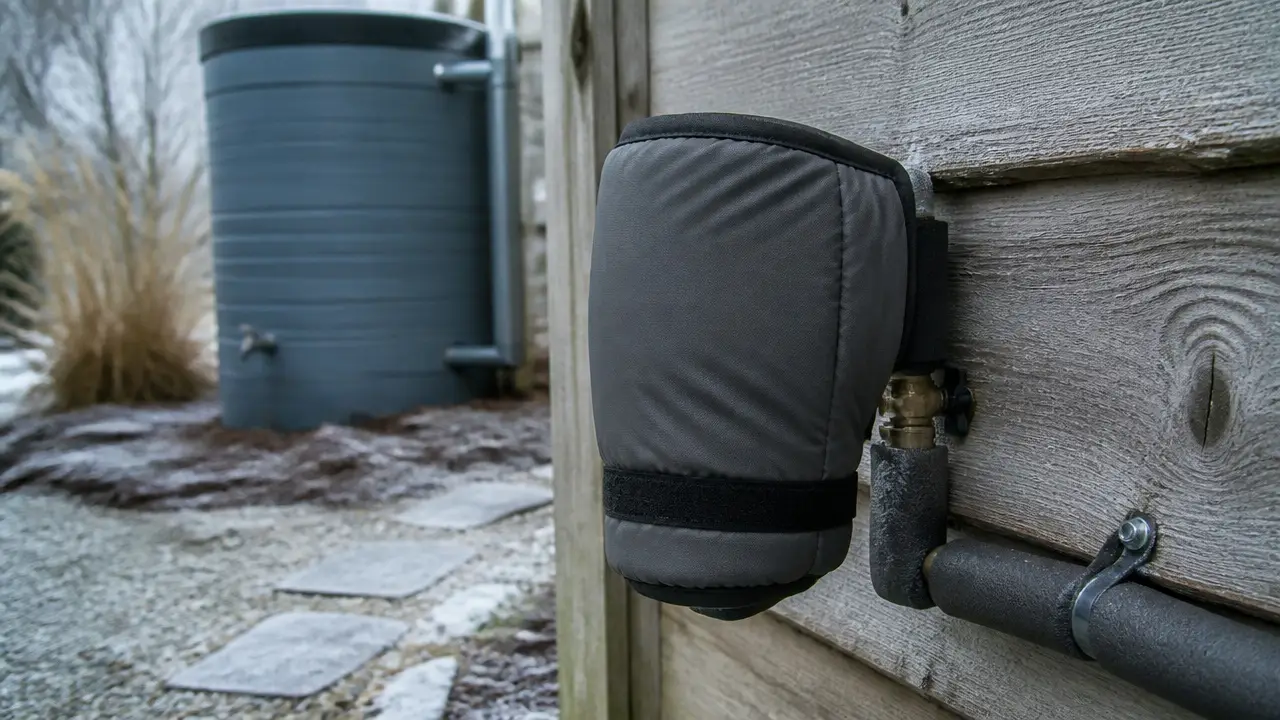
- Exposed fittings and valves
Rigid foam or other moisture-tolerant insulation may be used around suitable installations. Follow the insulation manufacturer's requirements for moisture, fire protection, and installation.
A protected tank enclosure is often easier to insulate well than a round tank itself.
Do Not Forget the Bottom
Heat can also leave through the bottom of the tank.
If a tank sits directly on a very cold slab or exposed platform, insulating only the sides may not be enough.
The tank still needs a flat, stable base that can safely carry its full weight. Do not use soft insulation beneath a heavy tank unless the tank manufacturer and structural design allow it.
Insulate Pipes, Valves, and Fittings
Pipe protection is often more important than adding extra insulation to the tank.
Insulate exposed water lines with material intended for the pipe size and location. Give extra attention to:
- Tank outlets
- Elbows
- Valves
- Pump connections
- Filter housings
- Sections near exterior walls
- Pipes passing through unheated spaces
Keep insulation dry. Wet insulation usually loses much of its insulating value.
Pipe insulation alone may not protect a water-filled pipe during prolonged freezing weather.
Avoid Long Runs of Standing Water
Water trapped in a pipe can freeze, expand, and damage the pipe or its fittings.
Where the system design allows it, arrange seasonal pipes so they can drain when they are not being used.
This is especially useful for:
- Garden irrigation lines
- Outdoor faucets
- Transfer hoses
- Seasonal rainwater systems
- Lines running to remote buildings
A pipe intended to drain needs a suitable slope and somewhere safe for the water to go.
Check valves and low spots can trap water even when most of a line appears empty.
Bury Water Lines Where Appropriate
Buried pipes receive some protection from changing air temperatures.
How deep they need to be depends on local frost conditions, soil, site drainage, pipe type, and local requirements. Do not assume that a shallow trench will remain frost-free.
For permanent plumbing, determine the appropriate frost depth and installation requirements for your location before trenching.
Also protect sections where buried pipes rise toward the surface. These transition points may freeze even when the deeper portion stays protected.
Keep the Tank Reasonably Full
A larger volume of water generally changes temperature more slowly than a small volume.
For that reason, a nearly full tank usually has more thermal mass than an almost-empty tank.
This does not mean a full tank cannot freeze. It simply takes more cooling to freeze a large mass of water.
Do not intentionally overfill a tank. Maintain the required overflow capacity and follow the tank manufacturer's operating limits.
Also remember that water expands when it freezes. A completely trapped volume of water can damage tanks, pipes, filters, valves, and other components.
Use a Heated Enclosure in Colder Climates
For outdoor systems exposed to long freezing periods, enclosing the tank may provide much better protection than wrapping the tank alone.
A tank shed can reduce:
- Wind exposure
- Rapid temperature swings
- Heat loss from pipes
- Direct exposure of pumps and filters
The enclosure can then be insulated as a single space.
In colder climates, the enclosure may still require a safe heat source.
Any heater used around a water system must be suitable for the environment and installed according to its electrical and fire-safety requirements. Water leaks and condensation make improvised electrical heating especially risky.
Tank Heaters Can Help, but Size Matters
Some water-storage systems use electric heaters or de-icers to keep water from freezing.
A heater must be suitable for:
- The tank material
- The water volume
- The expected temperature
- Outdoor or indoor use
- The intended water use
- Continuous exposure to water, if submerged
Do not assume that any stock-tank heater, aquarium heater, heat lamp, or household space heater is appropriate for a rainwater storage system.
The heater also needs enough capacity to offset heat loss.
A very small heater may work during a light frost but fail during several days of colder weather.
Electrical equipment around water should have appropriate protection, including grounding and ground-fault protection where required. Permanent electrical work should be handled according to local electrical requirements and by a qualified electrician when necessary.
Heat Cable Can Protect Some Pipes
Electric heat cable can help keep vulnerable piping above freezing.
It is commonly used on certain exposed water lines, but compatibility matters.
Use only heat cable approved for:
- Your pipe material
- The pipe diameter
- The installation location
- Wet or outdoor conditions when applicable
Follow the manufacturer's instructions for spacing, insulation, thermostats, and overlapping.
Do not wrap ordinary electrical cords, heating pads, or improvised heating elements around pipes.
Some heat cables must never overlap because they can overheat.
Protect Pumps and Filters
Pumps and filter housings can hold relatively small amounts of water. That makes them vulnerable during freezing weather.
A frozen pump housing may crack. A frozen filter housing may split or damage its seals.
For winter operation, these components may need to be:
- Inside an insulated enclosure
- Installed in a conditioned space
- Protected by appropriate heating
- Drained when the system is shut down
Follow the pump and filter manufacturers' winterization instructions.
Simply shutting off a pump does not remove the water trapped inside it.
Protect the Tank Outlet
Regarding insulating a cold-water storage tank, evaluate insulation or heating options for the actual winter exposure.
The lowest tank connection is often one of the coldest and most vulnerable parts of the system.
Water inside the tank may remain liquid while the outlet freezes.
Insulate the outlet assembly and minimize unnecessary exposed plumbing.
If a valve must remain outdoors, protect the entire valve body rather than insulating only the pipe leading to it.
A frozen outlet can prevent water from reaching the pump even when the tank itself contains plenty of usable water.
Keep Overflow Lines Working
The overflow must still be able to carry water away when temperatures are cold enough for ice formation.
Avoid creating low spots where water can collect and freeze.
Ice blocking an overflow can cause incoming water to back up or leave the tank through unintended openings.
The overflow should discharge somewhere that will not create a dangerous ice-covered walking surface or damage nearby structures.
Does Moving Water Prevent Freezing?
Moving water can sometimes delay freezing, but movement alone is not dependable freeze protection.
Circulating water redistributes heat within a tank. It may prevent localized freezing under mild conditions.
However, circulation does not create heat. If the entire system continues losing energy to cold surroundings, circulating water can eventually freeze too.
A circulation pump also adds:
- Electricity use
- More plumbing
- Another component that can fail
- Additional freeze-sensitive connections
Use circulation as part of a designed system rather than assuming that moving water cannot freeze.
Can You Put Salt or Antifreeze in the Tank?
Do not add automotive antifreeze to stored rainwater.
It is toxic and is not appropriate for a water-storage system.
Adding salt is also usually a poor solution. It can damage plants, soil, pumps, plumbing, and equipment and may make the water unsuitable for its intended use.
Some plumbing systems use products specifically formulated for winterizing certain non-potable equipment, but those products are normally used when a system is taken out of service rather than mixed into an operating water supply.
Follow equipment-specific winterization instructions.
Winterizing a Tank You Will Not Use
If you do not need the system during winter, draining and winterizing it may be simpler than keeping it operational.
The exact process depends on the tank and plumbing layout, but it may include:
- Stop new water from entering the system.
- Drain exposed pipes and hoses where the design allows.
- Drain pumps, filters, and housings according to manufacturer instructions.
- Open or position valves as directed for winter storage.
- Remove components that should be stored indoors.
- Protect openings against insects, debris, and animals.
- Secure the tank according to its manufacturer's recommendations.
Do not climb inside a water tank to winterize or inspect it. Tanks can be confined spaces with serious safety hazards.
Also consider whether an empty or nearly empty outdoor tank needs protection from wind. Large lightweight tanks may require anchoring or other manufacturer-approved measures.
What If You Need the Tank All Winter?
A year-round system requires a different level of planning than a seasonal garden tank.
For reliable winter use, think of freeze protection as several layers:
1. Reduce heat loss
Use a protected location, tank enclosure, and insulation.
2. Protect vulnerable plumbing
Insulate pipes, minimize exposed runs, and protect valves, pumps, filters, and fittings.
3. Add heat when necessary
Use suitable thermostatically controlled heating equipment where passive protection is not enough.
4. Plan for power loss
If the system depends on electric heat, consider what happens when electricity is unavailable during freezing weather.
You may need a safe way to drain vulnerable components before they freeze.
5. Inspect the system during cold weather
Look for:
- Ice around fittings
- Reduced water flow
- Bulging pipes
- Unusual pump behavior
- Leaks after a thaw
- Frozen overflow outlets
A sudden drop in flow may mean a pipe or tank fitting is beginning to freeze.
A Simple Approach for Different Winter Conditions
| Winter conditions | Typical approach |
|---|---|
| Occasional light frost | Protect exposed pipes and valves; use basic insulation where needed |
| Repeated overnight freezes | Insulate tank and plumbing; protect pumps and filters |
| Long periods below freezing | Insulated enclosure plus carefully designed active heating may be needed |
| Very cold winters | Consider a protected indoor installation, buried components where appropriate, and professional system planning |
| Seasonal garden system | Drain and winterize rather than heating the system all winter |
Actual performance depends on tank size, wind exposure, insulation, installation details, soil conditions, and how cold it stays for how long.
Common Freeze-Protection Mistakes
Insulating the tank but leaving the valve exposed
The valve can freeze long before the tank.
Assuming insulation produces heat
Insulation only slows heat loss.
Leaving water trapped in hoses
A hose or irrigation line can split when trapped water freezes.
Using an unsafe heater
Improvised heaters around plastic tanks, water, and combustible materials can create electrical or fire hazards.
Forgetting the pump
A pump can be damaged even when the tank remains mostly ice-free.
Relying entirely on moving water
Circulation may delay freezing but cannot overcome unlimited heat loss.
Waiting until a pipe freezes
Freeze protection is much easier to install before sustained cold weather arrives.
When to Get Professional Help
Professional help is a good idea when the system includes:
- Permanent household plumbing
- Large buried tanks
- Major excavation
- Pressurized water systems
- Complex pump controls
- Permanent electrical heating
- Structural supports for large indoor tanks
- Drinking-water treatment systems
A plumber, electrician, structural professional, or experienced water-system installer may be appropriate depending on the work.
For stored rainwater used as drinking water, freeze protection is only one part of the system. Collection, treatment, storage hygiene, maintenance, current laboratory testing, and applicable local requirements must also be addressed.
Frequently Asked Questions
How cold does it have to be for a water storage tank to freeze?
Water begins freezing near 32°F (0°C), but a large tank does not usually freeze solid as soon as outdoor air reaches that temperature. Tank size, starting water temperature, insulation, wind, exposure time, and plumbing layout all affect how quickly freezing occurs.
Will wrapping a water tank in insulation keep it from freezing?
Insulation can delay freezing, but it cannot guarantee that a tank will stay unfrozen during prolonged cold weather. In severe climates, an insulated enclosure or suitable heat source may also be needed.
Does a full water tank freeze more slowly?
Generally, yes. A fuller tank contains more water, so its temperature usually changes more slowly than a nearly empty tank. However, a full tank can still freeze if enough heat is lost.
Can I use a stock-tank heater in a rainwater tank?
Only if the heater manufacturer says it is suitable for the tank material, installation, water volume, environment, and intended water use. Do not assume heaters designed for livestock tanks are appropriate for every rainwater system.
Should I drain my rainwater tank for winter?
If you do not need the system during freezing weather, winterizing it can be easier than keeping it operational. Whether the tank itself should be empty, partly filled, or handled another way depends on its design and manufacturer instructions.
Can an IBC tote stay outside during winter?
An IBC tote can be damaged if water inside it or its outlet plumbing freezes and expands. The valve and lower plumbing are especially vulnerable. In cold climates, an outdoor tote may require winterization or a properly designed insulated and heated installation.
Will burying a water tank keep it from freezing?
Soil can provide substantial temperature protection, but burial does not automatically make a tank freeze-proof. Tank design, burial depth, local frost depth, access ports, pipes, and structural requirements all matter. Only tanks designed for burial should be installed underground.