As an affiliate, we may earn a commission from qualifying purchases. We get commissions for purchases made through links on this website from Amazon and other third parties.
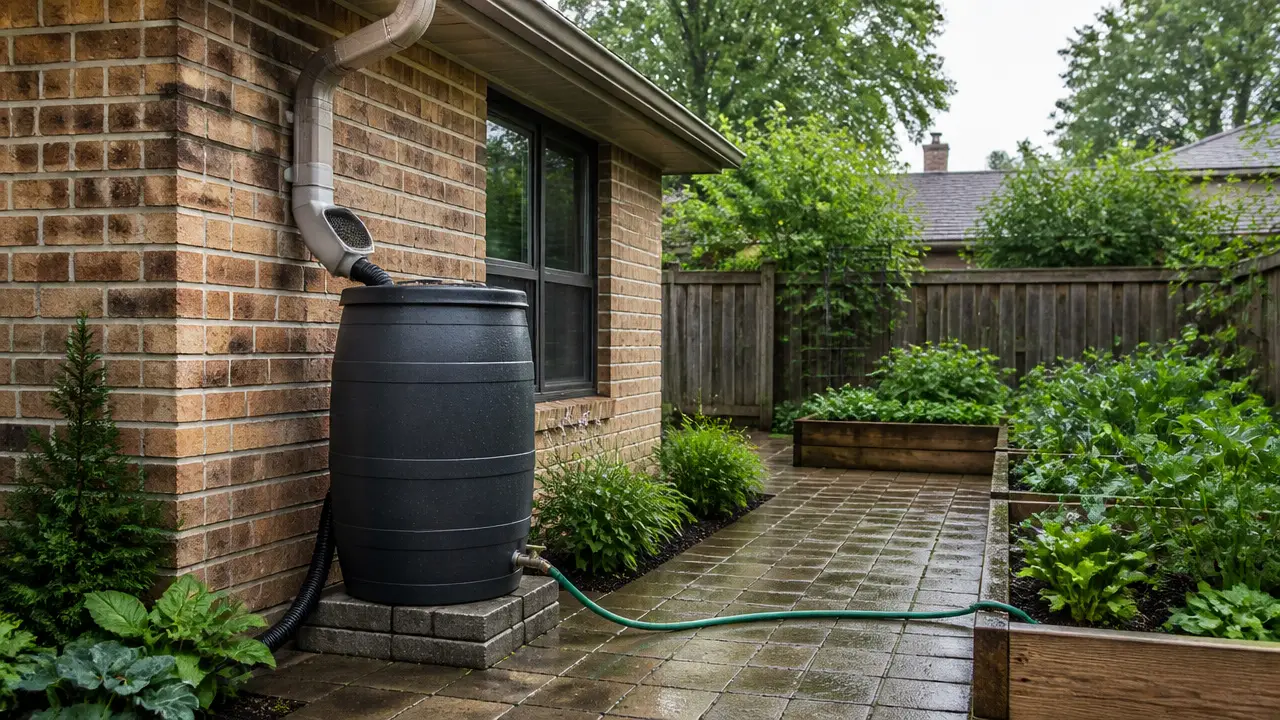
A rain barrel does not always need a stand, but a stand is useful if you need more clearance under the spigot or want a little more gravity-fed water pressure.
The important part is support. A full rain barrel is very heavy. Whatever it sits on must be level, stable, and able to carry the full weight without sinking, tipping, or shifting.
Why Put a Rain Barrel on a Stand?
A stand mainly solves two practical problems.
It Gives You Room Under the Spigot
Many rain barrel spigots are close to the bottom of the barrel. If the barrel sits directly on the ground, there may not be enough room to:
- Fit a watering can underneath
- Attach some hose fittings
- Reach the valve comfortably
- Drain the barrel fully
Raising the barrel 12 to 24 inches can make the outlet much easier to use. You do not need that much height in every setup. Raise it only enough to provide the clearance you need.
It Adds Gravity Pressure
Water pressure increases as the water surface gets higher above the outlet where you are using the water.
This height difference is sometimes called head height.
A taller stand can improve gravity flow through a short hose. However, raising a barrel a few feet does not create household-level water pressure.
As a useful rule, about 2.3 feet of water height produces roughly 1 psi of pressure.
That means a rain barrel on a modest stand may work well for:
- Filling watering cans
- Slow hand watering
- Short, low-resistance hoses
- Some gravity-fed drip systems designed for low pressure
It may still perform poorly with:
- Long garden hoses
- Uphill hose runs
- Small restrictive fittings
- Sprinklers
- Irrigation equipment that requires significant inlet pressure
For those uses, a pump may be more appropriate than building an unusually tall stand.
When You Probably Do Not Need a Stand
A rain barrel can sit at ground level when the setup already works without additional height.
For example, you may not need a stand if:
- You use a pump to move the water
- The outlet already has enough clearance
- The barrel drains into a lower garden area
- You only need a short gravity-fed line
- Raising the barrel would make the installation less stable
Do not add a stand just because rain barrels are commonly pictured on one. The stand should solve a specific problem.
The Base Matters More Than the Height
Whether you use a stand or place the barrel near ground level, the supporting surface needs to be strong and level.
Water weighs about 8.34 pounds per U.S. gallon. A 55-gallon barrel therefore holds about 459 pounds of water when full. The barrel, fittings, stand, and any collected debris add more weight.
Larger storage tanks become much heavier.
A good base should:
- Support the entire bottom of the barrel as required by the container design
- Stay level when the barrel fills
- Resist sinking into wet soil
- Resist movement during heavy rain
- Keep the barrel stable when someone operates the valve or pulls on a hose
A compacted base with suitable concrete or masonry support is often more dependable than placing a loaded barrel directly on loose soil.
Follow the barrel manufacturer's support requirements if they are available.
What Makes a Safe Rain Barrel Stand?
A rain barrel stand needs to support a large static load while remaining stable outdoors.
Suitable designs commonly use sturdy materials such as:
- Concrete blocks arranged to provide broad, stable support
- Properly supported masonry
- A purpose-built outdoor platform
- Structural lumber designed for the expected load
Do not assume stacked objects are safe simply because they can hold the empty barrel.
The stand should not wobble, lean, or have narrow contact points that could shift as the ground becomes wet.
Keep the Barrel Fully Supported
Some plastic tanks need continuous support across their base. Concentrating hundreds of pounds onto a few small points can deform or damage a container that was not designed for that support arrangement.
Check the manufacturer's installation instructions before putting a large tank on an elevated frame.
How High Should a Rain Barrel Stand Be?
There is no single correct height.
Choose the lowest height that gives you the clearance and gravity flow you actually need.
For many simple systems, roughly 12 to 24 inches of elevation provides useful access beneath the spigot without making the barrel unnecessarily high.
Greater height can increase gravity pressure, but it also raises the center of gravity. That can make the system more difficult to support safely.
If you need much more pressure than a normal stand provides, consider whether a properly selected water pump would be a better solution.
Think About the Downspout Before Raising the Barrel
Changing barrel height also changes where the inlet sits.
Before building a stand, check how the barrel will connect to the gutter or downspout.
A rainwater diverter usually needs to be installed at a suitable height relative to the barrel inlet. Raising the barrel too far can leave too little vertical space for the planned connection.
Also check:
- Inlet hose routing
- Overflow hose routing
- Downspout position
- Barrel lid access
- Space needed for cleaning
Account for practical how tall should a rain barrel stand to compare vessel capacity and fittings within the available space.
Plan the full water path before choosing the stand height.
Do Not Forget the Overflow
A stand does not change the fact that the barrel will eventually fill during sufficient rain.
The overflow needs a safe path away from the barrel and building foundation.
Use an adequately sized overflow connection and direct excess water somewhere appropriate for the site. Avoid creating erosion, pooling next to the foundation, or a slippery walking area.
The overflow hose should also be supported so it does not pull hard on the barrel fitting.
Can a Stand Improve Garden Hose Flow?
Yes, but only to a point.
Gravity flow depends on more than barrel height. It can also be reduced by:
- A long hose
- A small outlet
- Narrow fittings
- Elevation changes
- Filters
- Partly closed valves
- Small irrigation tubing
The water level inside the barrel matters too. Gravity pressure decreases as the barrel empties because the water surface gets lower.
A setup that flows well with a full barrel may become noticeably slower near the bottom.
What About Drip Irrigation?
A raised rain barrel can sometimes feed drip irrigation, but you need to check the irrigation system's pressure requirements.
Standard pressure-regulated drip components may expect more pressure than a barrel can provide by gravity alone.
Low-pressure or gravity-specific drip components are usually a better match.
Filtration can also matter because small emitters can clog with roof debris and sediment. A filter can help protect irrigation equipment, but it also adds resistance and requires cleaning.
Should a Large Tank Be Put on a Stand?
Be much more cautious with larger storage tanks.
Tank weight rises quickly as capacity increases. For example, hundreds of gallons of stored water can weigh several thousand pounds.
Large tanks may require:
- Engineered support
- Proper foundations
- Manufacturer-specified base preparation
- Anchoring
- Local structural or permit review
Do not treat an elevated cistern, IBC tote, or large tank as simply a bigger rain barrel. The structural consequences are much greater.
If you are unsure whether a platform, deck, roof, or elevated frame can carry the filled tank, have the structure evaluated by a qualified professional.
What About Freezing Climates?
A stand does not protect a rain barrel from freezing.
Water expands when it freezes and can damage barrels, valves, hoses, filters, and fittings. Raised plumbing may also be more exposed to cold air.
If freezing is possible, follow the barrel manufacturer's winterizing instructions. This may include draining the barrel and exposed plumbing before freezing conditions arrive.
Do not assume an insulated stand or barrel cover alone will prevent freeze damage.
A Simple Way to Decide
Start with how you plan to use the water.
If you only want to collect rainwater and pump it later, a stand may offer little benefit.
If you want to fill watering cans or use a short gravity-fed hose, modest elevation is often helpful.
If you need substantial pressure for sprinklers or longer irrigation runs, adding more and more stand height is usually not the best solution. A properly designed pump system may make more sense.
In every case, stability and load capacity matter more than maximum height.
Frequently Asked Questions
Can I put a rain barrel directly on the ground?
Yes, if the surface is level, stable, and suitable for the weight of the full barrel. Soft soil can settle or shift, so a prepared base is often more dependable.
How high should I raise my rain barrel?
Raise it only as much as necessary. Around 12 to 24 inches is often enough to improve spigot access and gravity flow for simple uses. Greater height requires increasingly careful structural support.
Does raising a rain barrel increase water pressure?
Yes. More vertical distance between the water surface and the outlet increases gravity pressure. However, a typical rain barrel stand still produces relatively low pressure compared with a household plumbing system.
Can I use concrete blocks for a rain barrel stand?
Concrete blocks can be used when they are placed on a firm, level base and arranged to provide stable support. Avoid unstable stacks or arrangements that concentrate the barrel's weight onto unsupported parts of its base.
Will a raised rain barrel run a sprinkler?
Usually not well. Most sprinklers need more pressure and flow than a modestly raised barrel can provide. Check the sprinkler's operating requirements or consider a suitable pump.
Can I put an IBC tote on a rain barrel stand?
An IBC tote can weigh several thousand pounds when full. Do not place one on a typical DIY rain barrel stand. Use support appropriate for the tote and its full operating weight, following the container manufacturer's requirements and obtaining professional structural advice when needed.
Do I need to secure a rain barrel to its stand?
The barrel should not be able to slide, tip, or shift during normal use or expected weather. Whether additional restraint is needed depends on the barrel, stand, location, and manufacturer instructions.