As an affiliate, we may earn a commission from qualifying purchases. We get commissions for purchases made through links on this website from Amazon and other third parties.
Turbidity makes water look cloudy, hazy, or muddy because tiny particles are floating in it. In a rainwater system, those particles may come from roof dust, soil, pollen, organic debris, tank sediment, algae, or very fine clay.
The best way to reduce turbidity is to stop new debris from entering the system, let heavy particles settle, remove tank sediment, and filter the water in stages. Very fine particles may need more advanced treatment because they can stay suspended for a long time.
Clear-looking water is not automatically safe to drink. Turbidity removal is only one part of drinking-water treatment.
What Is Turbidity?
Turbidity is a measure of how much suspended material makes water less clear.
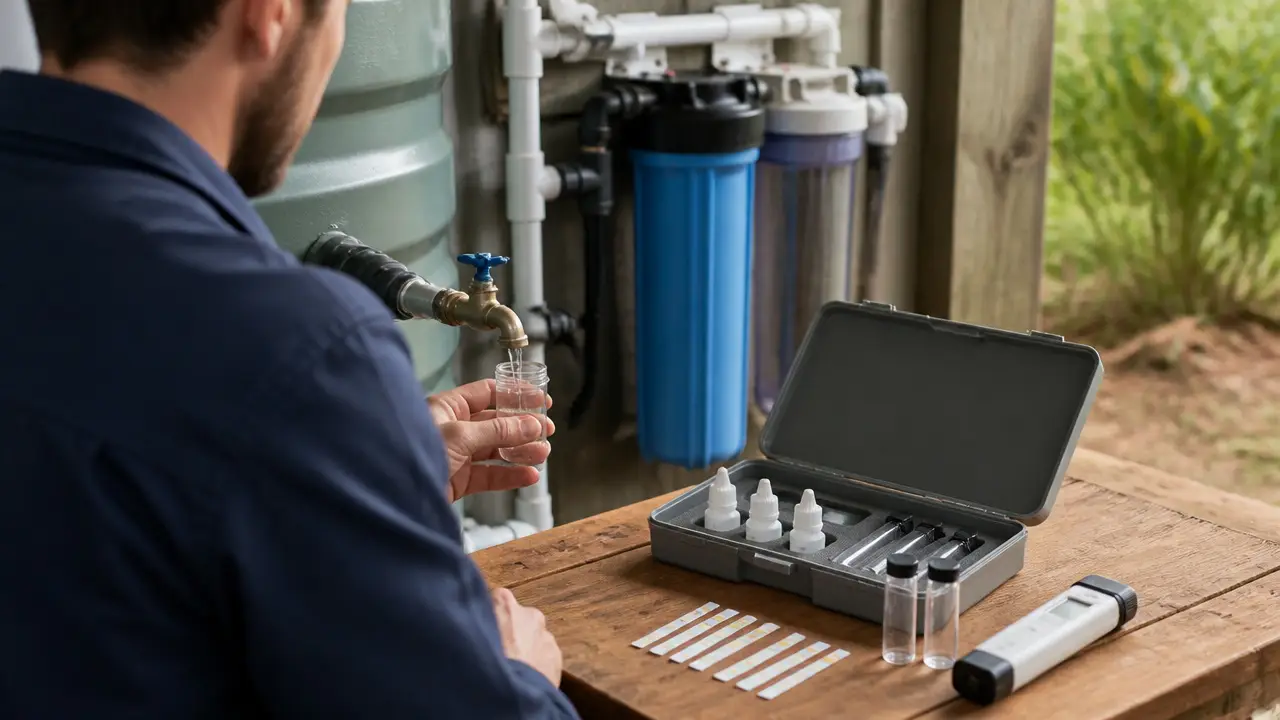
It is commonly measured in NTU, or nephelometric turbidity units. A turbidity meter shines light through the water and measures how particles scatter that light.
Common causes include:
- Dust and dirt washed from a roof
- Fine clay or soil
- Pollen
- Plant material
- Rust particles
- Tank sediment
- Algae
- Organic matter
- Microbial growth
Turbidity is different from total dissolved solids (TDS). TDS measures dissolved minerals and salts. A TDS meter does not tell you how much suspended sediment is causing cloudy water.
Start by Finding the Cause
Filtering water without fixing the source can lead to constantly clogged filters.
Look at when the turbidity appears.
Cloudy Water After Rain
If stored rainwater gets cloudy after every storm, debris may be washing into the tank.
Check:
- Gutters
- Downspouts
- Gutter screens
- Tank inlet screens
- Roof debris
- First-flush devices
A first flush is the first portion of roof runoff that is diverted away from the tank. It can carry concentrated dust, pollen, droppings, and other debris that built up between rains.
Cleaning these parts and keeping larger debris out can greatly reduce the amount of material that reaches the tank.
Cloudy Water Near the Bottom of a Tank
Sediment may have collected on the tank floor.
Water entering quickly can stir this sediment back into the water. A pump intake placed very close to the bottom can do the same thing.
In this case, the main problem may be sediment management rather than the filter itself.
Green or Brown Cloudiness
Green water can point to algae growth, especially when light reaches stored water.
Brown or rusty water may come from:
- Soil
- Organic matter
- Corrosion
- Iron in the water
The correct treatment depends on the cause. A sediment filter cannot solve every type of discoloration.
Milky Water That Quickly Turns Clear
Not all cloudy water is turbidity.
Tiny air bubbles can make water look white or milky. Fill a clear glass and leave it still. If the water quickly becomes clear as the bubbles disappear, trapped air may be the cause instead of suspended sediment.
How to Reduce Turbidity in Water
A good system removes larger material before asking a fine filter to handle tiny particles.
1. Stop New Sediment From Entering
For rainwater systems, start at the roof and work toward the tank.
Remove leaves and heavy debris from gutters. Keep inlet screens clean. Check whether runoff is carrying soil, roofing debris, or decaying organic matter into storage.
If you use a first-flush diverter, inspect and maintain it according to its design. A clogged or poorly maintained diverter may not work as intended.
Preventing contamination is usually easier than removing it after it reaches the tank.
2. Let Heavy Particles Settle
Sand, grit, and larger silt particles often settle naturally when water stays still.
Avoid unnecessary mixing while the water is settling. If possible, draw water from above the sediment layer rather than directly from the tank floor.
Settling can reduce the load on later filters, but it will not remove every suspended particle. Very fine clay and organic material may stay suspended for much longer.
CDC guidance also recognizes settling as a useful first step for cloudy water before further treatment.
3. Remove Sediment From the Tank
Once a thick sediment layer has formed, filtration alone does not fix the underlying problem.
Sediment may need to be flushed, drained, or removed during tank cleaning, depending on the tank design.
Do not enter a cistern or enclosed tank. Tanks can be confined spaces with serious safety hazards. Large tanks that cannot be safely cleaned from outside should be handled by a qualified service provider.
After cleaning, also find out why sediment accumulated so quickly.
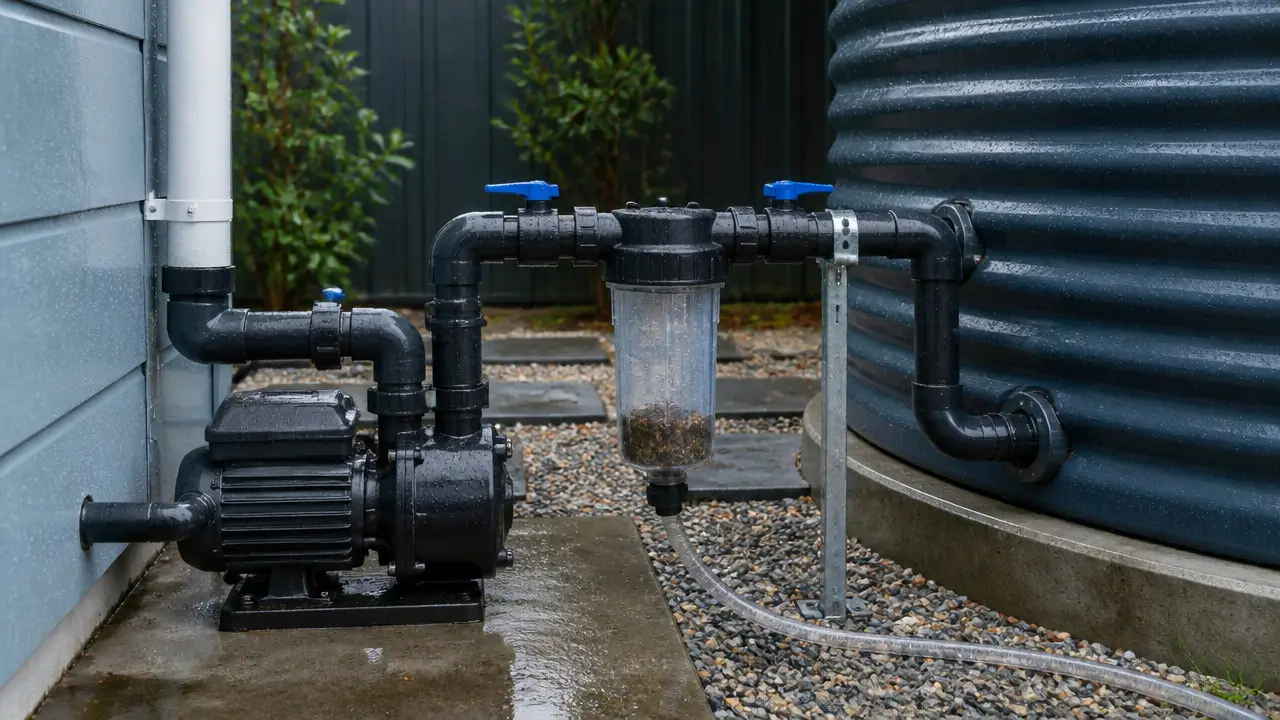
4. Use a Coarse Prefilter
A coarse filter catches larger suspended material before it reaches finer filters.
This may include a screen or sediment filter on the water line.
The goal is not to make the water completely clear in one step. The goal is to keep large particles from rapidly plugging the next filter.
5. Add Finer Filtration in Stages
After coarse debris has been removed, finer filtration can capture smaller particles.
A filter's micron rating describes the approximate size of particles it is designed to capture. A micron is one-thousandth of a millimeter.
For heavily turbid water, jumping directly to a very fine cartridge can cause rapid clogging and low flow.
A staged arrangement works more like this:
Tank → coarse sediment removal → finer sediment filtration → any treatment required for the intended use
The exact filter sizes depend on the water, desired flow rate, pump, filter housing, and final use.
Watch pressure before and after the filters if your system allows it. A growing pressure difference can indicate that a cartridge is filling with sediment.
6. Deal With Very Fine Particles Separately
Some particles are so small that gravity does not remove them easily.
Review home water-turbidity measurements to interpret testing scope appropriate to the planned level of human contact.
Fine clay is a common example. These tiny particles can stay suspended and pass through coarse filters.
Water treatment plants often use coagulation and flocculation for this problem. A coagulant helps tiny particles join together. Those larger clumps, called flocs, can then settle or be filtered more easily. Municipal treatment commonly combines coagulation, flocculation, sedimentation, filtration, and disinfection.
Chemical treatment requires proper dosing and control. For a household drinking-water system with persistent fine turbidity, professional treatment design is safer than guessing how much chemical to add.
7. Correct Algae or Biological Growth
If algae are causing the turbidity, simply installing another sediment filter treats the symptom rather than the cause.
Check whether:
- Sunlight reaches the stored water
- The tank lid seals properly
- Screens or vents allow debris or insects inside
- Organic material has accumulated
- The tank needs cleaning
An opaque tank and covered openings help limit light and contamination.
Do not assume that killing algae makes the water suitable for drinking. Biological problems may point to broader water-quality issues.
A Simple Turbidity Treatment Layout
For rainwater used for irrigation, cleaning, or another non-potable purpose, a basic setup might be arranged like this:
Roof → gutter screen → first flush → tank → sediment control → pump → staged filters → point of use
Non-potable means water that is not intended for drinking.
Not every system needs every stage. A garden drip system, for example, may mainly need enough sediment removal to prevent emitters from clogging.
A household system supplying drinking water requires much more than sediment removal.
How Clear Does Water Need to Be?
The answer depends on what you plan to do with it.
For irrigation or outdoor cleaning, the main concern may be preventing clogged valves, pumps, hoses, or emitters.
For drinking-water treatment, turbidity matters because suspended particles can interfere with disinfection. WHO guidance notes that turbidity should generally be kept below 1 NTU to support effective disinfection. Where that is not practical, WHO guidance discusses keeping it below 5 NTU while adjusting treatment appropriately. These numbers are treatment guidance, not proof that the water is safe to drink.
As of August 2026, WHO continues to recommend a whole-system approach to drinking-water safety rather than relying on one measurement or treatment device.
Why Turbidity Matters Before UV or Disinfection
Cloudiness is especially important when UV light or chemical disinfection is part of the system.
Particles can shield microorganisms from UV light. CDC notes that UV treatment does not work well in cloudy water because particles can block the light from reaching germs.
High turbidity can also interfere with chemical disinfection.
That is why sediment removal normally comes before a UV unit or other final disinfection stage.
Do not treat a UV light as a turbidity filter. It is a disinfection device, not a sediment-removal device.
Why One Fine Filter May Not Solve the Problem
A very fine filter can make water look clearer, but several problems can remain.
It may:
- Clog very quickly
- Reduce water flow
- Increase pressure loss
- Leave dissolved contaminants untouched
- Fail to remove some microorganisms
- Do nothing about the source of the sediment
Different filters remove different contaminants. CDC recommends choosing treatment based on what testing shows is actually present rather than assuming one filter handles every problem.
If cartridges keep becoming dirty within a short time, investigate the tank and collection system before installing increasingly fine filters.
Can Turbid Rainwater Be Used for Drinking?
Do not judge drinking-water safety by appearance alone.
Clear rainwater can still contain microorganisms or chemicals. Cloudy water can create additional treatment problems.
For drinking use, consider the complete path:
Collection surface → debris exclusion → storage → sediment removal → appropriate treatment → disinfection where required → protected plumbing and storage → current laboratory testing
Local rules may also apply to rainwater used inside a home or as drinking water.
A turbidity meter, TDS meter, filter, UV unit, or home test kit cannot by itself establish that roof-collected rainwater is potable.
Potable means suitable for drinking.
If drinking use is planned, use current laboratory testing and treatment designed for the contaminants and risks in your system. A qualified water-treatment professional or local health authority can help where treatment becomes complex.
How to Keep Turbidity From Returning
Long-term control is usually easier than repeatedly filtering dirty water.
Keep up with:
- Roof and gutter cleaning
- Inlet-screen cleaning
- First-flush maintenance
- Tank inspection
- Sediment removal
- Filter replacement or cleaning
- Light control around storage tanks
- Pump-intake inspection
- Overflow and vent screening
Also check the system after major storms. Heavy rain can move much more debris than a normal rainfall event.
If turbidity suddenly increases after the system has been stable, look for a change rather than simply replacing the filter. A damaged screen, disturbed tank sediment, roof work, contamination event, or failing component may be responsible.
Frequently Asked Questions
What is the fastest way to remove turbidity from water?
For sediment-based turbidity, allow the water to settle and draw clearer water from above the sediment. Then use staged sediment filtration. Also stop new debris from entering the tank, or the problem will quickly return.
Will a sediment filter remove turbidity?
A sediment filter can remove many suspended particles, but its effectiveness depends on particle size and filter design. Very fine clay and other small particles may require finer filtration or additional treatment.
Does boiling remove turbidity?
No. Boiling is used to kill many disease-causing microorganisms, but it does not remove suspended sediment or harmful chemicals. Cloudy water should normally be clarified before further drinking-water treatment.
Is turbidity the same as TDS?
No. Turbidity comes mainly from suspended particles that scatter light. TDS refers to substances such as minerals and salts dissolved in water. A TDS meter is not a turbidity meter.
Why does my rainwater tank become cloudy after heavy rain?
Heavy rain may wash roof dust, pollen, dirt, organic material, and gutter sediment into the tank. Incoming water can also stir up sediment already sitting on the tank floor. Check roof cleanliness, screens, first-flush equipment, inlet design, and tank sediment.
Can UV treatment fix cloudy water?
No. UV light disinfects water but does not remove suspended particles. Cloudy water can actually make UV treatment less effective because particles can block UV light. Turbidity should be reduced before UV treatment.
Does clear water mean the turbidity problem is completely solved?
Not necessarily. Water may look clear while still containing small particles, microorganisms, or dissolved contaminants. For drinking use, appearance is not a substitute for suitable treatment and laboratory testing.