As an affiliate, we may earn a commission from qualifying purchases. We get commissions for purchases made through links on this website from Amazon and other third parties.
There is no single water filtration system that is healthiest for every home. The healthiest choice is the system that removes the specific germs or chemicals in your water, is independently certified for those reductions, and is maintained correctly.
For treated city water, that may be a simple certified carbon filter or a reverse osmosis system at the kitchen sink. For private wells and collected rainwater, filtration alone may not be enough. These sources can need sediment removal, treatment for specific chemicals, and a separate disinfection step for germs. CDC recommends testing well and rainwater so treatment can be matched to what is actually present.
What Makes a Water Filtration System Healthy?
A good drinking-water system does three things:
- It addresses contaminants that are actually present.
- It has verified performance for those contaminants.
- It can be maintained well enough to keep working.
A filter that removes many substances is not automatically healthier than a simpler filter. If your public tap water already meets drinking-water requirements, you may not need extensive treatment. CDC notes that filters can also remove useful substances such as chlorine, which helps control germs, and fluoride, which helps protect teeth.
The starting water matters more than the number of filter stages.
Taste and smell are also poor ways to judge safety. Harmful contaminants may have no noticeable taste, smell, or color. Water that smells unpleasant can sometimes contain substances that are more of an aesthetic problem than a health problem.
Which Water Filtration System Gives the Broadest Treatment?
For drinking and cooking water, a certified reverse osmosis system is one of the broadest household treatment options when the goal is to reduce a mix of dissolved chemicals.
Reverse osmosis, or RO, pushes water through a very fine membrane. CDC states that RO can remove parasites, bacteria, and viruses and can reduce certain chemicals, including lead, copper, chromium, chloride, and sodium. Depending on the system, it may also reduce substances such as arsenic, nitrate, fluoride, radium, and sulfate. The exact list depends on the individual system and its certified claims.
However, this does not mean every home should install RO.
RO systems require regular filter and membrane service. They also produce a reject-water stream, remove some minerals, and usually deliver water more slowly than an ordinary faucet. Most importantly, an RO label by itself does not tell you every contaminant that a particular unit has been verified to reduce.
NSF/ANSI 58 is the main standard used for residential reverse osmosis systems. It includes requirements for materials, construction, total dissolved solids reduction, and other performance measures. Specific contaminant reductions are separate claims under the standard.
For many homes, a point-of-use RO system serving the drinking-water faucet makes more sense than treating every gallon entering the house.
How the Main Water Treatment Systems Compare
| Treatment type | Often useful for | Important limitation |
|---|---|---|
| Activated carbon | Chlorine taste and odor and certain chemicals when specifically certified | Most ordinary carbon filters are not designed to make germ-contaminated water safe |
| Reverse osmosis | Broad reduction of many dissolved substances plus very small contaminants | Exact reductions vary; needs maintenance and produces reject water |
| Ultrafiltration | Many parasites and bacteria | Does not generally remove dissolved chemicals |
| Nanofiltration | Parasites, bacteria, viruses, and some chemicals | Chemical reduction depends on the membrane and system |
| UV treatment | Disinfecting water containing germs | Does not remove chemicals |
| Distillation | Germs and many dissolved chemicals | Slow, energy intensive, and some volatile chemicals can carry over |
| Water softener | Hardness caused mainly by calcium and magnesium | Not a general drinking-water purifier |
No row in this table should be read as a guarantee. Household treatment systems should be selected for the contaminants they are tested and certified to address.
Activated Carbon Can Be Enough for Some Tap Water
Activated carbon is common in pitchers, refrigerator filters, faucet filters, and larger filter housings.
Carbon can be useful when the main goal is improving chlorine taste or odor. Some carbon systems are also certified to reduce health-related contaminants such as lead or certain organic chemicals.
But carbon is not one treatment with one fixed level of performance. The filter media, amount of carbon, water flow, contact time, and certification all matter.
A basic carbon filter should not be assumed to remove:
- Bacteria
- Viruses
- Nitrate
- Arsenic
- Dissolved salts
- Every heavy metal
- Every PFAS compound
CDC specifically warns that many common pitcher and refrigerator filters are mainly intended to improve taste and smell rather than remove germs.
For someone with treated municipal water who only wants better taste or reduction of one known contaminant, a properly certified carbon system may be a simpler choice than RO.
Reverse Osmosis Makes Sense When Dissolved Contaminants Are the Concern
A normal particle filter catches material according to particle size. RO goes much further by using a membrane that separates water from many dissolved substances.
That makes RO worth considering when testing or utility information shows contaminants that ordinary sediment filtration cannot address.
It is especially important to check the specific contaminant claim rather than buying a system simply because it says "reverse osmosis."
For example, EPA recommends checking for appropriate third-party certification when choosing treatment for PFAS. EPA also notes that certification requirements and health limits can change, so a certification for some PFAS reductions should not be interpreted as proof that every PFAS compound has been removed.
The same basic rule applies to lead, nitrate, arsenic, and other contaminants: match the certified reduction claim to the problem you need to solve.
UV Is Useful for Germs, but It Is Not a Chemical Filter
Ultraviolet systems expose water to UV light to disinfect it.
A well-designed UV stage can be valuable for private water supplies where microbes are a concern. It is often placed near the end of a treatment train after sediment has been removed.
Prefiltration matters because cloudy water and suspended particles can interfere with effective UV treatment. CDC notes that UV systems with prefiltration work better than systems treating unfiltered water. UV does not remove dissolved chemicals.
NSF/ANSI 55 covers residential ultraviolet systems. NSF distinguishes between Class A systems designed for disinfection of contaminated water and Class B systems intended to reduce normally occurring non-disease-causing bacteria in already disinfected drinking water.
UV also depends on electricity, lamp condition, proper flow, and water clarity. A glowing lamp alone does not prove that treatment is working correctly.
Ultrafiltration Is Different From Reverse Osmosis
Ultrafiltration, or UF, uses very small pores to block larger contaminants.
A micron is one-millionth of a meter. A micron rating tells you something about the size of the openings a filter uses.
CDC describes typical ultrafiltration pore sizes around 0.01 micron, although actual products vary. UF can remove parasites and bacteria and may reduce some viruses. It generally does not remove dissolved chemicals.
That makes UF useful where microbial filtration is needed but dissolved salts and many chemicals are not the main concern.
It should not be treated as a substitute for testing.
Distillation Provides Broad Treatment but Has Tradeoffs
A distiller heats water and collects the condensed steam.
This leaves many contaminants behind. CDC states that distillation can remove parasites, bacteria, viruses, and many chemicals, including substances such as lead, nitrate, sodium, arsenic, and chromium.
But distillation has limits.
Some volatile chemicals can evaporate with the water and carry into the condensed water unless the system is designed to control them. Distillers are also slow and require significant energy compared with passive filters.
NSF/ANSI 62 covers drinking-water distillation systems.
Distillation can make sense for a small amount of drinking water when testing shows contaminants the particular system is designed to address. It is rarely the simplest way to provide all household water.
A Water Softener Is Not a Drinking-Water Purifier
Water softeners mainly treat hardness.
Hard water contains relatively high amounts of minerals, especially calcium and magnesium. These minerals can create scale inside pipes, heaters, faucets, and appliances.
A conventional softener exchanges calcium and magnesium ions for sodium or potassium ions.
That can be useful for protecting plumbing, but a softener should not be confused with a filter or disinfection system. CDC states that water softeners do not remove parasites, bacteria, or viruses.
If a home needs both softening and drinking-water treatment, the two jobs should be considered separately.
Look for Certification, Not Just a Long List of Claims
Independent certification is one of the most useful tools for comparing drinking-water treatment systems.
Common NSF/ANSI standards include:
- NSF/ANSI 42: mainly aesthetic effects such as chlorine taste and odor.
- NSF/ANSI 53: reduction of contaminants with health effects.
- NSF/ANSI 55: ultraviolet treatment systems.
- NSF/ANSI 58: reverse osmosis systems.
- NSF/ANSI 62: distillation systems.
The standard number is not a quality ranking. Standard 58 is not "better" than Standard 53 simply because the number is higher. Each standard covers a different treatment method or type of performance.
Also read the actual contaminant claims.
A system may meet NSF/ANSI 53 for one contaminant without being certified for every contaminant covered by that standard.
The Healthiest Choice for Public Tap Water
With key facts about the healthiest water filter to use, you can compare a confirmation step tailored to the possible contamination source.
If you receive water from a regulated public water system, start by finding out what is in it.
In many cases, extensive filtration is unnecessary. Public utilities use treatment and disinfection to control harmful contaminants before the water reaches customers.
You may still have a reason to use home treatment. Examples include:
- Lead concerns from household plumbing
- A contaminant identified by your water utility
- An official local advisory
- Chlorine taste or odor
- A specific contaminant confirmed through suitable testing
If the concern is mainly chlorine taste, certified carbon treatment may be enough.
If the concern involves several dissolved contaminants, point-of-use RO may provide broader treatment.
If lead is the concern, look specifically for certified lead reduction rather than assuming any carbon or RO system will handle it. EPA provides guidance for identifying filters certified for lead reduction.
Avoid adding treatment stages simply because more stages sound healthier. Every cartridge creates another part that must be changed, cleaned, or monitored.
The Healthiest Choice for Well Water
Private well water needs a different approach because the homeowner is responsible for water quality.
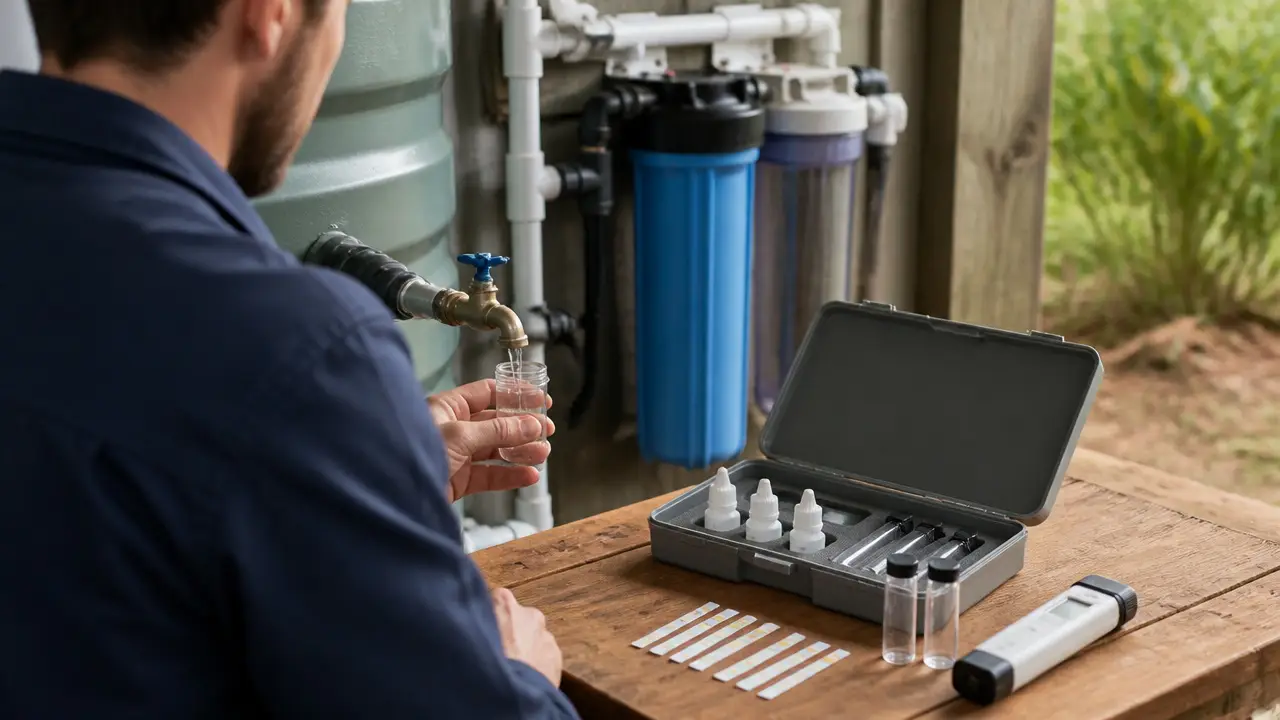
EPA recommends testing private wells annually for total coliform bacteria, nitrate, total dissolved solids, and pH, with additional testing based on local conditions and possible contamination sources. EPA recommends using certified drinking-water laboratories.
Total dissolved solids, or TDS, is a measure of dissolved material in water. It can help describe water chemistry and treatment performance, but a TDS reading does not tell you whether the water contains harmful bacteria or identify individual chemicals.
A well treatment system might include several separate jobs:
- Removing sediment.
- Correcting iron, manganese, hardness, or another water-quality problem when needed.
- Treating specific health-related chemicals found through testing.
- Controlling germs when testing and professional assessment show disinfection is needed.
There is no universal well-water filter because groundwater chemistry varies greatly from one property to another.
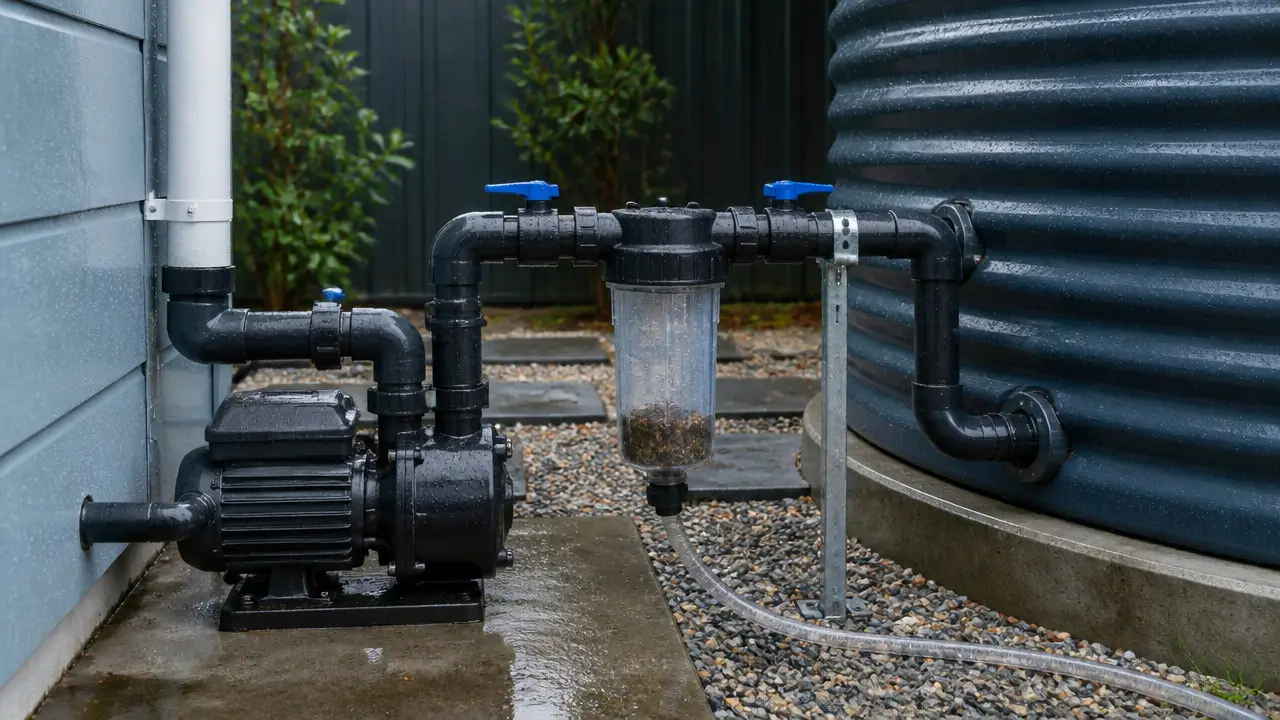
Rainwater Needs More Than a Drinking-Water Filter
Collected rainwater should not be treated like ordinary city tap water.
Rain can pick up material from the air. Once it lands on a roof, it can collect dust, animal waste, roofing chemicals, metals, and other contaminants before entering the tank. CDC states that rainwater is not necessarily safe to drink without treatment for germs and chemicals.
A drinking-water rainwater system therefore begins before the final filter.
A typical treatment concept may involve:
Catchment protection → debris screening → first flush → covered storage → sediment treatment → contaminant-specific treatment → disinfection → protected drinking-water plumbing
A first-flush diverter sends away some of the first runoff from a storm. That early runoff often carries more debris and contamination from the roof. It improves incoming water quality but does not make the remaining rainwater potable.
Potable means suitable for drinking. Non-potable water is water used for purposes where drinking-water quality is not required.
For garden irrigation, toilet flushing, or similar non-potable uses, treatment may be much simpler. For drinking, cooking, brushing teeth, or other uses where water can be swallowed, the consequences of treatment failure are greater.
CDC advises regularly testing rainwater used for drinking, cooking, or bathing and recommends contacting the local health department for guidance on appropriate testing and treatment.
An RO unit, carbon cartridge, or UV lamp by itself should never be treated as proof that roof runoff is safe to drink.
Maintenance Matters as Much as the Filter Type
Even a well-chosen treatment system can become a water-quality problem when it is neglected.
Filters collect material. Eventually they need replacement or cleaning. Dirty components can restrict flow and can provide places where microbes grow.
Follow the system's service requirements for items such as:
- Sediment cartridges
- Carbon media
- RO prefilters
- RO membranes
- Storage tanks
- UV lamps
- UV sleeves
- O-rings and seals
Do not extend cartridge life just because the water still tastes normal.
Also watch pressure and flow. A filter that is too small for the required flow can cause poor pressure. A treatment device operated above its rated flow may not provide the contact time or performance for which it was designed.
For a whole-house system, this means sizing treatment for peak household flow rather than only looking at pipe diameter.
Point-of-Use or Whole-House Treatment?
A point-of-use system treats water at one location, such as the kitchen drinking-water faucet.
A point-of-entry, or whole-house, system treats water as it enters the home.
For many health-related drinking-water concerns, point-of-use treatment is practical because only drinking and cooking water needs the highest level of treatment. CDC specifically identifies point-of-use equipment as an option when only water at a particular tap needs treatment.
Whole-house treatment makes more sense when the contaminant affects other household uses, plumbing, fixtures, or exposure routes.
The right location depends on the contaminant. It should not be decided only by the idea that whole-house filtration must be healthier.
A Practical Way to Choose
The healthiest water filtration setup usually comes from working backward from your water source.
First, identify whether you have municipal water, a private well, or collected rainwater.
Next, find out what treatment the water already receives and what contaminants are known or reasonably suspected. Use suitable laboratory testing when the source is private or when testing is needed to answer a specific concern.
Then choose treatment with verified reduction claims for those contaminants.
For many homes using treated municipal water, this may mean a certified carbon filter or point-of-use RO system.
For untreated well or rainwater, it can mean several stages because particle removal, chemical treatment, and germ control are different jobs.
The healthiest system is therefore not the one with the most cartridges. It is the one that fits the water, addresses the real risks, and can be maintained reliably.
Frequently Asked Questions
Is reverse osmosis the healthiest water filtration system?
Reverse osmosis is one of the broadest household treatment methods, especially for many dissolved contaminants. However, it is not automatically the healthiest choice. The best system is one certified to reduce the contaminants actually present in your water and maintained according to its requirements.
Is filtered water healthier than tap water?
Not always. If public tap water is already free of harmful contaminants, extra filtration may provide little health benefit. A filter can still be useful for a specific issue such as lead or for improving chlorine taste and odor.
Does reverse osmosis remove all contaminants?
No. RO can remove or reduce many contaminants, but no household RO system should be assumed to remove everything. Check the exact certified contaminant-reduction claims for the system.
Is UV better than reverse osmosis?
They do different jobs. UV is mainly used to disinfect water by inactivating germs. RO is used for membrane separation and can reduce many dissolved chemicals as well as microorganisms. Some private-water systems use both because one stage does not replace the other.
Do I need a whole-house water filtration system?
Not necessarily. If your concern only affects drinking and cooking water, a point-of-use system at the kitchen sink may be enough. Whole-house treatment is more useful when the contaminant or water-quality problem affects water throughout the home.
Can I use one filter to make rainwater safe to drink?
A single filter should not be assumed to make rainwater potable. Drinking-water use should be treated as a whole system that includes suitable collection, storage, prefiltration, treatment for identified contaminants, disinfection where needed, regular testing, maintenance, and applicable local requirements.
Does a low TDS reading mean water is healthy?
No. TDS measures the amount of dissolved material in water. It does not identify individual contaminants and cannot tell you whether bacteria, viruses, or specific harmful chemicals are present.
How often should well or rainwater be tested?
CDC recommends testing well and rainwater at least annually for harmful germs and chemicals. Rainwater used for drinking, cooking, or bathing should be tested regularly, with local health authorities helping determine which contaminants are appropriate to test for.