As an affiliate, we may earn a commission from qualifying purchases. We get commissions for purchases made through links on this website from Amazon and other third parties.
For most home water systems, the most reliable way to detect a leak is a controlled isolation test using a water meter, pressure gauge, or tank-level reading. This method works because it measures whether water is leaving a closed system when no water should be moving.
Electronic leak sensors, acoustic tools, thermal cameras, and moisture meters can help find the exact location. But they usually work best after an isolation test has confirmed that a leak actually exists.
Why Isolation Testing Is So Reliable
A good leak test separates normal water use from unwanted water loss.
The basic idea is simple:
- Stop all expected water use.
- Isolate the part of the system being tested.
- Record the meter, pressure, or water level.
- Wait for a set period.
- Check whether the reading changed.
If water continues to disappear from a closed section, there is probably a leak somewhere in that section.
This approach is reliable because it does not depend on seeing water, hearing a leak, or finding a wet spot.
That matters because many leaks are hidden underground, behind walls, beneath concrete, or around buried rainwater pipes.
The Best Method Depends on the Water System
There is no single leak detector that works best in every situation.
| System or leak type | Useful detection method |
|---|---|
| Pressurized household plumbing | Pressure or water-meter isolation test |
| Underground supply pipe | Isolation test followed by acoustic locating |
| Rainwater tank | Tank-level monitoring and section isolation |
| Gravity-fed rainwater pipe | Visual checks and controlled water testing |
| Hidden wall leak | Moisture meter or thermal imaging |
| Very difficult underground leak | Professional acoustic equipment or tracer gas |
| Irrigation system | Zone isolation and flow monitoring |
The important difference is between detecting a leak and locating a leak.
A meter or pressure test is often better at proving that water is being lost. Specialized equipment can then narrow down where that loss is occurring.
Water Meter Testing for Pressurized Plumbing
A water meter is one of the simplest ways to detect a continuous plumbing leak.
Turn off faucets, appliances, irrigation, toilets, and anything else that uses water. Record the meter reading.
Do not use water during the test period.
If the meter continues to register flow, water is moving somewhere in the system.
That could come from:
- a leaking toilet
- a dripping fixture
- an underground service line
- a water heater problem
- irrigation equipment
- a leaking pipe
- another device that automatically uses water
Check known water users before assuming the pipe itself is leaking.
Some meters have a small flow indicator that can reveal very low continuous flow.
Why a Meter Test Works Well
The meter measures actual water movement.
It does not matter whether the leak is visible.
A tiny underground leak may leave no obvious wet area, especially in dry or porous soil. But if water passes through the meter, the meter can still reveal the loss.
Pressure Testing a Closed Pipe
A pressure test can be especially useful when a section of plumbing can be isolated.
A pressure gauge measures the force of water inside the pipe.
Once the section is closed off and no fixtures are using water, its pressure should remain reasonably stable.
A continuing pressure drop can indicate a leak.
However, pressure can also change because of:
- temperature changes
- trapped air
- pressure regulator behavior
- water heater expansion
- check valves
- pump cycling
For that reason, a pressure drop should be interpreted in the context of the plumbing system.
Pressure testing becomes more useful when individual branches can be isolated one at a time.
For example, you might determine that the house piping holds pressure while the underground line to a garden does not.
You have now reduced the search area considerably.
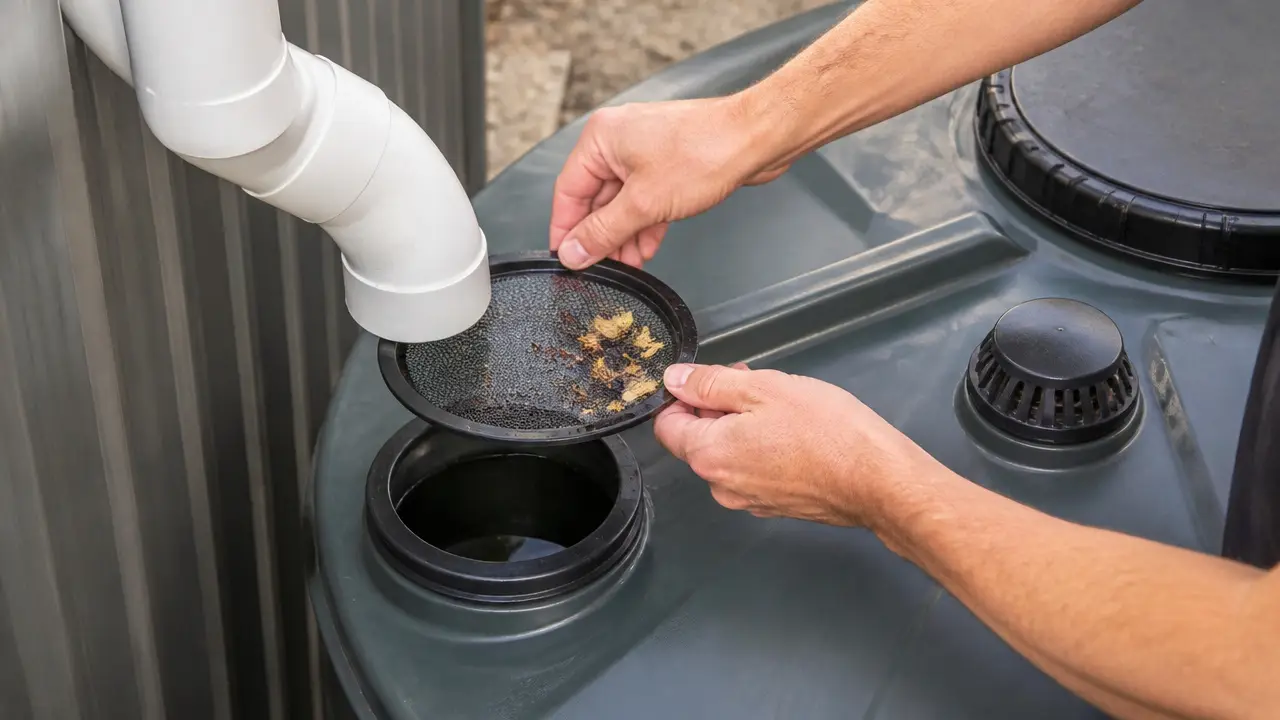
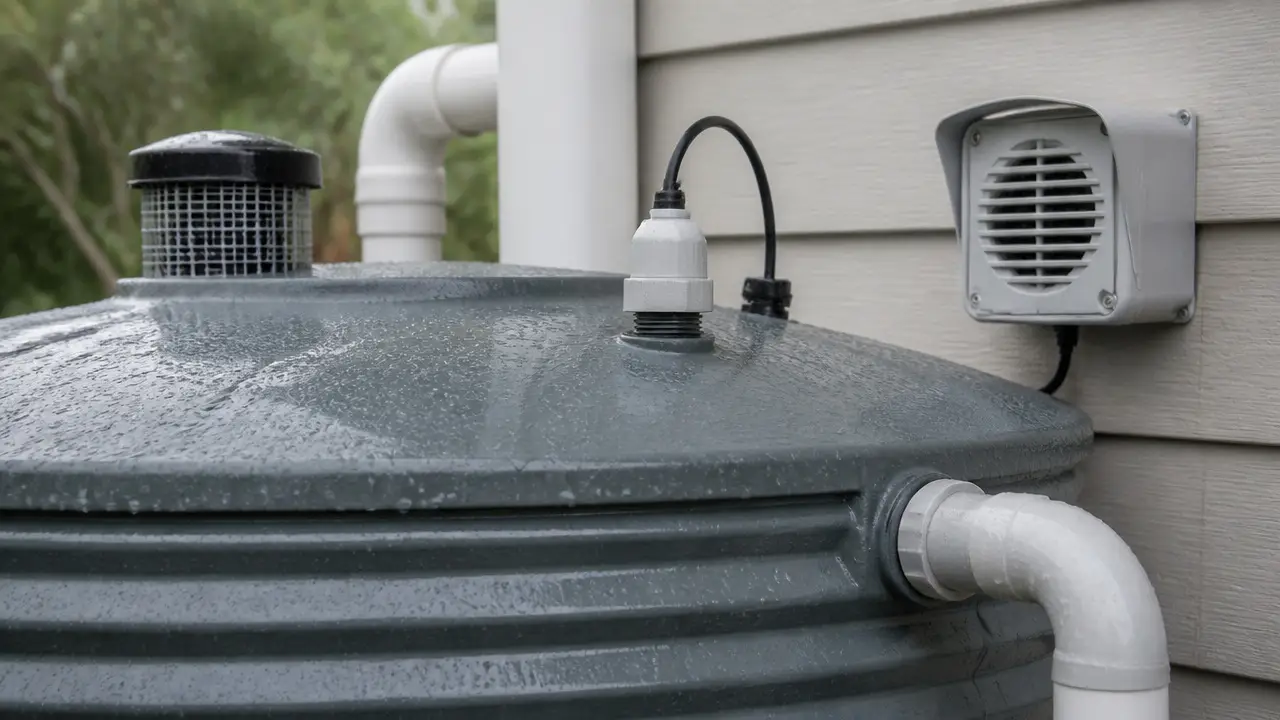
Detecting Leaks in a Rainwater Tank
A rainwater storage tank does not normally have a utility water meter to reveal leaks.
Tank-level monitoring can serve a similar purpose.
Choose a period when:
- no rain is expected
- no water is being used
- pumps are off
- irrigation is off
- overflow is not occurring
Record the water level.
Check it again later.
A falling level may indicate leakage, but first rule out normal losses and measurement errors.
Depending on the tank and climate, these can include evaporation or water being used by equipment connected to the tank.
Separate the Tank From the Plumbing
If possible, close the outlet valve from the tank.
Then monitor the tank separately from the downstream pipes.
If the tank level continues falling, inspect:
- tank walls
- tank seams
- outlet fittings
- bulkhead fittings
- valves
- drains
- connected hoses
A bulkhead fitting is a fitting that passes through the wall of a tank and creates a sealed connection for a pipe or valve.
If the tank level stays stable after the outlet is closed, the leak may be somewhere downstream.
This type of isolation is often much more useful than searching the entire rainwater system at once.
Acoustic Leak Detection
Once an underground pressurized leak has been confirmed, acoustic detection can be one of the best ways to locate it.
Water escaping from a pressurized pipe creates sound and vibration.
Professional equipment can listen for that sound through:
- pipes
- valves
- hydrants
- fittings
- the ground above the pipe
Some systems compare sound from sensors placed at two different points and estimate where the leak is located.
When Acoustic Detection Works Best
It tends to work better with:
- pressurized pipes
- continuous leaks
- known pipe routes
Results can become harder to interpret with very low-pressure systems or some plastic pipes because leak sounds may not travel as clearly.
Background noise can also interfere.
This is one reason acoustic detection is better viewed as a locating tool rather than a universal leak test.
Thermal Imaging
A thermal camera can sometimes reveal temperature differences caused by leaking water.
It can be useful for finding moisture behind:
- drywall
- ceilings
- floors
- some finished surfaces
But thermal cameras do not actually see water.
They measure surface temperature.
Insulation gaps, air leaks, sunlight, heating equipment, and building materials can create similar temperature patterns.
Thermal imaging is therefore best used with another method, such as a moisture meter.
Moisture Meters
Check practical what do plumbers use for leak detection to compare long-term maintenance priorities for the installation.
A moisture meter can help confirm whether a building material is unusually damp.
It is useful around:
- walls
- ceilings
- cabinets
- floors
- plumbing fixtures
It can help narrow the location of a leak after staining or thermal imaging suggests a problem.
The limitation is that a moisture meter detects moisture rather than the source of the moisture.
Water could have come from plumbing, rain intrusion, condensation, or an older leak.
Smart Leak Sensors
Electronic leak sensors can provide useful early warning.
Simple sensors sit near places such as:
- water heaters
- washing machines
- pumps
- filters
- toilets
- sinks
They sound an alarm or send a notification when water reaches the sensor.
More advanced systems monitor water flow through a supply pipe and look for unusual patterns.
Some can automatically close a valve.
These devices can reduce the time between a leak starting and someone noticing it.
However, they do not replace good system design or physical inspection.
A floor-mounted sensor only detects water that reaches the sensor. An underground leak may never do that.
Tracer Gas for Difficult Leaks
Professional leak specialists sometimes use tracer gas when ordinary methods cannot locate a buried leak.
A suitable gas mixture is introduced into an isolated pipe. Specialized equipment then looks for gas escaping through the ground or surrounding materials.
This can be useful when acoustic detection does not work well.
Tracer gas testing requires proper equipment and an understanding of the piping system. It is generally a professional leak-location method rather than a normal homeowner test.
A Practical Leak Detection Order
Using several methods in the right order is usually more reliable than starting with the most advanced equipment.
1. Check obvious water users
Look at toilets, faucets, valves, appliances, irrigation, pumps, and tank fittings.
2. Confirm that water is actually being lost
Use a water meter, pressure gauge, flow meter, or tank-level reading.
3. Isolate parts of the system
Close valves and divide the system into smaller sections.
Test each section separately.
4. Narrow down the problem
Determine whether the loss is coming from the tank, house plumbing, irrigation, underground pipe, or another branch.
5. Locate the exact leak
Use visual inspection, moisture testing, acoustic equipment, thermal imaging, or another suitable locating method.
This process prevents a common mistake: searching for a leak everywhere before confirming which section is actually losing water.
What About Leak Detection Dye?
Dye is useful for certain specific tests.
One common example is checking whether water is leaking from a toilet tank into the bowl.
Dye can also help track visible drainage or gravity flow.
It is much less useful for locating a hidden leak in a closed pressurized pipe.
Never add dyes or other chemicals to stored water without first considering the water's intended use and the effect on the system.
Rainwater Systems Need Extra Attention at Connections
Rainwater systems often have many places where small leaks can develop.
Common points include:
- tank outlets
- bulkhead fittings
- threaded adapters
- unions
- valves
- pump connections
- filter housings
- hose connections
- underground pipe joints
A fitting may leak only when the pump is running because pressure increases.
Another connection may leak slowly under gravity whenever the tank contains water.
Test the system under the conditions in which the leak normally appears.
Do Not Confuse Water Loss With a Leak
A changing water level does not always mean a pipe has failed.
Possible causes include:
- irrigation running automatically
- toilets refilling
- appliances using water
- pump priming
- filter flushing
- evaporation from open storage
- tank overflow
- inaccurate level measurements
Automatic equipment should be disabled or accounted for during a controlled test.
When to Call a Leak Detection Professional
Professional help makes sense when the leak is likely:
- beneath a concrete slab
- inside a wall with no clear access
- on a buried pressurized line
- near electrical equipment
- beneath a building
- in a large or complicated plumbing system
It may also be worth getting help when a meter or pressure test clearly shows water loss but repeated isolation tests cannot identify the affected section.
Breaking concrete, digging up pipes, or opening walls before locating the leak can create far more work than necessary.
Frequently Asked Questions
What is the most accurate way to tell whether a house has a water leak?
For a home connected through a water meter, shutting off all known water use and monitoring the meter is one of the most useful first tests. Continued flow indicates that water is still moving somewhere in the system.
Can a pressure gauge detect a small leak?
It can help detect leaks in an isolated pressurized section. A continuing pressure drop may indicate water loss, although temperature changes, trapped air, and plumbing equipment can also affect pressure.
What is the best method for finding an underground water leak?
First confirm and isolate the leak. Professional acoustic equipment is commonly useful for locating pressurized underground leaks. Tracer gas or other specialized methods may help when acoustic locating is difficult.
How can I tell if my rainwater tank is leaking?
Stop incoming rainwater and water use, record the tank level, and monitor it. Closing the tank outlet can help determine whether the loss is from the tank itself or the pipes connected to it.
Are electronic leak detectors reliable?
They can be very useful for early warning, especially near appliances and plumbing equipment. Their reliability depends on sensor location and the type of leak. They should supplement rather than replace isolation testing.
Can a thermal camera find a water leak?
It can sometimes show temperature patterns associated with moisture, but it does not directly detect water. Moisture testing or another method should be used to confirm the finding.
What is the best overall leak detection strategy?
Confirm water loss first, isolate sections of the system second, and then use a locating method appropriate for the remaining area. This approach is usually more dependable than relying on one leak-detection device.