As an affiliate, we may earn a commission from qualifying purchases. We get commissions for purchases made through links on this website from Amazon and other third parties.
Which Pipe Insulation Has the Highest R-Value?
Aerogel insulation usually has the highest R-value per inch among practical pipe insulation materials. It can provide strong insulation with a much thinner layer than fiberglass, rubber foam, or most rigid foam pipe insulation.
However, the insulation with the highest R-value is not always the best choice for a rainwater system. Cost, moisture resistance, pipe size, outdoor exposure, fittings, and the amount of space around the pipe can matter just as much.
For most home rainwater systems, rigid foam or closed-cell elastomeric foam is often easier to install. Aerogel becomes more useful when space is tight or when a very high R-value is needed without adding a thick insulation layer.
What R-Value Means for Pipe Insulation
R-value measures how strongly insulation slows heat movement.
A higher R-value means heat moves through the insulation more slowly.
For a rainwater pipe in winter, insulation helps slow the loss of heat from the water and pipe. For a cold-water pipe during warm weather, it can also reduce heat entering the pipe.
There are two numbers worth separating:
- R-value per inch tells you how well the material insulates for its thickness.
- Total R-value tells you how much insulation the complete installed layer provides.
A material with R-4 per inch installed 2 inches thick can provide more total insulation than a material rated near R-7 per inch installed only 1 inch thick.
Actual performance also changes with temperature, moisture, installation quality, and the specific insulation product.
Pipe Insulation R-Values Compared
Approximate insulation performance commonly falls into these ranges:
| Insulation type | Approximate R-value per inch | Common pipe use |
|---|---|---|
| Aerogel blanket | About R-8 to R-10 | High performance where space is limited |
| Polyisocyanurate rigid foam | About R-5.5 to R-6.5 | High-performance rigid pipe insulation |
| Polyurethane foam | About R-5.5 to R-6.5 | Rigid insulated pipe systems |
| Closed-cell elastomeric foam | About R-3.5 to R-4.5 | Water pipes, pumps, valves, and fittings |
| Fiberglass pipe insulation | About R-3 to R-4 | Indoor pipes and protected locations |
| Polyethylene foam | About R-3 to R-4 | Basic residential pipe insulation |
These numbers are useful for comparison, not as guaranteed specifications. Manufacturers may report different values based on temperature, density, thickness, and testing method.
Check the technical sheet for the insulation you plan to use.
Aerogel Has the Highest R-Value Per Inch
Aerogel pipe insulation is made from a very light material with extremely small air spaces. Those spaces make it difficult for heat to move through the material.
Its main advantage is simple: you can get a high R-value without making the insulation very thick.
That can help around:
- pipes installed close to walls
- crowded pump equipment
- valves and fittings
- large pipes where thick insulation would become bulky
- systems where clearance is limited
Aerogel blankets can also wrap around irregular shapes more easily than rigid foam shells.
But aerogel is not automatically the best insulation for an ordinary rain barrel or garden system. Many systems have enough room for thicker and simpler insulation.
Polyisocyanurate and Polyurethane Offer High R-Values
Rigid polyisocyanurate and polyurethane foams are also strong insulators.
They generally provide a higher R-value per inch than common fiberglass or flexible foam. Pipe insulation made from these materials may come as molded sections that fit around specific pipe diameters.
They can work well when you need both high insulation performance and a rigid protective layer.
Correct sizing matters. The inside diameter of the insulation needs to match the outside diameter of the pipe.
Gaps between sections can reduce the benefit of using a high-R insulation material.
Outdoor installations also need protection from sunlight, rain, physical damage, and other conditions listed by the insulation manufacturer.
Closed-Cell Foam Is Often More Practical Around Rainwater Pipes
Closed-cell elastomeric foam does not normally have the highest R-value per inch. But it has several features that make it useful around water systems.
It is flexible and can fit around:
- PVC pipe
- polyethylene pipe
- pump connections
- elbows
- valves
- short exposed pipe sections
Closed-cell construction also helps resist water vapor moving through the insulation.
That matters because wet insulation may perform much worse than dry insulation.
Flexible foam is often easier for a homeowner to fit around a small rainwater system than rigid insulation. It can be especially useful around complicated plumbing where rigid shells would require many cuts.
Still, seams and openings need attention. A long gap along the pipe can become a major weak point even when the insulation itself has a good R-value.
Fiberglass Can Provide Good Total R-Value
Fiberglass has a lower R-value per inch than aerogel or high-performance rigid foam, but it can still provide substantial insulation when installed thick enough.
It is commonly used around pipes in protected indoor areas.
Moisture is the main concern around rainwater equipment. Fiberglass insulation needs a suitable outer jacket or vapor barrier where condensation or water exposure could occur.
Once insulation becomes wet, its thermal performance can fall.
Outdoor rainwater pipes generally need a weather-resistant system rather than exposed fiberglass.
The Highest R-Value Does Not Guarantee Freeze Protection
Pipe insulation slows freezing. It does not prevent freezing forever.
Insulation does not create heat.
If an insulated pipe remains in freezing temperatures long enough, the water inside can eventually approach the surrounding temperature.
This is especially important for rainwater systems because they may contain long sections of pipe that do not have regular water flow.
Areas that deserve extra attention include:
- exposed outdoor pipes
- pump housings
- filters
- valves
- narrow tubing
- above-ground tank outlets
- pipes near exterior walls
- pipes exposed to wind
A small exposed fitting can sometimes freeze before a much longer insulated pipe.
Plan for the whole system
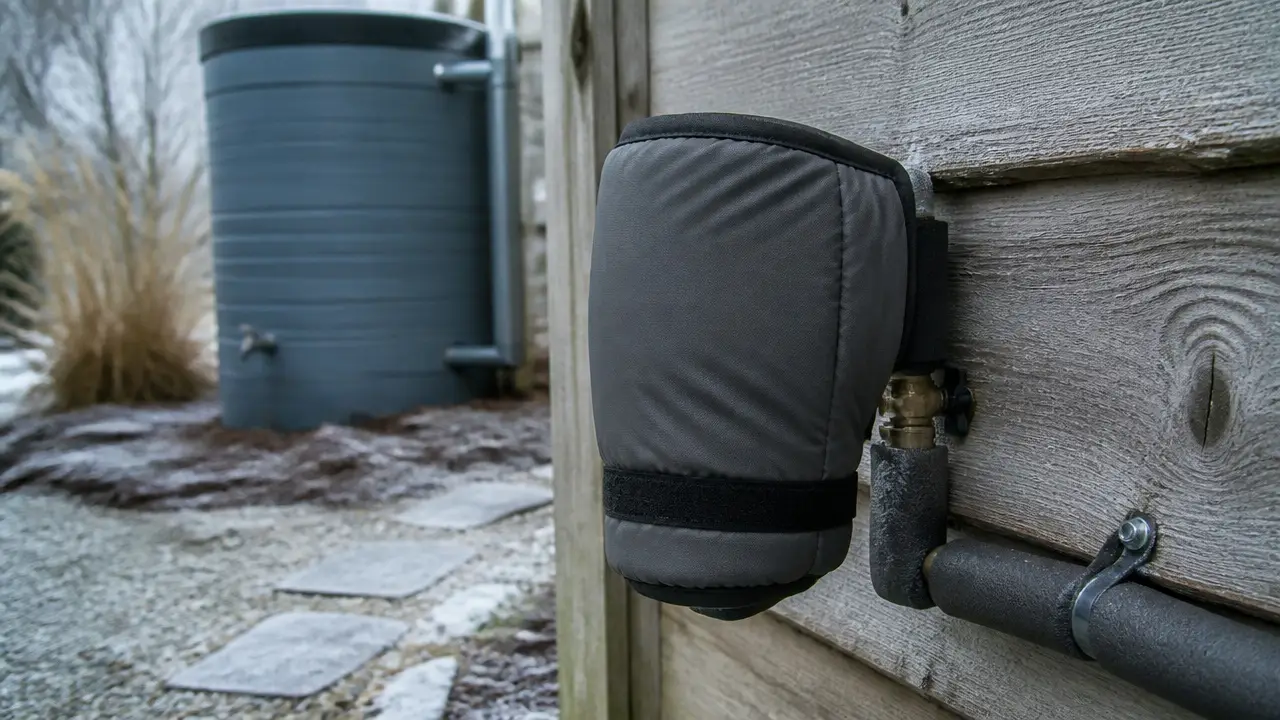
Review recommended pipe insulation options for rainwater systems to understand heating and insulation needs of the specific component.
In a freezing climate, protection may involve more than insulation.
Depending on the system, the safer approach may include draining seasonal lines, placing equipment in a protected enclosure, locating plumbing below the appropriate frost depth, or using an approved heating method where suitable.
Electrical heat cable must be compatible with the pipe and insulation and installed according to its instructions. Do not assume any heat cable is safe for every plastic pipe or insulation material.
Insulation Thickness Can Matter More Than Material
It is easy to focus only on R-value per inch.
Suppose one insulation provides roughly R-4 per inch while another provides R-6 per inch.
With enough room, 2 inches of the R-4 material may provide a greater total R-value than 1 inch of the R-6 material.
This is one reason a less expensive insulation can sometimes work well when there is plenty of clearance around the pipe.
Before choosing insulation, check:
- The pipe's outside diameter.
- The insulation's inside diameter.
- Available space around the pipe.
- Required insulation thickness.
- Whether the insulation can handle moisture and outdoor exposure.
- How elbows, valves, unions, and fittings will be covered.
The installation should form as continuous an insulation layer as practical.
Watch for Thermal Bridges
A thermal bridge is a spot where heat can move through the insulation more easily.
On piping, common thermal bridges include:
- gaps between insulation sections
- uncovered valves
- exposed pipe hangers
- poorly insulated elbows
- loose seams
- thin insulation around fittings
A very high-R insulation material will not perform as expected if several fittings remain uncovered.
For a rainwater system, inspect the entire water path rather than insulating only the straight sections of pipe.
Moisture Resistance Matters
Rainwater equipment is often installed in damp places.
Pipes may be near tanks, pumps, gutters, outdoor walls, or soil. Cold pipes can also develop condensation.
Some insulation materials handle moisture better than others.
Closed-cell insulation is usually easier to protect against moisture than open or fibrous insulation. Fiberglass and similar materials normally need a suitable jacket where water exposure is possible.
Outdoor insulation may also need a protective covering for UV light, weather, animals, and accidental damage.
Follow the insulation manufacturer's requirements for outdoor installation.
What Pipe Insulation Should You Choose?
Choose based on the problem you need to solve rather than R-value alone.
Choose aerogel when:
- maximum R-value per inch is important
- installation space is very limited
- thin insulation is necessary
- the system justifies a higher-performance material
Choose rigid polyurethane or polyisocyanurate when:
- you want high R-value
- there is room for rigid pipe sections
- the pipe diameter and fittings can be matched correctly
Choose closed-cell elastomeric foam when:
- you want a flexible material
- there are many elbows or fittings
- condensation or damp conditions are a concern
- you are insulating ordinary household or rainwater plumbing
Choose fiberglass when:
- the pipe is in a protected location
- there is room for thicker insulation
- the insulation can be kept dry and properly jacketed
For many rainwater systems, good installation and enough insulation thickness matter more than buying the material with the highest R-value per inch.
Insulating Rainwater Tank Pipes
Tank plumbing deserves special attention because the outlet is often close to the ground and exposed to outdoor temperatures.
Check the whole route from the tank to the point where the pipe reaches a protected area.
This may include:
- tank bulkhead fitting
- outlet valve
- pump inlet
- filters
- check valves
- pressure equipment
- above-ground supply pipe
A bulkhead fitting is a fitting that passes through the wall of a tank and creates a sealed pipe connection.
Insulating the pipe while leaving the valve and bulkhead area exposed may still leave an important freeze point.
Do not cover equipment in a way that blocks required ventilation, drainage, inspection, or service access.
Frequently Asked Questions
What pipe insulation has the highest R-value per inch?
Aerogel insulation generally provides one of the highest R-values per inch among practical pipe insulation materials. Exact values depend on the product and operating temperature.
Is R-6 pipe insulation better than R-4?
Per inch, yes. But total insulation thickness also matters. Two inches of an R-4-per-inch material can provide more total resistance to heat movement than one inch of an R-6 material.
What is the best insulation for outdoor water pipes?
There is no single best material for every installation. Closed-cell foam and rigid foam are common choices, but the insulation also needs suitable protection from weather, sunlight, moisture, and physical damage.
Will pipe insulation stop rainwater pipes from freezing?
Not by itself. Insulation slows heat loss but does not produce heat. Water in an exposed insulated pipe can still freeze during long periods of cold weather.
Is foam pipe insulation waterproof?
Some closed-cell foams resist moisture very well, but that does not mean every foam insulation product is waterproof or suitable for direct outdoor exposure. Check the manufacturer's instructions.
How thick should pipe insulation be?
The needed thickness depends on pipe size, water temperature, surrounding temperature, wind exposure, installation location, and the goal of the insulation. In freezing climates, insulation thickness should be part of a broader freeze-protection plan rather than treated as a guarantee against freezing.
Do I need to insulate valves and fittings too?
Yes, when freeze or heat loss protection matters. Valves, elbows, filters, and fittings can become weak points if the straight pipe is insulated but they are left exposed. Keep parts accessible when they require inspection or service.