As an affiliate, we may earn a commission from qualifying purchases. We get commissions for purchases made through links on this website from Amazon and other third parties.
A good rain barrel should do more than hold water. It should fit your available space, connect cleanly to your downspout, keep out debris and mosquitoes, and let you get water out without constant frustration.
For most homes, the best rain barrel is not simply the biggest one. Look at capacity, dimensions, overflow control, inlet screening, outlet location, connection size, material, stability, and ease of cleaning before you buy.
The right choice also depends on how you plan to use the water. A barrel for hand-watering containers has different needs from one feeding a garden hose or drip irrigation line.
Start With How You Plan to Use the Water
Before comparing barrels, decide what you want the stored rainwater to do.
Common uses include:
- Filling watering cans
- Watering container plants
- Supplying a short garden hose
- Feeding a gravity-powered drip line
- Storing water for garden use between storms
Rainwater collected from a roof is generally treated as non-potable water, meaning water that is not intended for drinking. Roof runoff can pick up dirt, animal waste, microorganisms, roofing material residues, and other contaminants.
Do not choose a basic rain barrel expecting the barrel itself to make roof runoff safe to drink. Drinking-water use requires a properly designed collection and treatment system, ongoing maintenance, appropriate testing, and compliance with applicable local requirements.
Choose a Capacity That Matches Your Roof and Space
Rain barrels come in many sizes, but residential barrels commonly hold several dozen gallons.
Bigger is useful only when you have enough runoff to fill the barrel and enough room to install it safely.
Roof runoff adds up quickly. In U.S. units, you can estimate theoretical collection with:
Gallons collected = roof area in square feet × rainfall in inches × 0.623
For example, 200 square feet of roof receiving 1 inch of rain produces about:
200 × 1 × 0.623 = 125 gallons
Actual collection will be lower because of losses from splash, gutter overflow, first-flush diversion, leaks, and other parts of the system.
This means even a modest roof section can fill a typical rain barrel during a good storm.
Do Not Ignore the Barrel's Footprint
Check the outside dimensions rather than looking only at capacity.
Measure:
- Available width
- Available depth
- Height below the downspout
- Clearance around the spigot
- Space needed to remove a lid or screen
- Room for an overflow hose
A narrow barrel may fit beside a house where a wider one will not, even if both hold about the same amount of water.
Make Sure the Barrel Has a Good Overflow System
Overflow is one of the most important features to examine.
Once the barrel fills, every additional gallon needs somewhere safe to go. A poorly designed overflow can dump water beside the foundation or flood the area around the barrel.
Look for a barrel with a dedicated overflow connection that can accept a hose or pipe.
Ideally, you should be able to direct that water toward an appropriate drainage area rather than letting it spill down the side of the container.
The overflow opening also needs enough capacity for the amount of water arriving from the roof. A tiny fitting may become a bottleneck during heavy rainfall.
If you connect several barrels together, remember that an overflow or linking system must still handle incoming water when all of the barrels are full.
Check the Inlet and Mosquito Protection
Roof runoff carries leaves, grit, seeds, insects, and other debris.
A useful rain barrel should have an inlet screen or another practical way to prevent larger debris from entering the tank.
The openings should also be protected against mosquitoes.
A screen only works if it stays securely in place. Look closely at how it attaches and whether you can remove it for cleaning.
You may also want additional debris control before the barrel, such as a gutter screen or downspout filter, depending on your roof and surrounding trees.
Some systems also use a first-flush diverter. This directs an initial portion of roof runoff away from storage so some of the dirt that accumulated on the roof is not sent directly into the barrel.
A first-flush device can reduce the contamination load, but it does not make collected rainwater automatically safe to drink.
Look Closely at the Spigot
The outlet may seem like a small detail until you start using the barrel every week.
Check four things:
Outlet Height
A spigot positioned very low allows you to use more of the stored water.
However, there still needs to be enough clearance underneath it for whatever you plan to connect.
If you want to fill watering cans or buckets, make sure they will fit beneath the outlet when the barrel is installed.
Connection Size
Find out what thread or fitting size the outlet uses.
This matters if you plan to attach:
- A garden hose
- A shutoff valve
- A hose adapter
- Drip irrigation tubing
- Another barrel
- A pump intake line
Avoid assuming that every rain-barrel outlet connects directly to a standard garden hose.
Fitting Design
Some barrels use fittings that pass through the wall of the container.
A bulkhead fitting is a sealed fitting that passes through the tank wall and creates a connection for a valve, hose, or pipe.
A sturdy, serviceable fitting is preferable to an outlet that is difficult to replace if it eventually leaks or becomes damaged.
Access for Repairs
Consider whether you can reach the inside of the barrel if the outlet fitting needs tightening or replacement.
On some closed barrels, replacing a fitting can be far more difficult than expected.
Understand Gravity Pressure Before Buying
A rain barrel does not provide household-style water pressure just because it has a hose connection.
Gravity creates only a small amount of pressure.
The important measurement is head height, which is the vertical distance between the water surface and the point where the water exits or is being used.
More height generally means more pressure.
As a useful rule of thumb, about 2.31 feet of water height produces roughly 1 psi of pressure.
That is far less than the pressure normally found in household plumbing.
A barrel can work very well for:
- Filling a watering can
- Slow hose watering close to the barrel
- Some low-pressure irrigation setups
It may struggle with:
- Long hoses
- Uphill watering
- Pressure-dependent sprinklers
- Some drip irrigation equipment
- Devices requiring a minimum operating pressure
If your irrigation equipment requires more pressure, you may need a pump designed for the job rather than relying on barrel height alone.
Check Whether the Barrel Can Be Raised Safely
Raising a barrel can provide useful clearance beneath the outlet and slightly improve gravity flow.
But water is heavy.
One U.S. gallon of water weighs about 8.34 pounds. That means 50 gallons of water alone weighs about 417 pounds, before adding the weight of the barrel and stand.
A full rain barrel therefore needs a firm, level, stable base.
If you use a stand, it needs to support the full expected load without tipping, sinking, or shifting.
Avoid improvised supports that could collapse. Stability becomes especially important around children, pets, walkways, sloped ground, or soft soil.
Choose a Material Suitable for Outdoor Water Storage
Evaluating drawbacks of using rain barrels helps assess long-term tank ventilation with dependable overflow handling.
Many rain barrels are made from plastic because it is lightweight when empty and does not rust.
When comparing materials, consider:
- Outdoor durability
- Resistance to sunlight
- Resistance to cracking
- Ease of cleaning
- Suitability for water storage
- Expected temperature range
If a barrel was previously used for something else, know its history before using it for rainwater storage.
Do not use a container that previously held hazardous chemicals, fuels, pesticides, or other substances that could contaminate stored water.
A Dark or Opaque Barrel Is Usually Better
Sunlight encourages algae growth.
An opaque barrel limits the amount of light reaching stored water and can help reduce algae compared with a clear or translucent container.
That does not eliminate the need for cleaning.
You still need to inspect the barrel periodically for:
- Sediment
- Organic debris
- Odors
- Algae
- Insect access
- Leaks
- Blocked screens
Location also matters. Keeping the barrel out of intense direct sunlight when practical can reduce heat and light exposure.
Make Sure You Can Clean It
A rain barrel will collect sediment sooner or later.
Before buying one, ask yourself how you will clean the bottom.
A removable lid or large access opening can make maintenance much easier.
A barrel with only small openings may be harder to scrub, rinse, or inspect internally.
Also check whether you can easily reach and clean:
- Inlet screens
- Overflow fittings
- Spigots
- Connecting hoses
- Downspout diverters
A system that is easy to maintain is more useful than one that looks tidy but is difficult to open.
Decide How the Downspout Will Connect
Not every barrel uses the same collection method.
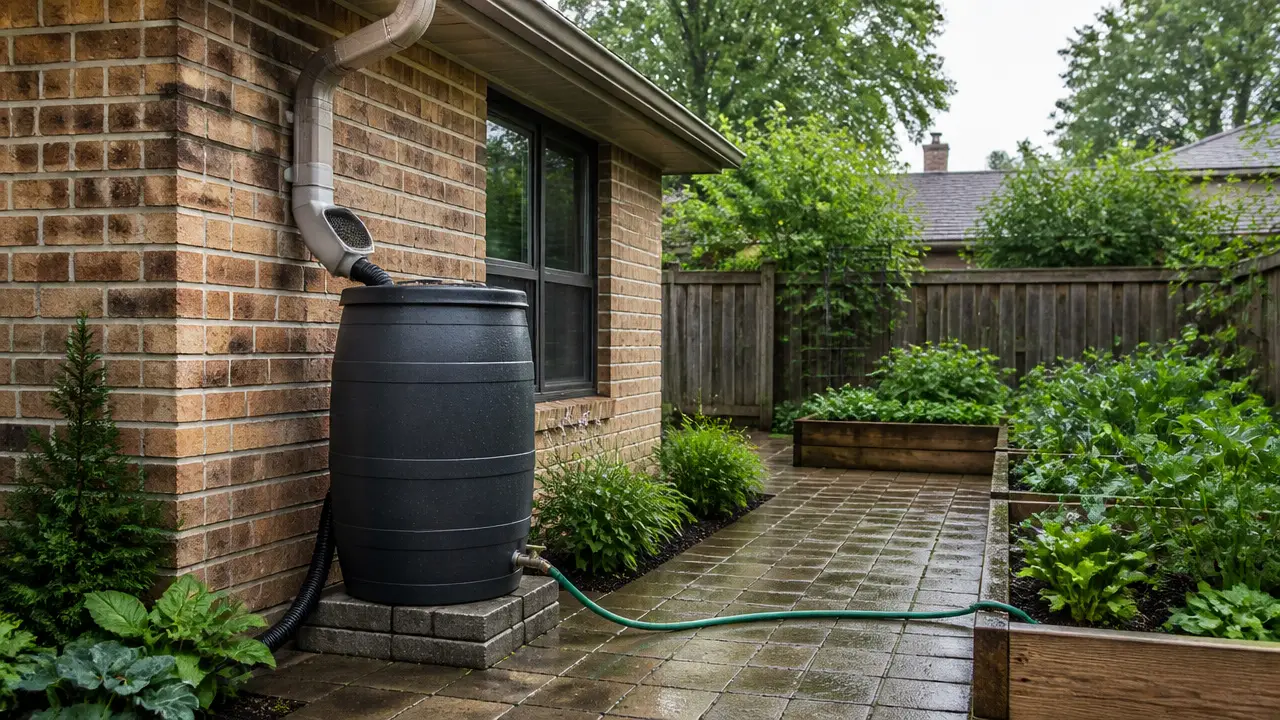
Two common arrangements are a direct downspout inlet and a downspout diverter.
Direct Downspout Connection
The downspout sends water directly into the top of the barrel.
When using this arrangement, you need a reliable overflow path once the barrel fills.
Downspout Diverter
A diverter installed in the downspout sends some water into the barrel.
Depending on its design, excess water may continue through the original downspout once the barrel is full.
Before choosing a barrel-and-diverter combination, check:
- Downspout dimensions
- Diverter compatibility
- Barrel inlet size
- Required installation height
- Hose or pipe connection size
- Overflow arrangement
Do not assume components from different systems will automatically fit together.
Think About Expansion Before You Buy
One barrel may not be enough once you see how quickly roof runoff fills it.
If you might add more storage later, look for barrels designed with accessible linking ports or fittings.
Barrels can sometimes be connected so water moves between them as they fill.
Pay attention to fitting height. The location of the connecting ports affects how water moves between containers and how much usable capacity you actually get.
Also make sure the final barrel in the system has a suitable overflow route.
For much larger storage needs, several small barrels may become less practical than a purpose-built cistern or tank.
Consider Freeze Protection
Freezing climates require extra planning.
Water expands as it freezes. Trapped water can damage:
- Barrels
- Valves
- Filters
- Hoses
- Fittings
- Pumps
- Diverters
Do not assume a barrel labeled for outdoor use can remain full through freezing weather.
Follow the manufacturer's winter-storage instructions. Depending on the system and climate, that may involve draining the barrel, disconnecting hoses, opening valves, bypassing the collection system, or storing components where they will not freeze.
Drainage needs to include fittings and small sections of hose where water could remain trapped.
Check the Lid and Child-Safety Design
An open barrel is not a suitable rainwater storage system.
The top should be securely covered.
A proper cover helps:
- Keep debris out
- Limit mosquito access
- Reduce accidental access
- Limit light entering the water
If the barrel will be located where children can reach it, choose a design with a secure lid or access cover that cannot easily be removed.
The barrel itself should also be stable enough that it cannot easily tip.
Watch for Decorative Features That Reduce Practicality
Some rain barrels are designed to resemble pottery, stone, wood, or planters.
There is nothing wrong with choosing one that looks good beside your house.
Just make sure appearance does not hide practical limitations.
Before buying a decorative barrel, check:
- Actual water capacity
- Outlet accessibility
- Overflow connection
- Screen accessibility
- Cleaning access
- Stability when full
- Compatibility with your downspout
The most useful barrel is the one you can install, use, drain, and maintain easily.
A Simple Rain Barrel Buying Checklist
Before choosing a barrel, confirm:
| What to check | Why it matters |
|---|---|
| Capacity | Determines how much runoff you can store |
| Outside dimensions | Ensures it fits the installation area |
| Stable base requirements | A full barrel is very heavy |
| Inlet screen | Helps keep larger debris and insects out |
| Secure lid | Limits contamination and accidental access |
| Overflow fitting | Gives excess stormwater somewhere safe to go |
| Spigot height | Affects access and usable water |
| Connection sizes | Determines whether hoses and other parts fit |
| Cleaning access | Makes sediment removal easier |
| Opaque walls | Helps limit light reaching stored water |
| Downspout compatibility | Prevents installation surprises |
| Linking ports | Makes future storage expansion easier |
| Winter requirements | Important where temperatures fall below freezing |
Frequently Asked Questions
What size rain barrel should I buy?
Choose a size based on your available space, roof collection area, rainfall pattern, and how quickly you will use the water. Even a relatively small roof area can produce enough runoff to fill a typical barrel during a single storm, so capacity alone should not determine your choice.
Is a 50-gallon rain barrel enough?
It can be useful for watering containers or a small garden, but it may fill quickly during rainfall. If you regularly need more water, you may eventually want multiple connected barrels or a larger storage tank.
Can I connect a garden hose directly to a rain barrel?
Sometimes. Check the outlet fitting before buying. Some barrels have garden-hose-compatible threads, while others require an adapter. Remember that gravity-fed barrel pressure is much lower than normal household water pressure.
Should a rain barrel have an overflow?
Yes. Once the barrel is full, additional roof runoff needs a controlled path away from the barrel and building. A dedicated overflow connection makes this much easier to manage.
Do rain barrels need mosquito screens?
Openings that mosquitoes could use to reach standing water should be properly screened or otherwise protected. Screens also need regular inspection because tears, gaps, and debris buildup can reduce their effectiveness.
Can I leave my rain barrel outside during winter?
That depends on the barrel design and your climate. In freezing areas, stored or trapped water can expand and damage barrels, valves, hoses, and fittings. Follow the manufacturer's winterization instructions and make sure components that need draining are actually empty.
Can I drink water from a rain barrel?
A basic rain barrel does not make roof runoff safe to drink. Drinking-water use requires suitable collection materials, appropriate treatment stages, maintenance, current water-quality testing, and compliance with applicable health and plumbing requirements. A qualified water-treatment professional or local health authority can help with systems intended for potable use.
What is the most important feature of a rain barrel?
There is no single feature that works for every installation, but overflow control, secure screening, usable outlets, cleaning access, and structural stability are especially important. A barrel that fits your downspout and intended use is usually a better choice than simply buying the largest container available.