As an affiliate, we may earn a commission from qualifying purchases. We get commissions for purchases made through links on this website from Amazon and other third parties.
The 200 rule for drip irrigation usually means the 200/200 rule for standard 1/2-inch polyethylene drip tubing:
- Keep one continuous run of 1/2-inch tubing at about 200 feet or less.
- Keep the combined flow of all emitters on that run at about 200 gallons per hour (GPH) or less.
It is a planning rule, not a universal engineering limit. Actual tubing diameter, water pressure, elevation, fittings, and manufacturer specifications can change how long a line can be and how much water it can carry. Colorado State University Extension also uses 200 feet and 200 GPH as conservative limits for typical 1/2-inch polyethylene tubing.
What Does the 200/200 Rule Mean?
The two numbers deal with different limits.
| Part of the rule | Meaning |
|---|---|
| 200 feet | Approximate maximum length of one 1/2-inch tubing run |
| 200 GPH | Approximate maximum combined emitter flow on that run |
You should generally stay within both limits.
For example, a 150-foot line using emitters with a combined output of 250 GPH exceeds the flow guideline even though the tubing is shorter than 200 feet.
A 250-foot line using only 40 GPH exceeds the simple length guideline even though its water demand is low. A low-flow system may sometimes work beyond 200 feet, but at that point you should check the tubing manufacturer's specifications rather than relying on the rule alone.
Why Is There a 200 Rule?
Water loses pressure as it travels through tubing. This is called friction loss.
The inside wall of the tubing creates resistance to moving water. Longer tubing creates more resistance. Trying to push more water through the same small tubing also increases the pressure loss.
If the pressure drops too much, emitters near the beginning of a line may deliver more water than emitters near the end.
The result can be:
- uneven watering
- weak flow at distant emitters
- poor performance from some drippers
- longer watering times to compensate for dry areas
The 200/200 rule gives homeowners a simple way to avoid pushing ordinary 1/2-inch tubing too far without doing detailed hydraulic calculations. University of California guidance describes the same basic relationship between tubing diameter, line length, flow, and friction loss.
The Rule Does Not Mean 200 Emitters
A common mistake is to read the 200 rule as "you can use 200 emitters."
The number of emitters depends on their flow rate.
Flow rate tells you how much water an emitter releases over time, usually in gallons per hour.
To calculate the total:
Number of emitters × flow per emitter = total GPH
For example:
- 100 emitters × 0.5 GPH = 50 GPH
- 100 emitters × 1 GPH = 100 GPH
- 100 emitters × 2 GPH = 200 GPH
- 50 emitters × 4 GPH = 200 GPH
Under the simple 200 GPH guideline, 100 two-GPH emitters would already use the full recommended flow capacity.
If you mix emitter sizes, add all their flows together.
For example:
- 40 × 1 GPH = 40 GPH
- 30 × 2 GPH = 60 GPH
- 10 × 4 GPH = 40 GPH
Total demand is 140 GPH.
Does the Rule Apply to Every 1/2-Inch Drip Tube?
No.
"1/2-inch tubing" is a broad description. Actual inside and outside diameters vary between tubing systems. Fittings are also not always interchangeable just because both packages say 1/2 inch.
Different manufacturers may allow different:
- maximum line lengths
- maximum flow rates
- operating pressures
- emitter spacing
- fitting sizes
Colorado State University notes that the 200 GPH figure is conservative and that some 1/2-inch tubing can carry more because tubing dimensions vary.
Use the 200/200 rule for early planning. Once you choose your tubing or dripline, use its published flow and run-length limits for the final layout.
What Happens If You Need More Than 200 Feet?
You usually do not have to abandon drip irrigation. You change the layout.
Split the system into shorter branches
Instead of one 300-foot line, a larger supply line can feed two shorter laterals.
This reduces the distance water must travel through the smaller tubing.
Create separate irrigation zones
A zone is a section of the irrigation system that runs at one time.
If the available water supply cannot operate all the emitters together, divide the garden into two or more zones and run them separately.
Use larger supply tubing
Larger-diameter tubing can carry more water with less friction loss.
For example, the commonly cited planning guideline for 3/4-inch tubing is much higher than the 200/200 guideline used for 1/2-inch tubing. However, do not choose tubing from a rule alone. Check the specific tubing's specifications and make sure its fittings, valves, filters, pressure regulators, and other parts match.
Reduce the required flow
A long line carrying a small amount of water may work differently from the same line carrying close to 200 GPH.
This is why line length and flow should be considered together rather than treating 200 feet as an absolute cutoff.
Your Water Source Must Supply the Required Flow
Staying below 200 GPH does not guarantee that your irrigation system will work.
Your water source must also be able to provide enough water.
Suppose your emitters require a combined 160 GPH. If the source can only provide 90 GPH under operating conditions, some emitters may not receive their expected flow.
Regarding key facts about the difference between emitter tubing and drip tubing, compare layout choices that balance flow among irrigation zones.
This matters with:
- household hose bibs
- wells
- pumps
- rainwater tanks
- elevated rain barrels
Measure or determine the available flow before designing a large zone.
The 200 Rule and Rainwater Irrigation
The rule needs extra care when the drip system is supplied by stored rainwater.
A normal household water connection may provide considerably more pressure than a gravity-fed rain barrel or tank.
With gravity systems, head height matters. Head height is the vertical distance between the water level in the tank and the irrigation outlet. More vertical height creates more available pressure.
That means a gravity-fed rainwater system can be well below 200 feet and 200 GPH and still perform poorly if its emitters require more pressure than the tank can provide.
Check:
- available pressure at the irrigation line
- emitter minimum operating pressure
- required flow
- filter requirements
- tubing size
- elevation changes
If a pump supplies the rainwater, size the irrigation zone around the pump's available flow and pressure at the same time, not its maximum advertised flow by itself.
Filters Also Affect Drip Performance
Drip emitters have small passages and can clog.
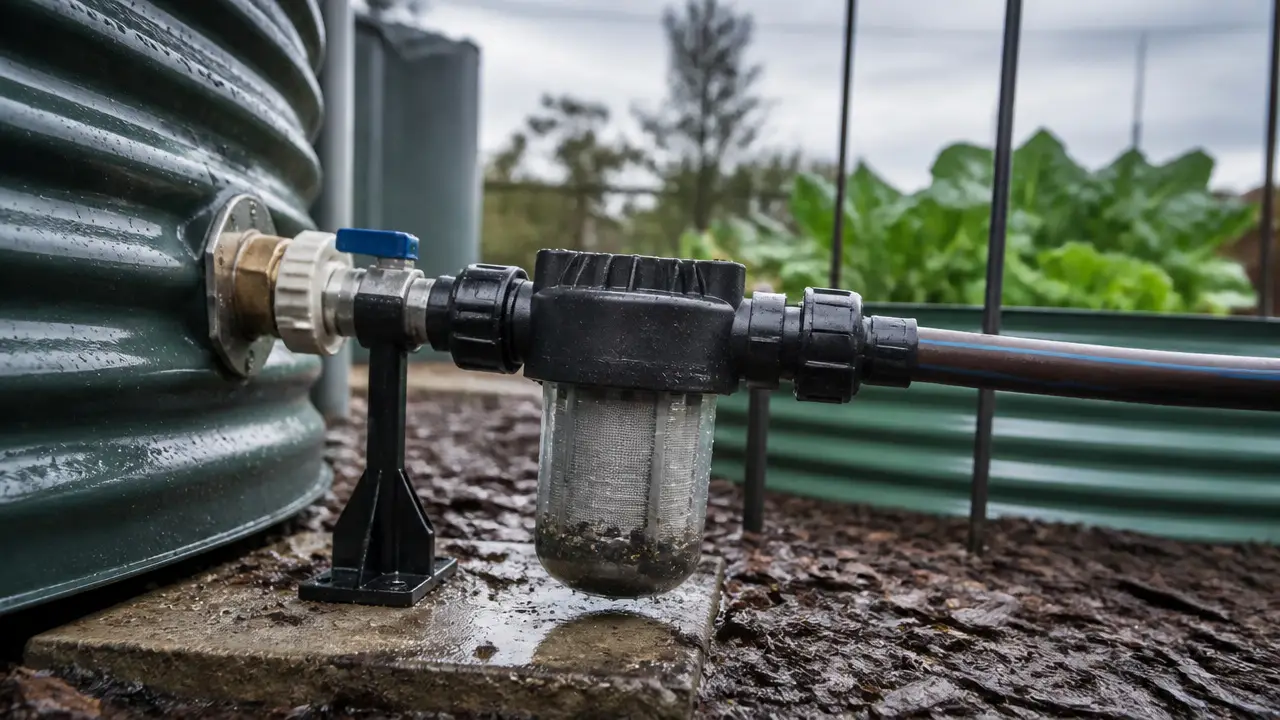
Rainwater systems can carry roof grit, organic debris, sediment, or material that settles inside a tank. A suitable irrigation filter helps protect the emitters.
A filter also causes some pressure loss, especially as it becomes dirty. The same is true of:
- pressure regulators
- valves
- long tubing runs
- small fittings
- sharp elevation changes
Do not design a system right at a theoretical maximum while ignoring these losses.
Flush the tubing periodically and clean or replace filtration components according to their requirements.
Does a Pressure Regulator Solve a Line That Is Too Long?
Not by itself.
A pressure regulator reduces excessive inlet pressure to a level suitable for the drip equipment. It does not create extra pressure at the end of an overloaded line.
If friction causes a major pressure drop through a long or high-flow section, adding a regulator cannot restore that lost pressure.
The better fix may be to:
- shorten the run
- divide it into branches
- reduce zone flow
- increase the supply tubing size
Pressure-compensating emitters can help maintain more consistent output across a reasonable pressure range, but they still need enough inlet pressure and flow to operate correctly.
A Simple Way to Use the 200 Rule
For a basic home system using ordinary 1/2-inch poly tubing:
- Measure the planned tubing run.
- Count the emitters.
- Find each emitter's rated GPH.
- Add their flow rates.
- Compare your design with the approximate 200-foot and 200-GPH limits.
- Check whether the water source can actually supply that flow.
- Check the tubing manufacturer's final length, flow, and pressure limits.
- Split or resize the system if necessary.
For example, consider a 120-foot garden line with 80 one-GPH emitters.
Total demand:
80 × 1 GPH = 80 GPH
Both the length and calculated flow are comfortably below the usual 200/200 planning guideline.
That still does not prove the system will work correctly. You also need suitable pressure, adequate source flow, compatible fittings, proper filtration, and acceptable elevation changes.
When the 200 Rule Is Not Enough
The simple rule becomes less useful for systems with:
- large elevation changes
- very long runs
- several branching laterals
- high-flow micro-sprayers
- very low-pressure gravity tanks
- pump-fed cisterns
- unusually small or large tubing
- commercial dripline
- buried irrigation
- many irrigation zones
For these systems, use manufacturer hydraulic charts or have the layout sized from expected flow, pressure, elevation, and pipe friction.
The important idea is not the number 200 itself. The goal is to keep enough pressure and flow throughout the system for every emitter to work as intended.
Frequently Asked Questions
What is the 200 rule for drip irrigation?
The 200 rule usually refers to the 200/200 guideline for standard 1/2-inch polyethylene tubing. Keep an individual run around 200 feet or less and combined emitter flow around 200 GPH or less. Actual limits depend on the tubing and system design.
Does the 200 rule mean I can install 200 emitters?
No. Add the flow rates of the emitters instead. Two hundred 1-GPH emitters require 200 GPH, while 200 two-GPH emitters require 400 GPH.
Can 1/2-inch drip tubing run farther than 200 feet?
Sometimes. A longer line with low water demand may work, and some tubing is designed for longer runs. Check the manufacturer's hydraulic specifications instead of assuming 200 feet is an absolute limit.
What happens if drip tubing is too long?
Pressure can fall as water travels through the tubing because of friction. Emitters near the far end may then provide less water than those near the source.
Should I use 3/4-inch tubing for a large drip system?
Larger tubing can make sense when you need longer runs or greater flow because it produces less friction loss at a given flow. Size it according to your actual system demand and the tubing manufacturer's limits.
Does the 200 rule work with a rain barrel?
The rule alone is not enough for a rain barrel. Gravity-fed rain barrels often have low pressure. The emitters must be able to work at the pressure created by the available head height, and the tank must supply enough flow.
Does a pressure regulator increase pressure at the end of a drip line?
No. A regulator limits excessive incoming pressure. It cannot make up for pressure lost because a tube is too small, too long, or carrying too much water.