As an affiliate, we may earn a commission from qualifying purchases. We get commissions for purchases made through links on this website from Amazon and other third parties.
JB Weld can fix some cracked plastic, but the repair depends on the type of plastic and how the part is used. It works best on hard, rigid plastics that the adhesive can grip. It is much less reliable on polyethylene and polypropylene, which are common in rain barrels, storage tanks, buckets, and other outdoor containers.
The important point is that JB Weld is a family of products, not one adhesive. The standard epoxy, PlasticWeld, and PlasticBonder do not all behave the same way on plastic.
Which Plastics Can JB Weld Repair?
J-B Weld says its Original epoxy can bond many rigid plastics, including PVC and CPVC. It does not recommend Original for flexible plastics, polypropylene, or polyethylene.
Its PlasticWeld products are made specifically for plastic repairs. However, the PlasticWeld epoxy putty also states that it does not adhere to polyethylene or polypropylene and recommends testing adhesion first.
That gives you a useful starting point:
| Plastic or part | JB Weld repair potential |
|---|---|
| PVC | Often a reasonable candidate |
| CPVC | Often a reasonable candidate |
| ABS and similar rigid plastics | May work; test adhesion first |
| Fiberglass or plastic composite | Often a reasonable candidate |
| Polyethylene, including many HDPE tanks | Poor candidate for most JB Weld products |
| Polypropylene | Poor candidate for most epoxy repairs |
| Soft or flexible plastic | Usually unreliable |
| Unknown plastic | Test before depending on the repair |
Do not assume that a hard-looking plastic is PVC. Many water-storage containers are made from polyethylene even though they feel very rigid.
Check the Plastic Type Before You Repair the Crack
Look for a molded recycling or material mark on the container or part.
Common markings include:
- HDPE or PE-HD for high-density polyethylene
- LDPE or PE-LD for low-density polyethylene
- PP for polypropylene
- PVC for polyvinyl chloride
- ABS for acrylonitrile butadiene styrene
HDPE is especially common in rain barrels, large water tanks, IBC tote bottles, drums, and outdoor containers.
Polyethylene has a low-energy surface. In simple terms, many adhesives have trouble wetting and gripping it strongly. A patch can appear solid when dry and then peel away after the tank flexes, fills with water, heats in the sun, or cools overnight.
That is why putting more epoxy over a failed polyethylene repair usually does not solve the underlying problem.
When JB Weld Can Be a Good Plastic Repair
JB Weld makes the most sense when all of these conditions are true:
- The plastic is compatible with the adhesive.
- The part is fairly rigid.
- The crack is small and stable.
- The repair will not carry a major structural load.
- The damaged area can be cleaned and dried.
- The surface can be lightly roughened.
- The part will not flex heavily during normal use.
A cracked rigid PVC housing, plastic cover, fitting body, or similar noncritical component may be a good candidate.
The repair becomes less dependable when the crack keeps opening and closing. A hard cured adhesive and a flexible plastic may move at different rates. Eventually, the bond can separate at the edge.
Why Rain Barrels and Water Tanks Are Harder to Patch
A water container puts more stress on a crack than an empty plastic object does.
Water creates pressure against the wall of the container. The pressure increases toward the bottom. At the same time, a large plastic tank changes shape slightly as it fills and empties.
Sunlight and temperature changes add more movement.
For that reason, a patch that holds on an empty rain barrel may begin leaking after the barrel is full.
This is especially important with polyethylene tanks. If the barrel or cistern is HDPE, standard JB Weld or PlasticWeld should not be treated as a dependable permanent repair. J-B Weld specifically lists polyethylene among the plastics for which several of its products are not recommended.
Depending on the damage, a better repair may involve plastic welding, a mechanically clamped fitting, or replacement of the damaged container.
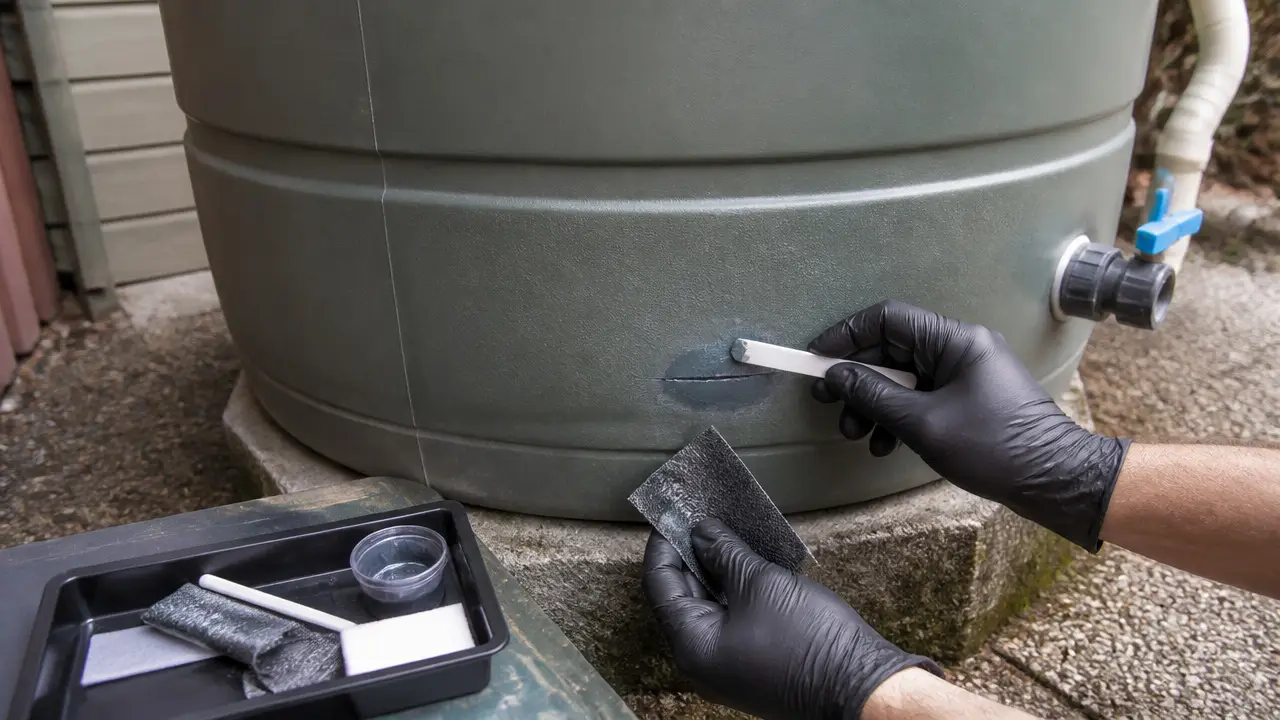
How to Use JB Weld on a Compatible Plastic Crack
Surface preparation matters almost as much as the adhesive itself. J-B Weld's PlasticBonder instructions call for removing dirt, grease, oil, paint, and loose material and roughening the surface for a better repair.
1. Empty and dry the part
Do not try to make a normal epoxy repair while water is pushing through the crack.
For a rain barrel or storage container, drain the water below the damaged area and let the surface dry.
Also remove any load that is causing the crack to spread.
2. Clean the damaged area
Remove:
- Dirt
- Algae
- Oil
- Soap residue
- Loose plastic
- Old adhesive
The surface needs to be clean enough for the adhesive to contact the plastic itself.
Allow it to dry completely unless the specific repair compound says otherwise.
3. Lightly roughen the surface
Smooth plastic gives adhesive very little texture to grip.
Light sanding around the crack can improve mechanical grip on compatible plastics. Do not grind deeply into a thin tank wall.
Clean away the sanding dust before applying the adhesive.
4. Mix the product correctly
Two-part products need the resin and hardener mixed as directed.
Poor mixing can leave soft spots that never develop their intended strength.
JB Weld products also have different working and curing times, so follow the directions for the exact product you have rather than assuming all JB Weld products cure the same way.
5. Cover more than the crack line
Do not simply place a thin line of adhesive directly over the visible crack.
A repair normally needs to extend onto sound plastic around the damaged area. This spreads stress over a wider surface.
For a deep crack or missing material, a product designed to fill gaps may make more sense than a thin adhesive layer.
6. Leave the repair alone while it cures
Do not refill a tank just because the adhesive feels hard on the surface.
Allow the full cure required by the product instructions. Low temperatures can also slow curing.
Once cured, inspect the repair before putting it back into normal service.
JB Weld Original vs. PlasticWeld vs. PlasticBonder
Evaluating recommended water tank patch kits for rainwater repairs helps assess a storage-tank design compatible with the location.
The product name matters.
J-B Weld Original
Original is a two-part epoxy that can bond many rigid plastics. J-B Weld lists PVC and CPVC among suitable plastics but does not recommend it for flexible plastic, polyethylene, or polypropylene.
It makes more sense for rigid parts than for a flexible plastic tank wall.
PlasticWeld
PlasticWeld is designed around plastic repair and is available in different forms.
The PlasticWeld epoxy putty can be shaped to fill cracks and missing areas, but J-B Weld states that the putty does not adhere to polyethylene or polypropylene.
Its syringe adhesive is intended for plastic, composite, PVC, fiberglass, and similar materials.
PlasticBonder
PlasticBonder is a two-part urethane adhesive rather than the same type of epoxy as Original.
J-B Weld describes it as suitable for many thermoplastics and composites. Its FAQ is more cautious about polypropylene, stating that it can guarantee cosmetic rather than structural repairs on polypropylene.
So even a product labeled for plastic should not automatically be trusted for every plastic tank.
When You Should Not Rely on an Adhesive Repair
A glued patch is not the right fix for every crack.
Consider replacing the damaged part or using another repair method when:
- The crack is growing.
- The plastic is brittle from age or sunlight.
- Several cracks are appearing.
- The tank wall is badly distorted.
- The crack surrounds a heavily loaded fitting.
- The container is pressurized.
- The repair would need to support significant weight.
- The plastic is polyethylene or polypropylene and the adhesive is not rated for it.
- Failure could cause serious flooding or property damage.
A crack around a rain-barrel spigot is a common example. Sometimes the problem is not simply a cracked wall. The fitting may have been overtightened, installed without enough support, or placed through a damaged hole.
In that case, covering the crack with epoxy does not correct the fitting problem.
A properly sized bulkhead fitting may be a better solution when the surrounding plastic is still sound. A bulkhead fitting passes through the tank wall and seals with a gasket and mechanical clamping force rather than relying only on adhesive.
What About a Cracked IBC Tote?
Most IBC tote bottles are made from HDPE.
That makes ordinary epoxy repair a poor choice for many IBC cracks.
Small surface damage is different from a crack through the bottle wall. If the inner bottle is leaking, especially near the bottom or around the outlet, remember that the repaired area will be exposed to water pressure whenever the tote is full.
Replacing the inner bottle or using a repair method specifically intended for that material is usually more dependable than assuming a general-purpose epoxy will permanently seal it.
Do not work inside an IBC tote or other enclosed tank. Confined spaces can present serious hazards.
Can JB Weld Be Used on a Drinking-Water Tank?
Do not assume an adhesive is suitable for potable water simply because it becomes hard and waterproof.
Potable means suitable for drinking.
For a drinking-water system, every material that contacts the water needs to be suitable for its intended use. The entire rainwater system also matters, including the roof, gutters, prefiltration, storage, treatment, plumbing, maintenance, and current laboratory testing.
A repaired rainwater tank should not be considered safe for drinking merely because the leak has stopped.
For potable-water storage, check the current certification and manufacturer instructions for the exact repair material and follow applicable local requirements. When there is uncertainty about a tank repair or water-contact material, replacement or professional repair is the safer choice.
The Bottom Line
JB Weld can fix cracked plastic when the plastic is compatible and the crack is suitable for an adhesive repair.
Rigid plastics such as PVC are much better candidates than polyethylene or polypropylene. Standard J-B Weld products and PlasticWeld should not be relied on for polyethylene tanks, which includes many rain barrels, drums, and IBC tote bottles.
Before repairing a water container, identify the plastic first. Then consider how much the wall flexes, where the crack is located, and what happens if the repair fails.
For a small crack in compatible rigid plastic, careful cleaning, roughening, mixing, application, and full curing can produce a useful repair. For a cracked polyethylene tank, a mechanical repair, plastic-welding method, or replacement is often the better path.
Frequently Asked Questions
Will JB Weld stick to HDPE plastic?
Most JB Weld epoxy products are poor choices for HDPE because HDPE is polyethylene. J-B Weld specifically states that several of its products are not recommended for or do not adhere to polyethylene.
Can JB Weld fix a cracked rain barrel?
Possibly, but first identify the plastic. Many rain barrels are polyethylene, which is difficult to bond with ordinary epoxy. A rigid PVC or compatible plastic container is a better candidate for an adhesive repair.
Can JB Weld seal a leaking plastic water tank?
It may seal a small crack in compatible rigid plastic, but stopping the initial leak does not prove the repair will survive a full tank. Water pressure, tank movement, temperature changes, and plastic type all affect durability.
Will PlasticWeld work on polyethylene?
J-B Weld states that its PlasticWeld epoxy putty does not adhere to polyethylene or polypropylene. It recommends testing adhesion because some other plastics can also be difficult to bond.
Should I sand plastic before applying JB Weld?
For compatible plastics, light roughening can improve mechanical grip. J-B Weld's PlasticBonder preparation instructions recommend cleaning the surface and roughening it with a file or coarse sandpaper for better adhesion.
Can JB Weld repair a crack around a rain-barrel spigot?
Sometimes, but first find out why the crack formed. An overtightened or poorly supported fitting can crack the tank again. If the surrounding wall is still sound, a properly installed bulkhead fitting may provide a better mechanical seal.
Is JB Weld safe for a potable rainwater tank?
Do not assume it is suitable simply because the cured repair is waterproof. For drinking-water systems, verify that the exact repair material is approved for the intended water-contact use and consider the safety of the whole collection, treatment, storage, and testing system.