As an affiliate, we may earn a commission from qualifying purchases. We get commissions for purchases made through links on this website from Amazon and other third parties.
Heat cables can use a noticeable amount of electricity, especially when they cover a long roof edge, gutter, or downspout and stay on for many hours.
A common roof-and-gutter cable uses about 5 watts per foot. Some self-regulating systems are rated around 5 to 8 watts per foot under stated test conditions, and their output can change with temperature. For example, Frost King lists its roof de-icing cables at 5 watts per foot, while King Electric lists a self-regulating roof-and-gutter cable at 8 watts per foot at 32°F.
That means a long installation can add up quickly. The key factors are cable length, watts per foot, and how many hours the system actually runs.
How Much Electricity Does a Heat Cable Use?
You can estimate electricity use with this simple formula:
Cable length × watts per foot = total watts
Then:
Total watts ÷ 1,000 × hours running = kilowatt-hours (kWh)
A kilowatt-hour is the unit your electric utility normally uses to measure electricity consumption.
For a 5-watt-per-foot cable:
| Cable length | Approximate power while on | Energy used in 8 hours |
|---|---|---|
| 30 ft | 150 watts | 1.2 kWh |
| 60 ft | 300 watts | 2.4 kWh |
| 100 ft | 500 watts | 4 kWh |
| 150 ft | 750 watts | 6 kWh |
| 200 ft | 1,000 watts | 8 kWh |
These numbers assume the cable draws its rated power continuously for the full eight hours.
Real use can be lower with thermostatic or moisture-based controls. Self-regulating cable can also change its heat output as conditions change.
A Long Roof Cable Can Use More Power Than You Expect
The wattage per foot sounds small until you multiply it by the full cable length.
A 100-foot, 5-watt-per-foot cable draws about:
100 × 5 = 500 watts
If it stays energized for 12 hours:
0.5 kW × 12 hours = 6 kWh
A 200-foot cable at the same rating draws about 1,000 watts. Run for 12 hours, it would use about 12 kWh.
Roof installations can also require much more cable than the straight length of the gutter. Cable may zigzag along the roof edge and continue through gutters and downspouts. Frost King, for example, notes that its roof layout can require substantially more cable than the roof-edge measurement alone.
So do not estimate power use from gutter length alone. Check the actual installed cable length.
Constant-Wattage and Self-Regulating Cables Use Power Differently
There are two common types of roof and gutter heat cable.
Constant-wattage cable
Constant-wattage cable produces roughly its rated heat output whenever it is powered.
A model rated at 5 watts per foot will therefore have fairly predictable electrical demand based on its length.
For example:
80 feet × 5 watts = 400 watts while energized
Many ready-made roof de-icing kits use this type of cable. Frost King and King Electric both list constant-wattage roof cables at 5 watts per foot.
Self-regulating cable
Self-regulating cable changes its heat output with surrounding conditions.
When the cable gets colder, it can produce more heat. When conditions get warmer, its output falls.
For example, WarmlyYours lists one self-regulating cable at 5 watts per foot at 50°F. Other self-regulating designs may have different ratings and operating curves.
This does not mean a self-regulating cable uses almost no electricity when conditions improve. It still uses power when energized. Check the manufacturer's electrical specifications rather than assuming a fixed number.
Leaving Heat Cable On All Winter Can Waste Electricity
Runtime often matters as much as cable length.
Roof and gutter heat cables are mainly meant to keep a drainage path open when snow melts and then reaches colder roof edges, gutters, or downspouts. They do not normally need to heat a dry roof through every cold day.
Frost King recommends powering its roof cable before snow and leaving it operating until the snow has melted, then disconnecting it once temperatures rise above freezing.
The correct operating method depends on the cable and its controls. Always follow the instructions for your system.
A cable that draws 500 watts for six hours uses much less energy than the same cable running continuously for several days.
Controls Can Reduce Unneeded Runtime
One way to limit electricity use is to control when the system operates.
Depending on the system, controls may respond to:
- Air temperature
- Roof or gutter temperature
- Snow or moisture
- A combination of temperature and moisture
A simple thermostat can prevent the cable from running during warm weather.
A snow-and-ice control can be more selective. It can keep the system off when conditions are cold but dry and turn it on when conditions are suitable for ice formation.
Controls must be compatible with the cable and its electrical load. Large or hardwired systems may also need relays, dedicated circuits, or other electrical equipment.
Do not add a household timer, thermostat, or controller unless the heat-cable manufacturer allows that setup.
Does Self-Regulating Cable Save Electricity?
It can reduce unnecessary heat output, but you should not assume it will always use less electricity than a constant-wattage cable.
Its actual consumption depends on:
- Cable length
- Outdoor temperature
- Whether the cable is in air, snow, ice, or water
- The cable's design
- How often the controller energizes it
Some self-regulating cables are specifically rated differently depending on temperature and surroundings. That is why comparing systems only by a single watts-per-foot number can be misleading.
Reviewing calculating household water use helps assess tank dimensions and fittings suited to the available space.
If electricity use matters, look at the manufacturer's power-output chart and the planned cable length.
Use Only as Much Cable as the System Needs
Using less cable can reduce electricity use, but you should not simply shorten a system without checking its design.
Roof cable is normally placed where meltwater needs a clear route. That may include:
- The lower roof edge
- Valleys where ice forms
- Gutters
- Downspouts
- Drain areas
The cable layout must follow the manufacturer's instructions.
Constant-wattage cables generally have strict rules about spacing, crossing, and overlap. Some should never touch or cross themselves because they can overheat.
Certain self-regulating cables can cross or overlap, but only if their instructions specifically allow it. Do not assume all heat cables can.
Heat Cable Is Not a Fix for the Cause of Ice Dams
If you are using large amounts of roof cable every winter, it is worth checking why ice keeps forming.
Ice dams often develop when heat from the building warms part of the roof while the roof edge stays cold. Snow melts higher on the roof and freezes again near the eaves.
Air sealing, attic insulation, and ventilation problems may therefore be part of the issue.
Heat cable can help provide a drainage path, but it does not correct every roof or building problem.
A roofing or insulation professional may be a better next step if ice dams are severe or appear every winter.
Heat Cables in Rainwater Harvesting Systems
Heat cable sometimes comes up around rainwater systems in freezing climates.
For example, a homeowner may want to keep a gutter or downspout from freezing so meltwater can drain correctly.
Be careful about treating heat cable as a complete winter solution.
It does not protect an entire rainwater system from freezing. Your:
- Rain barrel
- IBC tote
- Cistern connection
- Pump
- Filter housing
- Hose
- Valve
- Exposed pipe
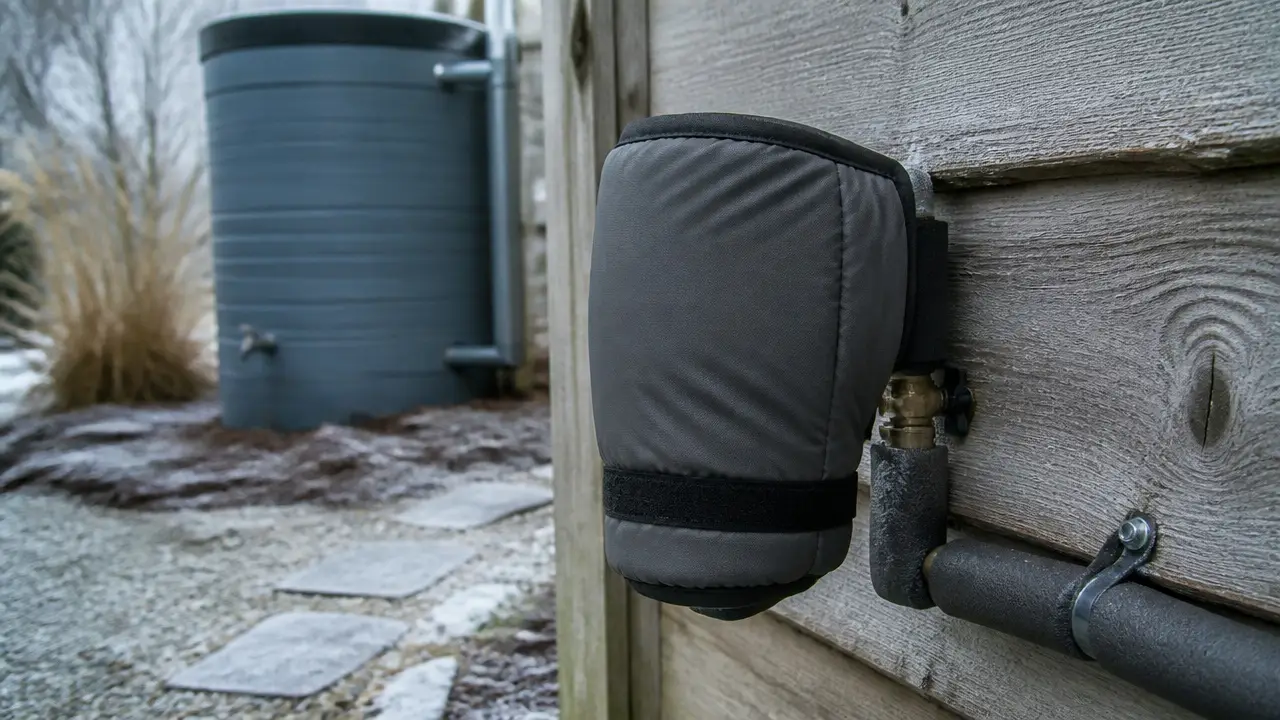
may still need to be drained, isolated, moved, insulated, or otherwise winterized.
If you stop collecting water during winter, keeping the full collection path heated may not be necessary. In some systems, routing winter runoff away from storage is simpler.
Never place ordinary roof heat cable on a water pipe, tank, hose, or other part unless its instructions specifically approve that use.
Electrical Safety Matters
Roof and gutter heat cable operates outdoors around water, snow, and ice. Installation must therefore follow the manufacturer's electrical requirements.
Use cable that is approved for the exact roof or gutter application. Some cables have restrictions based on roof material.
Ground-fault protection may also be required for heat-tracing installations. Some professional systems specify ground-fault equipment protection as part of the design.
Do not use damaged cable. Do not splice, shorten, cross, or modify a cable unless its design specifically allows it.
Roof work itself can also be dangerous. If installation requires working on a steep, icy, or high roof, use a qualified installer rather than trying to place the cable during winter conditions.
Hardwired systems and new circuits should be handled according to local electrical requirements, with a qualified electrician when needed.
How to Estimate Your Own Electricity Use
Start with the cable label or manufacturer's specifications.
Find:
- Installed cable length
- Watts per foot, or the total wattage listed for the cable
- Estimated hours of operation
For example, suppose you have 120 feet of cable rated at 5 watts per foot.
120 × 5 = 600 watts
Convert that to kilowatts:
600 ÷ 1,000 = 0.6 kW
If it runs for 10 hours:
0.6 × 10 = 6 kWh
If a thermostat or snow sensor switches the system off for part of the day, actual use will be lower.
For self-regulating cable, this calculation is only an estimate because power output can change with temperature.
Frequently Asked Questions
Do gutter heat cables use a lot of electricity?
They can. A short cable may use only a few hundred watts while running, while a long roof-and-gutter system can draw 1,000 watts or more. Cable length, watts per foot, and runtime determine total electricity use.
How many watts does a roof heat cable use?
It depends on the cable. Many constant-wattage roof cables are rated around 5 watts per foot. Self-regulating systems may have different ratings and can change their output with temperature. Check the specifications for your exact cable.
How much electricity does 100 feet of heat cable use?
At 5 watts per foot, 100 feet draws about 500 watts while operating. If it runs for eight hours, that equals about 4 kWh of electricity.
Should roof heat cables stay on all winter?
Usually not unless the manufacturer's control system is designed to manage them that way. Roof de-icing cable is generally needed when conditions can produce melting and refreezing. Follow the cable manufacturer's operating instructions.
Does a thermostat reduce heat-cable electricity use?
It can. A thermostat can keep the cable from operating when temperatures are too warm for it to be needed. Temperature-and-moisture controls can be even more selective when they are compatible with the heating system.
Does self-regulating heat cable turn itself completely off?
Not necessarily. Self-regulating cable changes its heat output as conditions change, but it may still draw electricity while energized. A separate controller may be used to switch the circuit off when heating is not needed.
Can heat cable keep a rainwater system from freezing?
Heat cable may help protect certain approved pipes, gutters, or downspouts, but it is not a complete freeze-protection plan. Tanks, pumps, valves, filters, hoses, and exposed plumbing may still need proper winterization.