As an affiliate, we may earn a commission from qualifying purchases. We get commissions for purchases made through links on this website from Amazon and other third parties.
For most exposed water pipes, the best pipe heating cable is a self-regulating heating cable specifically rated for pipe freeze protection. Choose one that is approved for your pipe material, outdoor or wet conditions if needed, and the lowest temperatures your system may face.
Self-regulating cable is usually a better fit than basic constant-output heat tape because it changes its heat output as temperatures change. But the cable still has to be sized, installed, insulated, and powered exactly as its instructions require.
What Type of Pipe Heating Cable Is Best?
There are two common types of pipe heating cable.
Self-Regulating Heating Cable
Self-regulating cable increases its heat output as the surrounding temperature drops. As the cable warms, its output decreases.
That makes it well suited to:
- Exposed household water pipes
- Rainwater supply lines
- Aboveground cistern plumbing
- IBC tote outlet plumbing
- Cabin water lines
- Pump and irrigation piping that cannot be drained for winter
Self-regulating does not mean you can install the cable any way you want. Some cables permit crossing or overlapping while others have specific restrictions. Always follow the installation instructions for the exact cable.
For most residential freeze-protection jobs, this is the type I would choose first.
Constant-Wattage Heating Cable
Constant-wattage cable supplies a more consistent amount of heat while it is powered.
It can work well when a system has been designed around a specific heat requirement. However, installation details matter more. Incorrect spacing, crossing, insulation, or temperature control can create problems.
For a simple residential pipe that only needs freeze protection, a properly selected self-regulating cable is usually easier to match to changing conditions.
How to Choose the Right Pipe Heating Cable
Do not choose heating cable based only on its length. Several parts of the system determine whether it can protect the pipe.
Start With the Pipe Material
Check whether the cable is approved for your pipe.
Common pipe materials include:
- Copper
- Steel
- PVC
- CPVC
- PEX
- Other plastic water pipe
A heating cable that works on metal pipe is not automatically suitable for plastic pipe.
Metal transfers heat quickly. Plastic does not transfer heat in the same way. Some systems approved for plastic pipe require aluminum tape or another specified installation method to distribute heat.
Do not add aluminum tape unless the cable manufacturer calls for it.
Measure the Pipe Diameter
Pipe diameter affects heat loss.
A small water line generally requires less heat to protect than a large pipe exposed to the same conditions.
Measure or identify the pipe size before buying cable. Do not assume that one cable will work equally well on every pipe diameter.
Measure the Actual Pipe Length
Measure every section that requires freeze protection.
Include fittings, valves, and other components only according to the manufacturer's sizing instructions. Some systems require additional cable around valves or other areas with greater heat loss.
Do not simply buy extra cable and coil the excess around the pipe.
The U.S. Consumer Product Safety Commission advises buyers to match heating cable to the diameter and length of the pipe and to follow the manufacturer's installation instructions.
Check the Lowest Expected Temperature
A heating cable that can protect a pipe during a mild frost may not provide enough heat during a much colder winter.
Manufacturers commonly size freeze-protection systems using factors such as:
- Pipe size
- Pipe material
- Minimum outdoor temperature
- Desired pipe temperature
- Insulation type
- Insulation thickness
- Available voltage
These variables matter more than choosing the cable with the highest watts-per-foot number.
Look at the Insulation Requirement
Heating cable and pipe insulation normally work together.
The cable adds heat. Insulation slows the rate at which that heat escapes.
A heating cable should normally be installed against the pipe as directed, with approved insulation installed over the completed system when the manufacturer's instructions call for it.
Do not place heating cable over existing pipe insulation unless that particular system is designed to be installed that way.
Also avoid adding extra insulation just because more seems better. CPSC warns that heating cables should only be insulated according to their instructions because unsuitable installation or excessive insulation can create a fire hazard.
How Much Heating Power Do You Need?
Heating cable output is often given in watts per foot, or watts per meter.
This tells you how much heat the cable can produce along the pipe. With self-regulating cable, the actual output also changes with temperature.
There is no single watts-per-foot rating that is best for every water pipe.
The required output depends on heat loss from the pipe. A larger pipe, thinner insulation, stronger wind exposure, or lower outdoor temperature can increase the amount of heat required.
For example, current professional heat-tracing selection guidance uses pipe size and material, insulation thickness, desired maintenance temperature, minimum ambient temperature, voltage, and other conditions when selecting cable output.
For a home installation, the safest approach is to use the sizing table supplied with the heating cable rather than calculating a wattage from a generic rule of thumb.
Best Pipe Heating Cable for Plastic Pipe
For PVC, CPVC, PEX, and other plastic pipes, choose a heating cable that specifically says it can be used on that pipe material.
This point is especially important in rainwater systems because plastic plumbing is common around barrels, tanks, pumps, and garden lines.
Do not assume a cable intended for copper pipe is safe for PVC or PEX.
The instructions may specify:
- How the cable should be attached
- Whether aluminum tape is required
- What insulation can be used
- Maximum cable length
- Whether the cable can cross itself
- Where the thermostat or temperature sensor should go
Follow those requirements rather than adapting instructions from another heating cable.
Best Pipe Heating Cable for Outdoor Use
Outdoor installations need more than cold-weather capability.
The cable and its electrical connections must be suitable for the environment where they will operate.
Look for a system specifically intended for outdoor pipe freeze protection when protecting exposed plumbing such as:
- Rainwater tank outlet pipes
- Aboveground pump lines
- Cabin supply lines
- Exterior hose bib plumbing
- Cistern plumbing
- Irrigation supply pipes
Weatherproofing matters too. A cable may tolerate cold conditions while its plug or connection kit still needs a dry or protected location.
For example, residential self-regulating systems may require the insulated pipe to be weatherproofed and may place specific restrictions on the electrical connection.
Never assume that an indoor heating cable can simply be wrapped in plastic and used outdoors.
Heating Cable for Rainwater Systems
Pipe heating cable can be useful in a rainwater harvesting system, but first decide whether the pipe actually needs to stay full of water during winter.
For seasonal garden systems, draining the plumbing is often simpler than heating it.
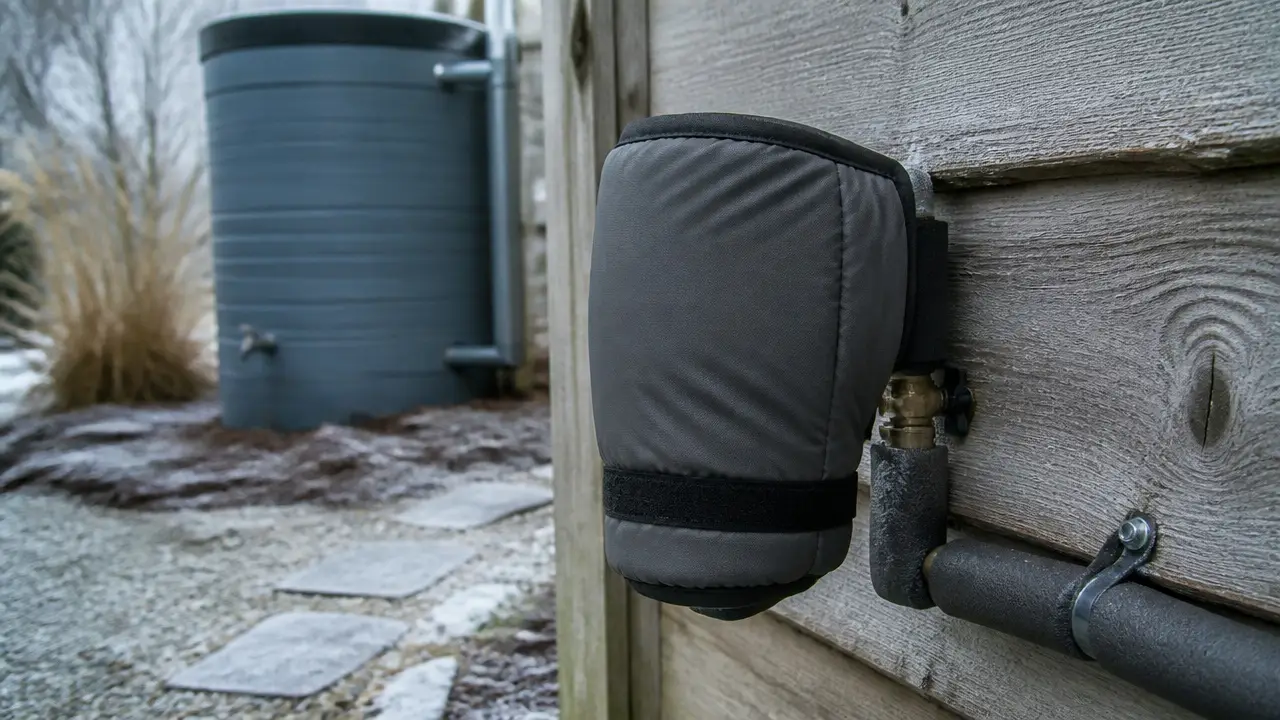
Use winter coverings for exposed water pipes to evaluate safe mounting and control of cold-weather equipment.
A typical winter shutdown might allow you to drain:
- Garden hoses
- Exposed irrigation branches
- Barrel outlet pipes
- Pump plumbing
- Filters that are not used during winter
Heating cable becomes more useful when a water line needs to remain operational through freezing weather.
Pay Attention to Valves and Fittings
Valves, filters, pumps, and large fittings can lose heat differently from a straight pipe.
Do not assume that running cable along the straight pipe protects every attached component.
Check whether the heating system's instructions provide a method for valves and fittings.
Some equipment should instead be drained, moved indoors, insulated separately, or protected using a system specifically designed for that component.
Do Not Use Pipe Cable to Heat a Water Tank
Pipe freeze-protection cable is designed for pipes unless its manufacturer explicitly lists other applications.
Do not wrap ordinary pipe heating cable around an IBC tote, rain barrel, or cistern and assume it will safely keep the whole tank from freezing.
Tank freeze protection involves a much larger volume of water and different electrical and heat-transfer conditions.
Thermostat-Controlled vs. Self-Regulating Cable
These terms describe two different things.
Self-regulating describes how the heating cable changes its heat output.
A thermostat or temperature controller determines when electrical power is supplied to the heating system.
Some self-regulating systems still use thermostatic controls. This can reduce unnecessary operation when freeze protection is not needed. Commercial heat-tracing systems commonly offer ambient- or pipe-temperature controls for this purpose.
Do not add a third-party thermostat unless it is suitable for the cable's electrical load and installation.
Electrical Safety Matters
Pipe heating cable combines electricity with places where condensation, leaks, snow, or rain may occur.
Use a properly grounded electrical supply and the ground-fault protection required by the cable instructions and applicable electrical rules.
Do not use a damaged cable.
Replace a heating cable if you find problems such as:
- Cracked insulation
- Exposed conductors
- Burn or char marks
- Damaged plugs
- Damaged connection points
CPSC specifically recommends replacing heat tape or cable with cracked covering, exposed wire, or charring.
If the installation requires a new outdoor receptacle, permanent hard-wiring, changes to a circuit, or electrical work you are not qualified to perform, use a qualified electrician.
Can You Overlap Heating Cable?
Only when the instructions for that exact cable say you can.
Some self-regulating cables are designed to tolerate crossing or overlapping under specified conditions. Other heating tapes and cables must never overlap.
Never use the general claim that "self-regulating cable can overlap" as an installation rule for an unknown product.
CPSC recommends against lapping heat tape over itself unless the manufacturer specifically permits it.
Should Heating Cable Be Covered With Insulation?
Usually, a pipe freeze-protection system works best when suitable pipe insulation is part of the design.
But the sequence matters.
Heating cable is generally attached directly to the pipe according to its instructions. Approved pipe insulation is then installed over the system when required.
The insulation type and thickness affect how much heating capacity is needed. They may also affect the safe operating temperature of the cable.
Follow the cable manufacturer's insulation limits instead of adding layers until the pipe "looks protected."
Features Worth Looking For
For a normal home water-pipe installation, prioritize compatibility and safety over convenience features.
A good pipe freeze-protection system should have:
| Feature | Why It Matters |
|---|---|
| Self-regulating operation | Adjusts heat output as temperature changes |
| Pipe-material approval | Confirms suitability for your metal or plastic pipe |
| Correct temperature range | Helps match the cable to your winter conditions |
| Outdoor approval when needed | Important for exposed rainwater and utility piping |
| Appropriate ground-fault protection | Important around water and damp locations |
| Clear sizing chart | Helps match cable to pipe diameter, insulation, and temperature |
| Suitable connection system | Prevents improvised electrical connections |
| Available installation instructions | Essential for correct attachment and insulation |
A long warranty or high wattage number does not compensate for the wrong pipe compatibility or an unsuitable installation.
Common Mistakes to Avoid
One of the biggest mistakes is treating heating cable like ordinary electrical wire.
Avoid:
- Using cable on a pipe material it is not approved for
- Guessing the required wattage
- Covering cable with unsuitable insulation
- Crossing or overlapping cable without permission
- Leaving extra cable coiled around the pipe
- Using indoor-only connections outdoors
- Running damaged cable
- Ignoring valves and exposed fittings
- Using pipe cable as a tank heater
- Installing cable over insulation when it should contact the pipe
- Using an extension cord unless the manufacturer's instructions specifically permit the arrangement
- Modifying plugs, end seals, or connection kits
The exact installation instructions supplied with the heating system take priority over generic advice.
The Best Choice for Most Homeowners
For an exposed residential water pipe, I would normally start with a self-regulating pipe freeze-protection cable approved for the specific pipe material and installation location.
Then check four things before buying:
- Your pipe diameter and material
- The length requiring protection
- The lowest expected outdoor temperature
- The insulation required by the cable manufacturer
For a small rainwater or garden system that is not needed during winter, draining the line may be simpler and more reliable than adding electrical freeze protection.
For permanent household plumbing, long pipe runs, buried systems, pump systems, unusually cold climates, or installations requiring hard-wired electrical equipment, have the heating requirement and electrical setup checked by qualified professionals.
Frequently Asked Questions
Is self-regulating heating cable better than heat tape?
For many residential pipe freeze-protection jobs, yes. Self-regulating cable changes its heat output with temperature and is often easier to use across pipes with changing conditions. It still must be properly sized and installed according to its instructions.
Can I put pipe heating cable on PEX?
Only if the heating cable is specifically approved for PEX or the type of plastic pipe you have. Follow any requirements for attachment tape, heat distribution, insulation, and cable spacing.
Can heating cable be used on PVC pipe?
Some heating cables can be used on PVC, but not all of them. Check the manufacturer's listed pipe materials before installation rather than assuming a cable intended for metal pipe is suitable.
Do I need insulation over pipe heating cable?
Many freeze-protection systems require suitable insulation over the cable and pipe. The insulation type and thickness are part of the heating system's design, so follow the cable manufacturer's instructions.
Can pipe heating cable overlap itself?
Only if the manufacturer specifically allows it for that cable. Do not overlap an unknown heating cable simply because it is described as self-regulating.
Should I leave pipe heating cable plugged in all winter?
Follow the control and operating instructions supplied with the system. Some systems use self-regulating cable, thermostats, or temperature controllers to reduce heating when it is not needed.
Can I use pipe heating cable on a rain barrel or IBC tote?
Do not use ordinary pipe freeze-protection cable as a tank heater unless the manufacturer specifically approves that application. Protect exposed plumbing separately, and consider draining seasonal components when they are not needed during freezing weather.
How do I know what wattage heating cable I need?
Use the manufacturer's sizing chart. Required heating capacity depends on pipe diameter, pipe material, insulation, minimum outdoor temperature, and other installation conditions. There is no single watts-per-foot rating that works for every pipe.