As an affiliate, we may earn a commission from qualifying purchases. We get commissions for purchases made through links on this website from Amazon and other third parties.
Will Flex Seal Bond to Polyethylene?
Flex Seal may stick to polyethylene at first, but you should not count on a strong, permanent bond.
Polyethylene, including HDPE used in many rain barrels, IBC totes, and water tanks, is a low-surface-energy plastic. That means many coatings, tapes, glues, and sealants have trouble gripping it. 3M lists polyethylene among plastics that are especially difficult to bond.
Flex Seal's own guidance also gives reasons to be cautious. The listed surfaces for Flex Seal Spray include materials such as PVC, metal, fiberglass, concrete, and wood, but polyethylene is not on that list. Flex Seal also notes that its epoxy products can have difficulty adhering to polyethylene.
For a polyethylene rain barrel or tank, Flex Seal is therefore better viewed as a possible temporary, low-stress patch than as a dependable permanent repair.
Why Polyethylene Is Hard to Seal
Polyethylene has a surface that naturally resists many adhesives.
A liquid adhesive needs to spread over, or "wet," a surface before it can form a good bond. On polyethylene, liquids tend to resist spreading. Even a strong adhesive can cure properly but still peel away from the plastic because it never formed a strong connection with the surface.
This is why polyethylene containers can be frustrating to repair. A patch may look solid when the tank is empty and then start lifting when the tank is filled.
Water storage adds several stresses:
- The tank wall can flex as the water level changes.
- Sunlight can heat and cool the plastic.
- Outdoor temperatures cause expansion and contraction.
- Water pushes continuously against cracks and patches.
- Fittings can pull or twist the tank wall.
A coating that sticks during a quick test may not survive these conditions for long.
Does the Type of Polyethylene Matter?
Yes, although most common polyethylene types are still difficult to bond.
Many rainwater containers are made from HDPE, or high-density polyethylene. Look for an HDPE or recycling number 2 marking on the container.
HDPE is common in:
- rain barrels
- IBC tote bottles
- large water tanks
- chemical drums
- storage containers
Other polyethylene types can have somewhat different properties, but polyethylene as a group remains a low-surface-energy material.
If you do not know what plastic you have, check the molded markings before choosing a repair method. PVC, ABS, polypropylene, and polyethylene do not behave the same way with adhesives.
Can Surface Preparation Make Flex Seal Stick Better?
A clean, dry surface generally gives any coating a better chance of sticking. Flex Seal also recommends clean, dry surfaces for best adhesion.
Cleaning, however, does not change the basic problem with polyethylene.
Removing dirt, algae, oil, and loose material can improve contact. Light surface roughness may also give some coatings more area to grip. But sanding alone does not turn ordinary adhesive into an adhesive designed for polyethylene.
Industrial polyethylene bonding sometimes uses special primers, chemical treatments, plasma treatment, or other surface-treatment methods. Specialty adhesives can also be formulated specifically for low-surface-energy plastic.
Those methods should not be confused with simply cleaning or sanding a rain barrel.
Avoid improvised flame treatment around a plastic tank. It can damage or weaken the container and creates unnecessary fire risk.
What About Flex Seal Spray?
Flex Seal Spray forms a flexible rubberized coating.
The manufacturer's current surface list includes PVC and several other materials, but does not specifically list polyethylene.
That does not mean the coating will immediately fall off every polyethylene surface. Plastic formulations, weathering, surface condition, and application can all change the result.
It does mean you should not assume the bond will be dependable.
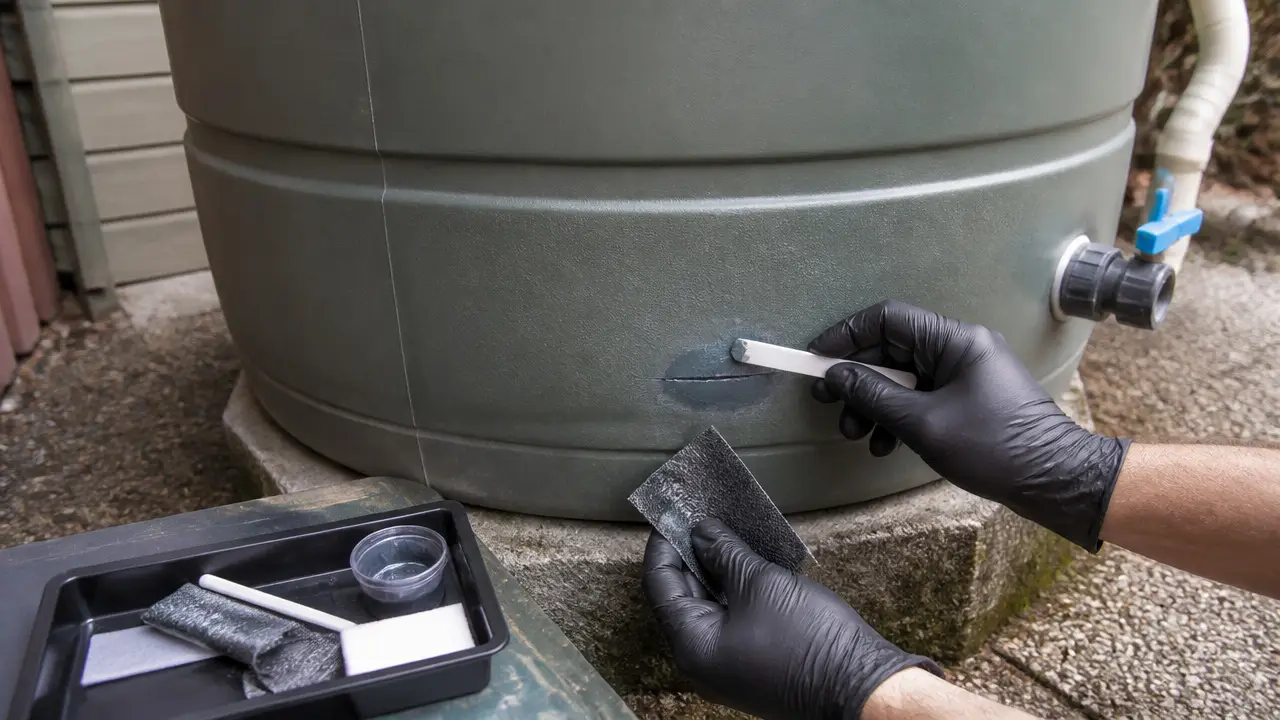
If you use Flex Seal Spray on a non-critical polyethylene repair, test a small area first. After it has fully cured, check whether the edge can easily lift or peel. Continue checking the patch after the tank has been filled and exposed to outdoor temperature changes.
Do not use a successful small test as proof that a large crack or stressed tank wall has been permanently repaired.
What About Flex Seal Liquid?
Flex Seal Liquid is applied as a thicker liquid coating rather than an aerosol.
Flex Seal states that the product can be used on the inside of rain barrels once it is fully cured.
That statement does not mean it will form a permanent structural bond to every polyethylene rain barrel. The material of the barrel and the location of the leak still matter.
A coating over a small pinhole has a much easier job than a coating trying to hold together a growing crack near a fitting.
It also does not automatically make stored rainwater suitable for drinking.
What About Flex Tape?
Flex Tape can sometimes stop a leak temporarily, especially where there is little pressure.
The manufacturer describes Flex Tape patches as temporary emergency repairs in some water-related uses and notes that some plastic surfaces may resist adhesion.
Polyethylene's difficult-to-bond surface makes the same caution important on rain barrels and tanks.
Evaluate a suitable glue for plastic water tanks to assess tank material choices for the intended end use.
A tape patch can also be vulnerable at its edges. Once water, dirt, movement, or temperature changes begin lifting an edge, the patch may gradually peel away.
Better Ways to Repair a Polyethylene Rainwater Container
The best repair depends on where the water is escaping.
If the Leak Is Around a Fitting
Do not depend on a layer of sealant to compensate for a poorly fitted connection.
For a spigot, outlet, overflow, or pipe connection, a proper bulkhead fitting is usually a better approach.
A bulkhead fitting passes through the wall of the container and uses a gasket and mechanical pressure to make the seal. The hardware, rather than adhesive alone, holds the connection together.
Check that:
- the fitting is the correct size for the hole
- the gasket is suitable for the application
- the tank wall is reasonably flat where the gasket sits
- the fitting is not being pulled sideways by unsupported pipe
- the plastic around the hole is not cracked
Do not overtighten a fitting against a thin polyethylene wall. Too much force can distort the plastic or damage the gasket.
If the Tank Has a Small Crack
A crack is more serious than a simple surface leak.
Polyethylene can sometimes be repaired using a plastic-welding method specifically suited to the type of polyethylene. Plastic welding joins compatible plastic material rather than relying only on surface adhesion.
The quality of the repair depends on the tank material, crack location, wall thickness, and stresses around the damaged area.
A crack next to a fitting, molded seam, tank support point, or heavily distorted wall deserves extra caution.
If the Tank Is Structurally Damaged
Replacement may be safer than repeatedly coating the damaged area.
This is especially true if:
- the crack keeps growing
- the wall is badly bulged
- several cracks have appeared
- damage is near the bottom of a large tank
- a fitting has torn through the tank wall
- the tank has been damaged by freezing
A large storage tank can place considerable force on its walls when full. An adhesive patch should not be treated as structural reinforcement.
Using Flex Seal on a Rainwater System
For a small external leak on a container holding non-potable rainwater, a Flex Seal product may be useful as a temporary patch if it adheres well after testing.
But consider what the water will be used for.
Non-potable means water that is not intended for drinking. Garden irrigation and some outdoor cleaning uses may fall into this category, depending on the system and local requirements.
For drinking water, material compatibility becomes much more important. Flex Seal states that Flex Seal Spray should not be used where it will contact drinking water. Flex Glue and Flex Tape have not been tested for potable-water use.
A waterproof repair does not establish that rainwater is safe to drink. Drinking-water systems require suitable collection materials, treatment, maintenance, current laboratory testing, and compliance with applicable local requirements.
When a Temporary Flex Seal Patch Makes Sense
A temporary patch is most reasonable when all of these conditions apply:
- The container is not under significant pressure.
- The damage is small.
- The tank itself remains structurally sound.
- The stored water is not being treated as drinking water based on the patch.
- Failure of the patch would not cause serious property damage.
- You can inspect the repair regularly.
For a garden rain barrel with a tiny seep, trying a patch may be reasonable.
For a large cistern with a spreading crack near the bottom, adhesive coating is not a good substitute for a proper repair.
Frequently Asked Questions
Does Flex Seal stick to HDPE?
It may stick temporarily, but HDPE is a type of polyethylene and is difficult for many adhesives and coatings to bond to. Do not assume Flex Seal will make a permanent repair.
Can I use Flex Seal on a polyethylene rain barrel?
It may be suitable for a small, low-stress, non-critical repair if testing shows good adhesion. Flex Seal Liquid's manufacturer says it can be used inside rain barrels once fully cured, but that does not guarantee strong adhesion to every polyethylene barrel.
Will sanding polyethylene make Flex Seal stick?
Sanding and cleaning may improve surface contact, but they do not remove polyethylene's basic low-surface-energy problem. A coating can still peel after the tank flexes or experiences temperature changes.
Is Flex Seal a good way to repair a leaking rain barrel spigot?
Usually not as the main repair. If the leak comes from a spigot or outlet, check the bulkhead fitting, gasket, hole size, and support for attached pipe. A properly installed mechanical fitting is generally more dependable than coating the outside with sealant.
Can Flex Tape permanently patch an HDPE tank?
It should not be assumed to be permanent. The manufacturer describes Flex Tape as a temporary emergency repair for some water-related applications, and polyethylene can be difficult for adhesive tape to grip.
What is the best permanent repair for cracked polyethylene?
The right method depends on the damage. Plastic welding designed for the correct polyethylene material may be an option for some cracks. Severe, growing, or structurally important damage may justify replacing the container instead.
Can I use Flex Seal inside a drinking-water tank?
Flex Seal states that Flex Seal Spray should not be used where it directly contacts drinking water. Do not assume other Flex products are suitable unless their current documentation specifically approves that product for your potable-water application.